Wiss

The Investment Nobody Wants to Make (And Why We’re Making It Anyway)

I connect with leaders and look at what other firms are doing. When the AI investment question comes up, too often I hear: “We can’t afford it.”

Meanwhile, we’re making investments that impact our bottom line in real ways.

And honestly? That’s exactly why we’re positioned to win.

The Real Reason Firms Aren’t Adopting AI

It’s not capability. Every firm has access to the same tools, the same vendors, the same implementation partners.

It’s willingness.

AI investment hits your financials immediately. The licensing costs show up in expenses. The implementation time shows up in utilization rates. The learning curve shows up in productivity metrics.

Your profitability takes a hit. Your margins compress. The returns you’re used to seeing get delayed.

That’s not theoretical. That’s the trade-off every firm faces right now.

But here’s what separates strategic thinking from short-term optimization: You can optimize for this year’s results, or you can position for the next decade. You can’t do both.

Why “Waiting for ROI Data” Means Waiting to Lose

There’s a certain logic to saying “let’s see how this plays out before we commit.”

Let someone else be the guinea pig. Let the market mature. Let the ROI become proven and obvious.

The problem? By the time ROI is obvious, the opportunity is gone.

The firms building AI capabilities now are learning what works and what doesn’t. They’re training their teams. They’re refining their delivery models. They’re having conversations with clients about what’s possible, not what used to be standard.

When the market catches up and everyone needs these capabilities, those firms will be three years ahead. They won’t be shopping for vendors and planning implementations. They’ll be scaling what they’ve already proven.

The firms waiting for certainty will be scrambling to catch up—at premium prices, with compressed timelines, and with clients who are already working with competitors.

The Exponential Return Math

Here’s the calculation that justifies short-term pain:

If AI lets us handle 30% more volume with the same headcount, that’s not a 30% revenue increase. It’s a fundamental shift in our cost structure.

If it reduces our delivery time from weeks to days, that’s not just efficiency. It’s a competitive advantage that changes what we can promise clients.

If it frees our senior people from tactical work to focus on strategy, that’s not just productivity. It’s a transformation in the value we deliver.

Those returns compound. Year one might show a modest improvement. Year three? The gap between firms that invested and firms that waited becomes exponential.

We’re not betting on AI because it’s trendy. We’re betting on it because the math works—if you’re willing to look past this quarter’s results.

The Three-Year Horizon

In three years, every firm will have some version of AI-enabled services. The question is whether you’ll be leading the conversation or playing catch-up.

The firms that start now will have refined their approach. They’ll have client case studies. They’ll have teams that are fluent in these tools. They’ll have delivery models that competitors are trying to reverse-engineer.

The firms that wait will be making the same investments, but under pressure, with less time to experiment, and with clients who’ve already experienced what modern service delivery looks like.

The Decision We’re Making

We’re choosing not to let this year’s margin protection sacrifice the next decade’s market position.

We’re asking our teams to learn new tools while still serving clients at the same level. We’re investing in technology that might not all work out. We’re accepting short-term financial impact for long-term capability.

We’d rather make mistakes now—when we have time to course-correct—than make them in three years when we’re desperately trying to compete with firms that are already operating at a different level.

That’s not bravery. That’s just math.

And it’s the same math that built every sustainable competitive advantage: Invest early, learn fast, and position for where the market is going, not where it is today.

Residential Construction Accounting: What Separates Builders Who Grow from Those Who React

Key Takeaways

  • Job costing is only valuable if it’s timely. Most builders have it. Far fewer use it to make real-time decisions — which is the only way it actually changes project performance.
  • WIP reporting is an early warning system, not a compliance exercise. If you’re reviewing work-in-progress quarterly or at project close, you’re already behind.
  • Profitable builders still face cash pressure. The cause is almost always timing — costs running ahead of billings, slow collections, and misalignment between project progress and cash position.
  • Backlog quality matters more than backlog size. A pipeline built on thin margins and unfavorable terms isn’t a sign of a healthy business — it’s a liability structured as an asset.
  • Bottom Line: The residential construction companies performing best right now have a tighter handle on their numbers and are using them to make decisions before problems become expensive. In this margin environment, that discipline is the difference.

I just got back from the Atlantic Builders Convention in Atlantic City. Three days of conversations with residential builders across New Jersey — custom builders, remodelers, multifamily developers at every stage of growth.

The theme I kept hearing: margins are tighter, projects are taking longer to finance and close, and there’s less room for error than there was a few years ago. The builders navigating that environment well aren’t necessarily running better jobs. They’re running their businesses with more financial discipline. They know their numbers, they know what their numbers mean, and they’re using that information to make decisions before problems become expensive ones.

Here’s what’s working.

Job Costing Has to Drive Decisions, Not Just Records

Most residential builders have job costing in place. That’s not the problem. The problem is that most aren’t using it in a way that actually changes how they manage the work.

Job costing is only useful if it’s timely, if costs are entered consistently, and if someone is reviewing performance against the original estimate often enough to act on what they find. If your job cost reports lag two or three weeks behind what’s happening in the field, you’re not managing a project. You’re documenting what already went wrong.

The gap between builders who use job costing as a management tool and those who use it as a record-keeping function is significant. The first group finds out early that a subcontractor’s scope has drifted or that material costs are running over estimate. The second group finds out at project close, when the only thing left to do is absorb the margin hit.

This is especially true for custom builders and remodelers, where scope changes move fast and every project carries its own set of variables. The closer your job costing reflects real-time field conditions, the more control you have over the outcome.

WIP Reporting: Your Earliest Warning Sign

Work-in-progress reporting is one of the most powerful financial tools available to a construction business — and one of the most underused.

Done well, WIP reporting tells you how you’re actually performing on active projects, not how you think you’re performing. It surfaces margin fade before the project closes. It identifies underbillings quietly building up on your balance sheet. It catches estimates that were more optimistic than the actual work has supported.

For multifamily builders and larger-scale developers, even small percentage variances can translate into meaningful dollar impacts.

The builders managing this well are reviewing WIP at minimum monthly and treating what it surfaces as an action item — not a reporting formality. When a project starts showing signs of margin erosion, they want to know early enough to do something about it: a conversation with a subcontractor, a change order, a revised cost to complete.

If your WIP process is happening quarterly or at project milestones, you’re working with information that’s already too old to be useful.

Cash Flow Is Where Problems Show Up First

One of the more consistent situations I encounter: profitable builders facing serious cash pressure.

This surprises people. It shouldn’t. Profitability and liquidity aren’t the same thing — and in construction, the gap between them can be substantial. The cause is almost always timing. Costs are being incurred ahead of billings. Retainage is tied up for months. Collections are running slower than expected.

Builders managing this well share a few habits. They’re forecasting cash on a rolling basis, not just checking their balance at month end. They’re billing as aggressively as their contracts allow, not when it’s convenient. And they’re addressing collection issues early, before the relationship dynamic shifts and the conversation becomes harder.

For remodelers and smaller custom builders, the exposure is especially acute. A handful of delayed client payments can create pressure that threatens operations — even when the underlying business is performing. This isn’t a problem that announces itself in advance. You build the infrastructure to manage it before you need it, not after.

Backlog Quality Over Backlog Size

There’s a full pipeline that represents a healthy business. There’s another version that represents a problem that hasn’t surfaced yet.

More builders are taking a harder look at what’s actually in their backlog — not just total contract value, but projected margins on each job, contract terms, and the risk profile of the work they’ve committed to. A backlog full of jobs priced at thin margins, on unfavorable payment terms, with clients who have a history of slow payment or scope disputes, is not something to be proud of.

For multifamily builders and developers, backlog quality connects directly to financing. Lenders and investors are looking at what the pipeline will actually produce, not just how much work is under contract.

Backlog is a leading indicator. What it tells you about your business’s future depends entirely on the quality of what’s in it.

Accurate Financials Aren’t Enough — Timing Is

Accuracy in financial reporting is a baseline expectation. Timing is where most construction businesses fall short.

Financial statements that close 15 to 20 days after month end aren’t particularly useful for running a construction business. By the time leadership sees them, the decisions those numbers should have informed have already been made on incomplete information.

The distinction matters more in this environment than it did when margins were thicker. When there’s room for error, stale financials are an inconvenience. When margins are tight and the cost of a bad decision compounds quickly, they’re a liability.

Financial information that’s accurate and timely is a management tool. Financial information that arrives two weeks late is a historical record. Know which one you’re working with.

The Metrics That Matter Most

There’s no shortage of data available to a construction business. The challenge is focusing consistently on the metrics that actually drive decisions.

The builders managing their businesses well tend to monitor the same things: gross margin by job, cost-to-complete accuracy, underbillings and overbillings, and working capital. These aren’t complicated or novel concepts. What separates strong financial management from reactive decision-making is the consistency with which these numbers are tracked — and the willingness to act on what they reveal.

  • Gross margin by job tells you which work is actually producing for the business.
  • Cost-to-complete accuracy tells you whether your project estimates reflect reality or optimism.
  • Underbillings and overbillings tell you something important about the health of your cash cycle and billing practices.
  • Working capital tells you whether the business has the financial foundation to operate through normal delays and timing mismatches.

Tracking them isn’t enough. What matters is doing something with what they show you.

Align Growth With Financial Capacity

Growth is still happening across residential construction in New Jersey. But it’s more intentional than it was a few years ago — and for good reason.

The builders growing well right now are asking hard questions before taking on new work: Can we finance this project the way it needs to be financed? Do our internal systems — accounting, project management, field operations — have the capacity to support this volume without degrading quality or financial control?

For multifamily builders and developers, this discipline is especially important given the capital intensity of larger projects. For growing custom builders, the risk is subtler: it’s possible to win more work than your business can actually manage and not realize it until the financial consequences are already in motion.

Scaling into work you can’t finance or manage isn’t growth. It’s exposure dressed up as momentum.

Talk to Wiss

If any of what I’ve described sounds familiar, it’s worth a conversation. The Wiss Construction and Engineering practice works with residential builders, developers, and contractors across New Jersey and greater New York on the financial operations that determine whether a business is growing intentionally or managing problems after the fact.

Contact the Wiss Construction Practice Team to learn how Wiss can support your residential construction business.

IRS Issues Guidance on 100% Depreciation for Production Facilities

Key Takeaways 

  • New deduction opportunity: Under Section 168(n) of the OBBBA, manufacturers and producers may elect to deduct up to 100% of the cost of qualified production property (QPP) in the year it is placed in service. 
  • Tight eligibility window: Construction must begin after January 19, 2025, and before January 1, 2029 — and the property must be placed in service after July 4, 2025, and before January 1, 2031. 
  • Interim guidance is in effect now: Taxpayers can rely on IRS Notice 2026-16 until proposed regulations are finalized. 
  • Recapture risk is real: If QPP ceases to be used in a qualified production activity within 10 years of being placed in service, Section 1245 depreciation recapture applies. 
  • Bottom Line: Manufacturers, chemical producers, refiners, and agricultural producers building or renovating U.S. facilities now have a significant tax incentive — but the rules are detailed, and the election is largely irrevocable, so careful planning before placing property in service is essential.

On February 20, 2026, the IRS and Treasury Department issued Notice 2026-16, providing interim guidance on a new depreciation provision under Section 168(n) of the Internal Revenue Code — one of the most significant manufacturing incentives included in the One Big Beautiful Bill Act (OBBBA). For companies in manufacturing, chemical production, agricultural production, or refining, this provision is worth understanding before breaking ground. 

Here is what the guidance says, and what it means for your business.

What Is Section 168(n) and Who Does It Apply To? 

Section 168(n) was added to the tax code by Section 70307 of the OBBBA, signed into law on July 4, 2025. It allows taxpayers to elect a special 100% depreciation allowance — taken in the year the property is placed in service — on the unadjusted depreciable basis of qualified production property (QPP). 

QPP is, broadly speaking, nonresidential real property used as an integral part of a qualified production activity (QPA). A QPA is defined as the manufacturing, production, or refining of a “qualified product” that results in a substantial transformation of that product. Under the statute, “production” covers only agricultural production and chemical production. 

A qualified product is any tangible personal property, with one notable exception: food or beverages prepared and sold in the same building as a retail establishment do not qualify.

What Qualifies as a Qualified Production Activity? 

This is where the guidance gets precise. A QPA requires substantial transformation — meaning the taxpayer’s activity must turn constituent raw materials, inputs, or subcomponents into a final, complete, and distinct item of property that is fundamentally different from what went in. 

The Notice provides helpful illustrations: 

  • Converting wood pulp to paper: substantial transformation. 
  • Steel rods to screws and bolts: substantial transformation. 
  • Freshly caught tuna fish to canned tuna: substantial transformation. 
  • Grouping and packaging finished goods into a gift basket or subscription box: not a substantial transformation. 

The Notice also defines each activity type in detail: 

Manufacturing means materially changing the form or function of tangible personal property to create a new item held for sale or lease. Packaging, repackaging, labeling, and minor assembly do not count. 

Refining means purifying a substance into a higher-value product. The Notice lists specific examples, including petroleum processing, sugar refining, vegetable oil processing, wet corn milling, and recovery of nonferrous metals from scrap. 

Chemical production encompasses processes in which a product is formulated from organic or inorganic raw materials — including pharmaceutical manufacturing, fertilizer production, adhesive manufacturing, and synthetic resin manufacturing. 

Agricultural production includes cultivating the ground, planting seeds, raising and harvesting crops, and breeding or managing livestock for sale or lease. It does not include food marketing or activities that support agriculture but do not directly constitute production.

What Property Qualifies — and What Doesn’t? 

To be QPP, nonresidential real property must meet all of the following: 

  • It is MACRS property. 
  • It is used by the taxpayer as an integral part of a QPA (or will be once placed in service). 
  • It is placed in service in the U.S. or a U.S. territory. 
  • Original use commences with the taxpayer (or the used property rules in section 4.06 of Notice 2026-16 are satisfied). 
  • Construction begins after January 19, 2025, and before January 1, 2029. 
  • The taxpayer designates the property as QPP in a timely election. 
  • The property is placed in service after July 4, 2025, and before January 1, 2031. 
  • The property is not subject to the alternative depreciation system (ADS). 

Critically, property used for offices, administrative services, lodging, parking, sales activities, research activities, software development, or engineering activities is explicitly excluded. Storage of finished products is also excluded, though storage of raw materials and manufacturing inputs used in the QPA may qualify as an essential activity. 

There is a de minimis rule: if 95% or more of the physical space of a property satisfies the integral part requirement, the taxpayer may elect to treat the entire property as qualifying.

How Is the Deduction Calculated? 

The deduction equals 100% of the unadjusted depreciable basis of the property designated as QPP. Taxpayers do not have to designate their entire basis — they may designate a specific dollar amount up to the total eligible basis. 

When the property contains a mix of eligible and ineligible space, the taxpayer must allocate basis using a reasonable method. The Notice specifically approves use of square footage, cost segregation data, architectural or engineering plans, process diagrams, and construction invoices. Employee headcount and employee time spent on QPA activities are explicitly not acceptable allocation methods. 

How Is the Election Made? 

The election must be made on the taxpayer’s original federal income tax return for the year the eligible property is placed in service, no later than the return’s due date, including extensions. 

The election is made by attaching a statement — titled “STATEMENT PURSUANT TO SECTION 7 OF NOTICE 2026-16” — that identifies the property, provides its address and description, states the total unadjusted depreciable basis, identifies the portion allocable to eligible property, and states the dollar amount designated as QPP. 

This election is largely irrevocable. Revocation requires filing a private letter ruling request and obtaining the IRS Secretary’s written consent, which is available only in “extraordinary circumstances.” Importantly, the IRS will not grant consent if the revocation request reflects hindsight.

What Happens If the Property Changes Use? 

This is a critical planning consideration. If QPP ceases to be used as an integral part of a QPA and is used in another productive use at any point during the 10-year period beginning on the date the property is placed in service, Section 1245 depreciation recapture applies. The taxpayer is treated as having disposed of the property, and the excess of the recomputed basis over the adjusted basis is recognized as ordinary income. 

There are a few nuances worth noting: 

  • Switching from one QPA to another does not trigger recapture.
  • Temporarily idle property — taken out of service for a finite period with the expectation of resuming production — does not trigger recapture.
  • If only a portion of QPP changes in use, recapture applies only to that portion.
  • An automatic one-year extension of the placed-in-service deadline is available for property located in a federally declared disaster area during 2030.

Safe Harbor for Property Placed in Service in 2025 

For property placed in service after July 4, 2025, and on or before December 31, 2025, the Notice provides a safe harbor. A taxpayer’s activity will be treated as a QPA if the principal business activity code on its most recently filed return corresponds to an applicable NAICS code under sectors 31, 32, or 33 (manufacturing) or subsectors 111 or 112 (crop and animal production), and the activity otherwise results in substantial transformation of a qualified product.

What Comes Next? 

The IRS and Treasury have announced that forthcoming proposed regulations will follow the framework set out in Notice 2026-16. Taxpayers can rely on the interim guidance in its entirety until those regulations are finalized. 

Comments on the interim guidance are due by April 20, 2026, and may be submitted electronically at regulations.gov (search IRS-2026-0016). The IRS has specifically invited input on allocation methods for mixed-use property, the scope of manufacturing and refining definitions, and additional examples of substantial transformation.

What This Means for Your Business 

Section 168(n) represents a meaningful incentive for companies investing in U.S. production facilities. A 100% first-year deduction on the eligible basis of a new manufacturing plant or production facility — which may represent tens or hundreds of millions of dollars — can significantly accelerate the tax value of that investment.

That said, the rules are detailed: eligibility turns on specific construction start dates, placed-in-service windows, use requirements, and proper allocation of basis. The election is effectively permanent, and the 10-year recapture window is meaningful for businesses that might pivot operations. Planning ahead — before the property is placed in service — is essential.

If your company is in manufacturing, chemical production, refining, or agricultural production and has construction activity currently underway or planned, now is the time to evaluate whether Section 168(n) applies.

Have questions about how this guidance applies to your situation? Reach out to a Wiss advisor — we are closely tracking the OBBBA provisions and can help you determine whether your production facility qualifies and how to structure your election.

Contact Us.

Construction Equipment Financing: Options and Tax Strategies

Key Takeaways

  • The OBBBA raised the Section 179 cap from $1.16 million to $2.5 million, with a phase-out threshold of $4 million, substantially expanding the immediate expensing capacity for mid-sized construction companies.
  • The financing structure determines the tax treatment: whether you purchase, finance, or lease equipment has direct, non-equivalent tax consequences. The analysis must be done before the transaction is executed — not at year-end when the options have already closed.
  • The business interest deduction limitation reverted to EBITDA-based calculation: Starting in 2025, IRC Section 163(j) again allowed the add-back of depreciation, amortization, and depletion in computing Adjusted Taxable Income, increasing the deductibility of interest on financed equipment for most construction companies.
  • Bottom Line: Equipment acquisition decisions in construction are simultaneously capital allocation decisions and tax planning decisions. CFOs who treat them as one conversation — not two separate ones — consistently produce better after-tax outcomes.

Heavy equipment is among the most significant capital expenditures a construction company makes, and among the most tax-sensitive. A crawler crane, a fleet of excavators, a concrete pump — these are not just operational assets. They are opportunities for substantial, immediate tax deductions if the acquisition is structured correctly, or forgone deductions if it isn’t. The difference between an optimized equipment financing strategy and a default one can represent six figures in a single tax year for a mid-sized commercial contractor.

The legislative environment as of 2026 is favorable. If your company is planning equipment acquisitions and hasn’t reviewed the current rules with your tax advisor, this is the year to do it with some urgency.

The Current Depreciation Environment: What the Law Actually Says

Before evaluating financing structures, you need a clear understanding of the depreciation rules applicable to assets placed in service in 2025 and beyond under the OBBBA.

100% Bonus Depreciation (IRC Section 168(k)) has been fully restored for qualified property acquired and placed in service after January 19, 2025. This means construction equipment — which is generally classified as five-year or seven-year MACRS property — can be deducted entirely in the year it is placed in service, rather than depreciated over its MACRS recovery period. There is no partial-year convention limitation on the deduction itself, though the half-year or mid-quarter convention still applies in calculating the first-year MACRS amount for assets not electing bonus depreciation. For most construction equipment acquisitions, 100% bonus depreciation produces a larger first-year deduction than the standard MACRS schedule by a material amount.

Section 179 Expensing (IRC Section 179) permits an immediate deduction for the cost of qualifying property placed in service during the tax year. The OBBBA raised the maximum expensing limit to $2.5 million, with a dollar-for-dollar phase-out beginning when total qualifying property placed in service during the year exceeds $4 million. Unlike bonus depreciation, Section 179 is subject to an income limitation — the deduction cannot exceed the taxpayer’s taxable income derived from the active conduct of a trade or business. Any disallowed Section 179 deduction is carried forward to subsequent tax years; it does not generate a net operating loss.

The practical relationship between Section 179 and bonus depreciation requires deliberate planning. Section 179 is applied first, then bonus depreciation applies to the remaining basis. For pass-through entities, the income limitation on Section 179 is particularly important — it is determined at the entity level and flows through to partners or shareholders as a carry-forward, not as a current deduction, if taxable income is insufficient. CFOs of S corporations and partnerships should model the entity-level income limitation explicitly before relying on Section 179 as the primary depreciation strategy.

Equipment Financing Structures and Their Tax Treatment

How you finance an equipment acquisition is not independent of the tax analysis. Each structure produces a different set of deductible items, at different times, with different cash flow implications.

Outright Purchase (Financed or Unfinanced)

A direct purchase — whether paid in cash or financed through a term loan or equipment financing agreement — results in the company holding the asset as property. The full purchase price (or financed amount) establishes the depreciable basis, and the company is eligible for both Section 179 and bonus depreciation on that basis in the year the asset is placed in service. Interest paid on equipment loans is deductible under IRC Section 163, subject to the Section 163(j) business interest limitation.

The OBBBA’s reversion of the Section 163(j) limitation to an EBITDA-based Adjusted Taxable Income (ATI) formula — restoring the add-back of depreciation, amortization, and depletion — meaningfully increases deductible business interest for capital-intensive companies, such as construction contractors. Under the EBIT-based formula that applied from 2022 through 2024, significant depreciation deductions actually reduced the interest expense limitation by compressing ATI. The EBITDA-based formula eliminates that interaction, allowing companies with substantial depreciation deductions and financing costs to deduct both in the same year without one limiting the other.

Finance Lease (Capital/Finance Lease)

Under a finance lease — classified as such under ASC 842 when the lease transfers substantially all risks and rewards of ownership — the lessee recognizes the leased asset on the balance sheet and records a right-of-use asset and a corresponding lease liability. For tax purposes, if the arrangement is treated as a conditional sale or financing (rather than a true lease), the lessee is treated as the owner of the property and is eligible for depreciation deductions, including Section 179 and bonus depreciation, on the asset’s tax basis. The interest component of the finance lease payment is deductible as business interest.

The distinction between a finance lease and a true operating lease is determined by the substance of the arrangement, not its label. IRS Revenue Procedure 2001-28 provides guidance on the characteristics of true leases for federal tax purposes. The determination matters significantly: if the IRS recharacterizes a purported operating lease as a conditional sale, the lessee will be treated as the owner for tax purposes — potentially retroactively — with consequences for both depreciation and interest deductibility.

Operating Lease

Under a true operating lease — one in which the lessor retains meaningful economic risk and benefits, and the lessee has neither an option to purchase at a bargain price nor a lease term covering the majority of the asset’s useful life — the lessee does not own the asset for tax purposes. The lessee deducts lease payments as ordinary and necessary business expenses under IRC Section 162 as they are paid or accrued, with no depreciation deduction available.

The tax calculus here is straightforward: in a 100% bonus depreciation environment, an operating lease almost never produces a superior tax outcome for a profitable construction company compared to a financed purchase. The operating lease deduction is spread over the lease term; the purchase deduction is accelerated entirely to year one. The only scenarios in which an operating lease produces a better tax outcome are when the company has insufficient taxable income to absorb a large first-year deduction, or when operational flexibility — the ability to return the equipment without residual-value risk — outweighs the tax timing advantage of ownership.

Equipment-Specific Sale-Leaseback Arrangements

Sale-leaseback transactions — in which a contractor sells owned equipment to a financing entity and immediately leases it back — can provide immediate liquidity while preserving the asset’s operational use. The tax treatment depends on whether the arrangement is respected as a true sale-leaseback or recharacterized as a financing. If respected as a sale, the seller-lessee recognizes gain or loss on the sale in the year of the transaction, and the subsequent lease payments are deductible as operating expenses. CFOs considering sale-leaseback structures should obtain a tax opinion on the characterization before execution, as the gain recognition in the sale year can produce unexpected current-year tax cost if not modeled in advance.

The Placed-in-Service Requirement: Precision Matters

For both Section 179 and bonus depreciation, the asset must be “placed in service” during the tax year in which the deduction is claimed. Placed in service means the asset is in a condition or state of readiness and availability for its specified use — not merely purchased or delivered. 

Document placement in service with contemporaneous evidence: commissioning records, operator training completion, assignment to a specific project or project pool, and equipment maintenance log initiation. This documentation requirement is not an administrative formality — it is the evidentiary foundation of the deduction.

State Tax Conformity: The Variable Nobody Accounts For

Federal bonus depreciation and Section 179 elections do not automatically translate to equivalent state tax deductions. State conformity to federal depreciation rules is highly variable, and several major construction states — New Jersey among them — decouple from federal bonus depreciation, requiring separate state depreciation schedules under MACRS without the first-year acceleration.

The practical consequence: a CFO who models the net tax benefit of a major equipment acquisition based solely on federal effective tax rates will overstate the tax savings if the company operates in states with limited or no conformity to bonus depreciation. The correct analysis computes the deduction — and the corresponding cash tax benefit — separately at the federal and each applicable state level, then sums the combined after-tax cost.

For construction companies operating across multiple states, this analysis requires the allocation of the asset’s depreciable basis across state jurisdictions, which in turn requires understanding each state’s apportionment methodology. It is not a back-of-the-envelope calculation.

How Wiss Approaches Equipment Tax Planning for Construction Companies

Equipment financing decisions have a short window for optimization. Once an asset is acquired and placed in service, the available elections — Section 179, bonus depreciation opt-out, alternative depreciation system (ADS) election — must be made on a timely filed return and, in most cases, cannot be retroactively changed without filing a Form 3115 for a change in accounting method. The planning conversation belongs in the acquisition decision, not the tax return preparation process.

At Wiss, our Tax Advisory practice works with construction company CFOs to model the after-tax cost of equipment acquisition alternatives — comparing purchase, finance lease, and operating lease outcomes on a combined federal and state basis — before transactions close. We analyze the Section 163(j) interest deduction capacity under the EBITDA-based ATI formula, evaluate the interaction between bonus depreciation and pass-through income limitations, and ensure that placement-in-service documentation is established contemporaneously with acquisition.

The OBBBA has created a favorable window for investment in construction equipment. The CFOs who capture the maximum tax benefit from it will be the ones who planned for it, not the ones who discovered it at year-end.

Contact the Wiss Tax Advisory Team to discuss your construction equipment financing strategy.

Cost Segregation Studies: The Strategic Tax Decision Commercial Property Investors Get Wrong

Key Takeaways

  • Cost segregation reclassifies building components from 39-year real property into 5-, 7-, and 15-year personal property and land improvements — accelerating depreciation deductions that would otherwise be spread across decades.
  • Under the One Big Beautiful Bill Act (OBBBA), 100% bonus depreciation is permanently restored for qualifying property acquired and placed in service after January 19, 2025 — making cost segregation more valuable now than at any time since 2022.
  • The decision to commission a study is not just about property value — it depends on your tax position, holding period, passive activity status, and how the resulting accelerated deductions can actually be used.
  • Properties held for years without a study can still benefit retroactively via Form 3115 (change in accounting method), capturing missed depreciation in a single year without amending prior returns.
  • Bottom Line: A cost segregation study yields results. Your tax strategy determines whether these results actually save you money or merely create deferred losses you can’t use.

Commercial real estate investors spend considerable time analyzing acquisition prices, cap rates, and financing terms. Fewer spend equivalent time on the tax structure that determines how much of the investment’s cash flow they actually keep.

Cost segregation is one of the most direct mechanisms for improving after-tax returns on commercial property. It is also the strategy most frequently either ignored entirely or implemented without the surrounding tax analysis needed to unlock its full value.

The engineering study is the easy part. What you do with the results — and whether your tax position can absorb them — is where the real work happens.


What Has Changed in 2025

The One Big Beautiful Bill Act permanently restored 100% bonus depreciation for qualifying property acquired and placed in service after January 19, 2025. Under the Tax Cuts and Jobs Act phase down, bonus depreciation had dropped to 60% in 2024 and was scheduled to fall to 40% in 2025 before phasing out completely after 2026. That trajectory is now reversed.

The practical effect: personal property and land improvements identified through a cost segregation study on a qualifying acquisition can be fully expensed in the year placed in service. For example, on a $4 million commercial acquisition where a study identifies $1.5 million of shorter-life components, the first-year depreciation deduction on those components is $1.5 million — not $1.5 million spread over five, seven, or fifteen years.

There is, however, a precise acquisition date threshold that controls eligibility. Property subject to a written binding contract on or before January 19, 2025, is treated as acquired under the prior rules, regardless of when it is placed in service. For those properties, the applicable bonus rate for most assets placed in service in 2025 is 40%. The acquisition date – not the placed-in-service date governs, and that distinction requires careful review for any property currently under development or recently closed.

The Tax Position Question Nobody Asks First

A cost segregation study that generates $500,000 of accelerated depreciation in year one is only valuable if you can use that deduction. That answer depends entirely on your tax position — and it varies significantly across investor types.

Passive activity rules under IRC §469 restrict the use of passive losses against ordinary income for taxpayers who do not materially participate in real estate activities. For a passive investor, accelerated depreciation generally creates a passive loss that is suspended until the property is sold or offset by other passive income. The deductions accumulate on paper but provide no current-year cash tax benefit until that trigger occurs. That is a timing difference, not a permanent loss of value — but it changes the analysis of when a cost segregation study maximizes ROI.

Real estate professionals under IRC §469(c)(7) — taxpayers who spend more than 750 hours per year in real property trades or businesses and for whom that activity constitutes more than half their working time — can use real estate losses against ordinary income without restriction. For these taxpayers, accelerated depreciation can generate in current-year tax savings at ordinary income rates. The value of a cost segregation study to a qualifying real estate professional is materially higher than its value to a passive investor in the same property.

For taxpayers who operate commercial properties through a trade or business in which they materially participate, the analysis differs again. Entity structure, participation level, and income mix determine the year-by-year tax impact of accelerated depreciation — and those factors need to be modeled before the study is commissioned, not after the report is delivered.

Holding Period and Disposition Strategy

Cost segregation typically makes the most economic sense for investors who plan to hold a property through the period over which the accelerated deductions are claimed. An investor who sells within two or three years of placing property in service still benefits from the time value of accelerated deductions — but the benefit is smaller, and depreciation recapture at sale partially offsets it.

Under IRC §1245, depreciation on personal property (5- and 7-year assets) is recaptured as ordinary income at sale, to the extent of the depreciation previously allowed or allowable. Under IRC §1250, the portion of gain attributable to straight-line depreciation on real property is subject to the 25% unrecaptured Section 1250 gain rate. Bonus depreciation claimed through cost segregation accelerates not just the deduction but also the recapture exposure — it pulls both forward in time.

A 1031 exchange defers that recapture by rolling the adjusted basis and accumulated depreciation into a replacement property. Investors who plan to exchange rather than sell can accelerate depreciation aggressively, defer recapture indefinitely through successive exchanges, and ultimately obtain a basis step-up at death. That is a legitimate, well-established tax strategy. But it requires the holding period and exit planning to be structured before the depreciation strategy is implemented.

For illustration, an investor who takes 100% bonus depreciation on $1.2 million of identified components in year one and then sells the property outright in year three will recognize significant ordinary income recapture. Whether the net tax position after that recapture still favors the cost segregation study depends on the investor’s marginal rates at the time of sale, the holding period, and the discount rate applied to the deferred tax savings. That calculation needs to be modeled, not assumed.

Retroactive Studies and the Form 3115 Mechanism

Properties acquired or placed in service in prior years without a cost segregation study can still benefit from a retroactive study. Under the change in accounting method rules, a taxpayer can file Form 3115 — Application for Change in Accounting Method — to reclassify components and claim a catch-up adjustment for all missed depreciation in the current taxable year.

The mechanics: the difference between the depreciation claimed under the 39-year schedule and the depreciation that would have been claimed under the correct shorter-life classifications is treated as a Section 481(a) adjustment, recognized entirely in the year of the accounting method change. A property owned for eight years with $900,000 of reclassifiable basis might generate a six-figure catch-up deduction in the year the Form 3115 is filed — without amending any prior returns.

The same passive activity and real estate professional analysis applies to catch-up adjustments as to current-year deductions. A large catch-up deduction in a year when the investor has no offsetting passive income or real estate professional status results in a suspended loss rather than immediate tax savings. Timing the Form 3115 filing to coincide with a year of significant passive income recognition — for example, a sale of another passive activity can convert what would otherwise be a suspended loss into real cash savings.

How to Evaluate Whether a Study Makes Economic Sense

The IRS has effectively blessed cost segregation methodology in its Cost Segregation Audit Techniques Guide, and studies performed by qualified firms with engineering expertise and proper documentation rarely face successful IRS challenges. The study itself is not the risk. The real risk is spending $5,000 to $25,000 on a study that generates deductions you cannot currently use, in a year when the tax savings do not justify the cost.

A disciplined pre-study evaluation should consider property value and estimated reclassifiable basis by asset category; the applicable bonus depreciation rate based on acquisition date; the taxpayer’s passive activity status and current-year income mix; anticipated holding period and exit strategy; and the net present value of accelerated deductions versus study cost, using the investor’s actual marginal tax rates. That analysis — not the study itself — is where a qualified tax advisor earns their fee.

Properties valued at less than $500,000 rarely justify study costs unless the asset mix is highly specialized. Properties above $1 million with meaningful personal property content — such as restaurants, medical offices, hotels, manufacturing facilities, specialized retail — often do, provided the investor’s tax position can absorb the deductions.

The Advisor Role

Wiss works with commercial property investors on the tax strategy surrounding cost segregation: evaluating whether a study makes economic sense given your tax position, coordinating with qualified cost segregation engineering firms, integrating the study results into your depreciation schedules and tax returns, and modeling the impact on your overall real estate portfolio.

The study identifies the components. The tax strategy determines what you do with them. If you own commercial real estate and want to know whether accelerated depreciation is working for you — or whether you’re leaving money on the table — contact our real estate tax team to find out.

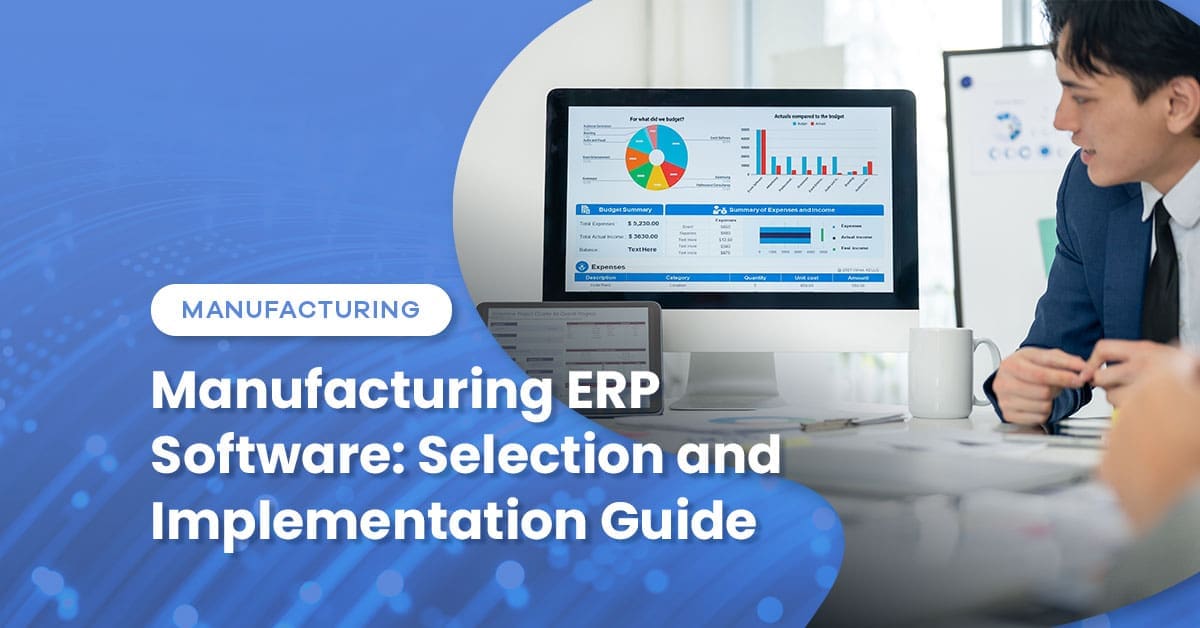
Manufacturing ERP Software: Selection and Implementation Guide

Key Takeaways

  • A recent Censuswide survey of 4,295 global executives found that 36% believe the traditional ERP model will soon become obsolete — replaced by modular, API-driven architectures. Another 33% expect significant AI integration. Manufacturing CFOs evaluating platforms today are making a longer-term architectural decision than they may realize.
  • ERP implementations fail for organizational reasons far more often than technical ones. The two leading causes at mid-sized manufacturers: undisciplined scope creep and unclear decision rights during the project.
  • Manufacturing ERP selection must be driven by industry-specific functional requirements — bill of materials, production scheduling, job costing, lot and serial tracking, and shop floor control — before any vendor demos occur.
  • Finance-grade data migration for a manufacturing ERP requires named data owners, formal reconciliations for every opening balance (GL, AR, AP, inventory valuation, open orders), and a parallel close before cutover. These are acceptance gates, not optional cleanup.
  • Companies that rush to vendor selection report implementation timelines 2–3x longer than projected. The preparation phases — strategy, requirements, and readiness — are where implementations are won or lost.
  • Bottom Line: The ERP decision isn’t a software purchase. It’s a multi-year operational commitment that will either support or constrain every production, financial, and inventory decision your company makes. It deserves the same rigor you’d apply to a capital equipment acquisition.

There is no category of technology investment more consequential — or more frequently mishandled — than ERP selection for a manufacturing operation. The system that runs your production scheduling, manages your bill of materials, tracks your inventory through every stage of transformation, and feeds your financial statements is not a tool you swap out easily. The average mid-sized manufacturer lives with an ERP decision for seven to ten years, minimum. Some live with a bad one considerably longer.

Getting this right requires a structured process that starts well before you talk to any vendor. What follows is the guide that manufacturing CFOs and COOs should use.

Why Manufacturing ERP Is a Different Problem

A generic accounting or business management system does not address the specific operational requirements of a manufacturing environment. The functional gaps reveal themselves quickly in production and much more slowly — and expensively — in the financial statements.

Manufacturing operations require an ERP capable of handling bill of materials (BOM) management with multi-level assemblies, production orders and work-in-process tracking, shop floor scheduling and capacity planning, job costing with labor, material, and overhead absorption, lot and serial number traceability for quality and compliance purposes, and inventory valuation methods appropriate to the manufacturing cost accounting model — standard, actual, or average costing.

A system that does not handle these functions natively forces manufacturers into a familiar workaround pattern: the ERP becomes the system of record for basic financial transactions while production data lives in separate spreadsheets, job costing is reconstructed manually at month-end, and inventory accuracy degrades because the system cannot reflect real-time production status. The financial statements eventually become the last place you find out what happened operationally, which is precisely the inverse of useful.

The software selection question for manufacturers is not “which ERP has the most features.” It is “which platform handles our specific production model with the precision our cost accounting and financial reporting require.”

The Architecture Question You Can’t Ignore

A recent Censuswide survey of over 4,000 global executives found that 36% believe the traditional ERP model will become obsolete — replaced by composable, modular architectures where specialized applications connect via APIs rather than a monolithic system doing everything. Another 33% expect AI integration to fundamentally reshape how ERPs operate.

For a manufacturing CFO evaluating platforms today, this matters in a specific way: the system you select needs to be evaluated not just for what it does today, but for its architectural flexibility over the investment horizon.

The ERP vendors who are threading AI into their platforms are moving toward agentic workflows — systems where automated agents can execute multi-step processes across production, procurement, and finance without manual intervention. For manufacturers, the near-term practical value is real: automated purchase order generation based on inventory reorder points, real-time production variance alerts, and cash flow forecasting that updates dynamically based on open order backlog.

This does not mean you should evaluate platforms based on AI marketing claims — most of what ERP vendors are calling AI today is the automation of manual processes or enhanced search, which are useful but not transformative. It does mean you should ask vendors specifically about their integration architecture, API capabilities, and roadmap for agentic functionality, because you will be evaluating those questions again in three to four years, whether you plan to or not.

Before Vendor Demos: The Preparation That Determines Outcomes

The manufacturers who end up with implementations running 2–3x longer than projected share a common pattern: they rush vendor selection before completing the preparation work that makes it meaningful.

Define measurable objectives first. Vague goals produce vague results. Before engaging any vendor, define what success looks like in specific, measurable terms: for example, reduce financial close from 14 days to 5 days, improve inventory accuracy from 82% to 97%, eliminate the manual job cost reconciliation that currently consumes 20 hours per month, and reduce the order-to-ship cycle by 25%. These objectives shape every subsequent decision — what you require from a system, how you evaluate demonstrations, how you measure whether the implementation was actually delivered.

Assess organizational readiness honestly. ERP projects fail for organizational reasons far more often than technical ones. Before selecting a platform, answer these questions without optimism: Is there a senior executive with genuine decision-making authority actively committed to this project — not just approving the budget, but available to resolve issues and trade-offs when they arise? Who has the authority to approve requirements, sign off on configurations, and make scope calls? Do your key subject-matter experts in production, finance, and IT have meaningful capacity to participate? ERP implementation typically requires a 20% to 30% time commitment from your most knowledgeable operational personnel throughout the project. If that capacity does not exist, the project will stall or produce a system that does not reflect how your operation actually runs.

Document current-state processes before evaluating anything. Map how orders flow from sales entry through production scheduling, material procurement, shop floor execution, quality inspection, and shipment. Document how job costs are currently accumulated and closed. Identify the Excel spreadsheets that have become mission-critical systems. Interview the people who do the work daily — they understand operational nuances that executives miss. This documentation serves two purposes: it gives you a requirements baseline to evaluate systems against, and it surfaces process problems that a new ERP must solve rather than perpetuate.

What Manufacturing ERP Selection Actually Requires

With current-state documentation complete and objectives defined, you are ready to develop requirements and evaluate vendors.

The must-have requirements for a manufacturing ERP are the functional capabilities without which the system cannot support your production model: the BOM structure that reflects your assembly complexity, the production order workflow that matches your shop floor, the costing methodology that produces accurate product profitability, and the inventory tracking granularity required for your quality and compliance obligations. These are non-negotiable. A system that handles them inadequately should not advance in your evaluation regardless of other capabilities.

For the financial function specifically, requirements must include future-state close process design before configuration begins. Define who owns each close step, the target completion time for each stage, and how the system’s approval workflows, role-based security, and audit trails support your control environment. Define revenue, billing, and tax requirements — multi-state nexus considerations, credits and returns handling, project-based billing if applicable — and confirm system support before signing a contract.

When evaluating vendors, focus demonstrations on your specific workflows, not generic presentations. Provide scenarios drawn from your documented processes: “Show us how your system handles a production order for a custom assembly with customer-specific pricing, lot-tracked components, and multiple work center operations.” Evaluate how the system handles the edge cases that consume operational time, not the standard workflow that every ERP handles adequately.

Evaluate the total cost of ownership, not licensing cost. Include implementation consulting fees, data migration effort, required customization, training, infrastructure if applicable, and ongoing maintenance. Many manufacturers select an “affordable” platform and discover post-implementation that the total cost of getting it functional exceeded what a more capable system would have cost from the start.

Implementation: The Phases That Determine Whether It Works

ERP implementation is a phased process. The phases that most often get compressed — and that most reliably determine success or failure — are those that occur before configuration begins.

Governance before kickoff. Undisciplined customization and unclear decision rights are the two most common reasons mid-market manufacturing ERP projects stall or exceed budget. Before engaging the implementation team, establish a steering committee with defined authority to resolve escalated issues and approve scope trade-offs. Create a formal change-control process that requires documented impact assessment — timeline, cost, and long-term upgrade complexity — for every customization request. No customization moves forward without a steering committee sign-off. This is not bureaucracy. It is the mechanism that keeps a six-month project from becoming a fourteen-month one.

Finance-grade data migration. Manufacturing data migration is more complex than most implementations account for. The chart of accounts, customer and vendor master data, item master data with BOM structures, open production orders, and inventory on hand at each location all require migration. More importantly, every opening balance that carries into the new system — general ledger balances, AR and AP aging, inventory valuation — requires formal reconciliation tied to audited financial statements and signed off by named owners before go-live. “It looks approximately right” is not an acceptance criterion for a manufacturing operation that will be running financial statements through this system within 30 days of launch.

Plan for a parallel close. Run the first month-end close — or a simulated close — in the new system while retaining access to legacy records. This confirms the system produces the financial results you expect before you have fully committed to the platform.

Testing that reflects manufacturing reality. End-to-end functional testing must include integration testing under realistic production volumes, not just isolated workflow validation. A payment or shipping integration that works for 10 transactions per day may behave differently when processing peak-day volumes. Performance test month-end processing loads and concurrent user scenarios — a system that runs smoothly with 15 users performs differently with 60 users executing simultaneous close procedures. Test role-based access controls and segregation of duties configurations explicitly; do not assume the configuration produces the access model you designed.

Hypercare planning before go-live. The 2–6 weeks immediately after launch represent the highest-risk operational period. Define the hypercare support model before you go live: daily issue triage with named owners and resolution timelines, tiered response SLAs for critical versus lower-priority issues, and explicit escalation paths to both the implementation partner and internal leadership. Define rollback criteria — the conditions that would trigger a return to the legacy system, at what point rollback is no longer feasible, and who has the authority to make that call. That decision needs an owner before cutover begins, not during a production crisis at 2 a.m.

Why the ERP Architecture Conversation Is Changing for Manufacturers

The 36% of executives who believe traditional ERP will become obsolete are not describing an abstract future. For manufacturing specifically, the trajectory toward modular, API-driven architecture means the ERP’s role is evolving from the system that does everything to the data layer that stores financial and operational records while specialized applications handle production scheduling, quality management, and supply chain execution in purpose-built environments.

For manufacturers currently running aging ERP systems, this does not mean replacement is imminent or advisable. It means the path forward involves strategic augmentation — building capability around the existing system through integration layers and automation tools — rather than wholesale replacement. For manufacturers evaluating platforms for the first time or replacing systems that have genuinely reached end-of-life, it means selecting a platform with an architecture that can accommodate modular additions as the technology continues to evolve.

In both cases, the financial evaluation needs to include a realistic total cost of ownership analysis — not just licensing and implementation, but the IT resources required to maintain the system, the productivity consumed by complexity, and the strategic opportunities foreclosed because the system cannot adapt quickly enough. Most manufacturers significantly underestimate this number.

How Wiss Supports Manufacturing ERP Decisions

Wiss Technology Solutions works with manufacturing companies across the full ERP lifecycle — from initial strategy and requirements development through vendor selection, implementation oversight, and post-launch optimization.

The Wiss approach is deliberately independent of vendor relationships. We are not selling a specific platform or earning implementation fees tied to a particular vendor’s success. We help manufacturing CFOs and COOs evaluate their actual situation — current system capability, organizational readiness, realistic budget, and production-specific functional requirements — and develop a technology strategy that fits their operation rather than a vendor’s preferred use case.

For manufacturers already running an ERP, Wiss helps evaluate where the current system falls short, which gaps can be addressed through augmentation versus replacement, and how to build a migration strategy that maintains operational continuity. For manufacturers selecting a platform for the first time or replacing a legacy system, Wiss structures the selection process from requirements definition through vendor evaluation and contract negotiation.

The Wiss Technology Advisory practice also connects to the firm’s accounting and CFO advisory capabilities — meaning the financial modeling that supports an ERP investment decision, the data migration and opening balance reconciliations, and the post-implementation financial reporting design are all within the scope of a single engagement rather than requiring coordination across multiple outside advisors.

If your manufacturing operation is evaluating ERP platforms, planning a migration, or managing a current implementation that is not on track, contact Wiss Technology Solutions to discuss your specific situation.

This article incorporates data from the Censuswide survey of 4,295 global executives referenced in Wiss’s February 2026 analysis of ERP architecture evolution. Technology guidance reflects general best practices and the Wiss Technology Solutions implementation methodology. Specific recommendations should be developed based on your manufacturing operation’s requirements and current technology environment.


ERP Consulting: How to Choose the Right Implementation Partner

Key Takeaways

  • The partner matters more than the platform. Two organizations running identical ERP software can have dramatically different outcomes based on who implemented it and how.
  • Industry-specific expertise is non-negotiable. A consulting partner who understands your business model configures your ERP for your actual workflows, not generic best practices that don’t fit.
  • Accounting expertise and technology expertise are not interchangeable. ERP systems are financial operations infrastructure. A partner who understands accounting — not just configuration — produces implementations that actually work in practice.
  • Post-go-live support determines long-term value. The implementation ends at go-live. The value of the ERP continues for years. Your partner’s capabilities after launch matter as much as their capabilities during it.
  • Bottom Line: Evaluate ERP consulting partners the way you’d evaluate any high-stakes vendor relationship — on demonstrated expertise, industry depth, and a clear track record of implementations that delivered what they promised.

ERP implementations fail. Not occasionally — with notable regularity, and at high cost. The reasons are well documented: scope creep, insufficient data migration planning, configuration that doesn’t match actual business processes, inadequate user training, and partners whose expertise ends at go-live, while the problems begin three months later.

The software vendor is rarely to blame. The same ERP platform delivers outstanding results in one organization and costly regret in another. The differentiating variable, almost invariably, is the implementation partner.

Selecting an ERP partner is consequently one of the higher-stakes technology decisions a CFO or technology leader makes. This guide provides the evaluation criteria that separate partners worth serious consideration from those worth avoiding.

Why ERP Implementations Go Wrong

Before evaluating partners, it’s worth being precise about the failure modes — because a good partner is specifically equipped to prevent them.

The most common point of failure is the configuration gap between what the software can do in a demo and what it does when setup  for your specific business. ERP platforms are highly configurable systems. They don’t arrive pre-configured for your chart of accounts, your approval hierarchies, your project billing structure, or your revenue recognition requirements. Configuration is where expertise matters, and configuration performed by a consultant who doesn’t deeply understand your industry produces a system that technically functions but operationally frustrates.

Data migration is the second major failure point. Historical financial data, vendor records, customer data, and project information all need to migrate from legacy systems to the new platform accurately, completely, and in a format the new system can interpret. Organizations that underinvest in data preparation discover the consequences at go-live: reports that don’t reconcile, vendor payment histories that don’t match actual obligations, and chart of accounts structures that require manual correction for months after launch.

The third failure mode is change management — specifically, its absence. ERP implementations change how people work. Employees whose daily workflows are disrupted by a new system, without adequate training and support, revert to workarounds that undermine the investment. A consulting partner who delivers a configured system without investing in user adoption has delivered half an implementation.

Understanding these failure modes shapes how you evaluate partners. You’re not evaluating whether someone can configure the software — you’re evaluating whether they’ll prevent these specific outcomes.

The Criteria That Actually Distinguish Partners

Industry expertise that matches your business model

ERP systems must be configured to the organization’s operational model. An architecture and engineering firm bills by project, tracks utilization by resource, manages complex multi-phase contracts, and needs to understand project profitability by engagement — none of which maps neatly to a generic ERP configuration designed for a product-based manufacturer.

Deltek Vantagepoint, for example, was built specifically for project-based professional services firms. It integrates project management, resource planning, business development, and financial reporting in a single system designed for how A&E and professional services firms actually operate. A consulting partner who has implemented Deltek exclusively for project-based firms — and has 25-plus years of experience advising those firms on financial operations — brings a fundamentally different caliber of configuration than a generalist who learned the platform from documentation.

Ask prospective partners for specifics on industry experience: not general ERP experience, but the number of implementations in your specific industry, the typical size and complexity of those engagements, and the types of operational challenges they’ve helped organizations navigate. Vague answers are informative.

Accounting expertise alongside technology expertise

ERP systems are financial operations infrastructure. They manage the general ledger, accounts payable, accounts receivable, project accounting, revenue recognition, and the financial reporting that your executives rely on for business decisions. Getting the configuration right requires understanding not just how the software works, but how accounting principles apply to your specific transactions and business structure.

A consulting partner that combines deep accounting expertise with technology implementation capability produces configurations that are technically sound and financially correct. This distinction matters when the question isn’t “how do I configure this field” but “how should this transaction be recorded given our contract structure and revenue recognition policy.”

Wiss brings this combination: certified ERP advisors supported by a team of experienced accountants who understand the financial implications of configuration decisions — not just the mechanics of executing them.

Demonstrated implementation methodology

Good consulting partners have a defined methodology for how they approach implementations: how they conduct business process reviews before configuration begins, how they structure data migration planning, how they manage testing and user acceptance, and how they handle the transition from implementation to post-go-live support.

Request a detailed project plan for an implementation comparable to yours. The plan should include phases with defined deliverables, data migration milestones, testing protocols, and user training structure. A consulting partner who can’t produce a concrete methodology is telling you something about how they actually run projects.

Post-implementation support that reflects how ERP systems work in practice

ERP systems evolve. Organizational needs change, additional modules get deployed, reporting requirements shift, and technical questions arise that weren’t anticipated at go-live. The value of the ERP over its useful life depends substantially on having a partner who can support configuration adjustments, develop custom reporting as needs emerge, and provide strategic guidance on how to get more out of the investment.

Ask specifically about the post-go-live support structure: who manages support requests, what response-time standards apply, and whether the same team that implemented the system is available for ongoing support. Partners who hand off to a separate support team after go-live introduce continuity gaps that surface as unresolved tickets.

The Certification Question

ERP vendors certify consulting partners. Certifications indicate that the partner has met the vendor’s training and competency standards, providing a baseline of confidence that the team understands the platform. What certifications don’t indicate is the depth of industry expertise, the quality of implementation methodology, or the actual outcomes the partner has delivered for clients.

Certifications are necessary but not sufficient. A partner without relevant certifications for your platform should be eliminated from consideration. A partner with certifications and no industry-specific experience is still a significant risk. The evaluation criteria above carry more predictive weight than certification status alone.

Wiss holds certification as a trusted Deltek partner and has been recognized with the 2024 Deltek Consulting MVP Award — recognition for implementation quality and client outcomes, not just platform knowledge. For NetSuite implementations, Wiss brings certified advisory experience across mid-market organizations with complex financial reporting requirements.

What the Evaluation Process Should Look Like

Start by defining the scope precisely before engaging any consulting partner. The scope should include current system architecture, data migration requirements, integration needs, the specific modules being implemented, approximate transaction volumes, and the number of users and entities involved. Vague scopes produce vague proposals that become expensive change orders.

Request proposals from two to three partners who meet the industry expertise and certification threshold. Evaluate proposals against each other on methodology specificity, timeline realism, data migration approach, and post-go-live support structure. Reference checks from clients in your specific industry — not generic references — are the most reliable predictor of what your experience will be.

The final conversation before selection should specifically address how the partner has handled implementations that encountered problems: what went wrong, how they responded, and the outcome. Every ERP implementation encounters unexpected complications. A partner’s track record of managing those complications is more informative than their track record of implementing projects that went smoothly.

Where Wiss Fits

Wiss’ Business Intelligence & Transformation  team implements Deltek Vantagepoint and Ajera for architecture, engineering, and professional services firms, and NetSuite for mid-market organizations across industries. Both practices are supported by Wiss’s core accounting expertise — certified advisors who understand financial reporting, project accounting, and the operational requirements that determine whether an ERP investment delivers its promised return.

The service scope covers the full implementation lifecycle: business process review, software selection when the platform hasn’t been determined, project management, data migration, custom reporting and analytics, user training, and post-go-live support.

If you’re evaluating ERP implementation partners, the conversation starts with understanding your specific requirements, your current system limitations, and what successful outcomes look like for your organization. Contact Wiss’s Advisory team to begin that conversation.

QBI Deduction for Real Estate Professionals: Maximizing Section 199A Benefits

Key Takeaways

  • The One Big Beautiful Bill Act (OBBBA) permanently extended the Section 199A deduction, eliminating the prior expiration date of December 31, 2025. Real estate owners now have an indefinite planning horizon for this deduction.
  • The 20% QBI deduction applies to qualified business income from a qualified trade or business — rental real estate income does not automatically qualify. Owners must clear the trade or business threshold, either through facts-and-circumstances analysis or the IRS Safe Harbor under Rev. Proc. 2019-38.
  • For taxpayers with taxable income above the 2026 threshold amounts (indexed annually from 2025 base amounts of $197,300 single / $394,600 married filing jointly), the deduction becomes subject to W-2 wage and qualified property limitations that can reduce or eliminate it on service income but are highly favorable for real estate.
  • The Section 199A deduction is calculated at the entity level for each separate trade or business — grouping elections under Prop. Reg. §1.199A-4 allows owners to aggregate multiple rental properties into a single QBI calculation, which can satisfy wage limitations and optimize the deduction across a portfolio.
  • Bottom Line: The QBI deduction is not passive. For real estate owners who invest the time to structure their activities correctly, it can reduce effective tax rates on rental and real estate business income by up to 20% of qualified income — permanently, under current law.

The Section 199A deduction was among the most significant tax provisions enacted by the Tax Cuts and Jobs Act, and also among the most misunderstood. For real estate owners, the deduction is not automatic. It requires meeting a specific threshold of business activity, navigating income-based limitations, and making deliberate structuring decisions about how rental properties are organized and reported. Those who cleared these hurdles during the 2018–2025 window captured substantial tax savings. The OBBBA’s permanent extension means that optimization efforts can provide significant tax benefits indefinitely.

Here is what real estate owners need to understand to position themselves correctly for 2026 and beyond.

The Foundation: What Section 199A Actually Allows

Section 199A permits non-corporate taxpayers — individuals, trusts, and estates — to deduct up to 20% of qualified business income from a qualified trade or business. The deduction reduces taxable income but not adjusted gross income, and it cannot exceed 20% of the taxpayer’s taxable income in excess of net capital gains.

For taxpayers below the income threshold — $197,300 for single filers and $394,600 for married filing jointly in 2025, indexed annually for inflation — the deduction is straightforward: 20% of QBI, subject to the overall taxable income cap. No W-2 wage limitation applies below the threshold.

For taxpayers above the threshold, the deduction for each qualified trade or business is limited to the greater of: (a) 50% of the W-2 wages paid by that business, or (b) 25% of W-2 wages plus 2.5% of the unadjusted basis immediately after acquisition (UBIA) of all qualified property. This second prong — the UBIA prong — is where real estate becomes particularly advantaged. Buildings with substantial acquisition cost basis generate significant qualified property amounts even in the absence of W-2 payroll, allowing owners with large, capital-intensive portfolios to maximize the deduction without employees.

QBI itself is defined as the net amount of qualified items of income, gain, deduction, and loss that are effectively connected with the conduct of a qualified trade or business in the United States. Capital gains and losses, dividends, interest income not allocable to a trade or business, and reasonable compensation paid to the owner are all excluded from QBI. In a rental real estate context, net rental income — gross rents less deductible expenses including depreciation, interest, taxes, and maintenance — constitutes QBI, provided the rental activity qualifies as a trade or business.

The Trade or Business Threshold: Where Real Estate Owners Get Tripped Up

The phrase “qualified trade or business” is where Section 199A gets complicated for rental property owners. A trade or business for IRC §162 purposes requires regularity and continuity of activity with a primary purpose of income or profit. Passive rental income from a triple-net lease in which the owner has minimal involvement does not automatically satisfy this standard.

The IRS addressed this ambiguity in Rev. Proc. 2019-38, which provides a Safe Harbor under which a rental real estate enterprise will be treated as a trade or business for Section 199A purposes if specific conditions are met. A rental real estate enterprise is defined as an interest in real property held to generate rental income — a single property or multiple properties treated as a single enterprise.

The Safe Harbor conditions are: the taxpayer must maintain separate books and records for each rental real estate enterprise; during the taxable year, the taxpayer (or employees, agents, or contractors of the taxpayer) must perform 250 or more hours of rental services per year with respect to the enterprise; and the taxpayer must maintain contemporaneous records, including time reports or logs, describing the hours of services performed, who performed them, the dates the services were performed, and the nature of the services. The 250-hour requirement applies to the enterprise as a whole, not each individual property, when multiple properties are aggregated.

Critically, the Safe Harbor is not available for real estate leased under a triple-net lease — a structure in which the tenant is responsible for property taxes, insurance, and maintenance in addition to base rent. Triple net arrangements can still qualify as a trade or business under the general facts-and-circumstances standard, but the Safe Harbor’s clear bright-line rule is unavailable. Owners of NNN-leased properties who want QBI deduction treatment should work with their tax advisor to document the level of business activity conducted with respect to the property, including lease negotiation, financing decisions, property oversight, and strategic management activities.

Grouping Rental Properties: The Aggregation Election

One of the most important planning decisions for multi-property real estate owners is whether — and how — to group rental properties into a single enterprise for Section 199A purposes under Prop. Reg. §1.199A-4.

Aggregation is permitted when the owner can demonstrate that the rental real estate enterprises being combined constitute an integrated trade or business — that is, they are operated in coordination and share common ownership, management, and operational integration. The benefit of aggregation is significant: W-2 wages and UBIA across all aggregated properties are combined into a single QBI calculation. This allows a portfolio in which some properties have high payroll and others have high capital investment, resulting in a more favorable limitation calculation than if each property were treated separately.

The election to aggregate must be made on the taxpayer’s timely-filed return, including any extensions, for the first year the aggregation is claimed. Once made, the aggregation must be maintained in all subsequent years unless a change in facts and circumstances — such as a sale of property or change in ownership structure — justifies a different grouping. The aggregation election must be consistently applied to all aggregated enterprises and disclosed annually on Form 8995-A.

A real estate owner with ten commercial properties generating different levels of net income, W-2 wages, and capital investment should model the QBI deduction under several aggregation scenarios before making the election. The optimal grouping is not always obvious and depends on the interplay between the W-2 wage limitation, the UBIA prong, and the overall taxable income cap.

The Real Estate Professional Interaction

Taxpayers who qualify as real estate professionals under IRC §469(c)(7) — spending more than 750 hours per year in real property trades or businesses in which they materially participate, with those activities constituting more than half of their personal service hours — have an additional planning consideration. Real estate professional status affects the passive activity analysis (allowing real estate losses to offset ordinary income), the NIIT analysis (excluding materially participated real estate income from the 3.8% Net Investment Income Tax), and the Section 199A analysis.

For a real estate professional who materially participates in rental activities, those activities are non-passive and more readily satisfy the trade or business standard for Section 199A. The IRS has confirmed in guidance that real estate professional status, while helpful, does not, by itself, satisfy the Section 199A trade or business requirement — each rental enterprise must still independently meet the standard or the Safe Harbor. However, a taxpayer who can demonstrate real estate professional status and material participation has a substantially stronger position on the facts-and-circumstances analysis than a passive investor.

Self-Rental and Triple Net Lease Considerations

Two specific scenarios deserve precise attention.

Self-rental income — rental income received by an owner from a business entity in which the owner materially participates — is treated as non-passive under Reg. §1.469-2(f)(6). For Section 199A purposes, the IRS has confirmed in Notice 2019-07 and final regulations that self-rental income from property rented to a commonly controlled trade or business is treated as QBI, even without a separate analysis of whether the rental activity itself constitutes a trade or business. This is a favorable rule for business owners who hold real estate personally and rent it to their operating company.

Triple net leases (“NNN), as noted above, are excluded from the Safe Harbor under Rev. Proc. 2019-38. Owners of NNN properties must qualify under the general trade or business standard. The IRS has not provided a bright-line test for what level of NNN landlord activity suffices, but documented participation in lease negotiation, refinancing decisions, property inspections, tenant credit review, and portfolio management activity supports the position. This documentation must be contemporaneous — reconstructed records created at audit time have limited persuasive value.

Stacking QBI with Other Real Estate Tax Strategies

The Section 199A deduction can be used in conjunction with several other real estate tax strategies to create a more favorable tax outcome.

Accelerated depreciation through cost segregation reduces taxable income in the year of the study — but that depreciation also reduces QBI in the same year. The net Section 199A deduction on a lower QBI figure may still produce meaningful tax savings, and the timing should be modeled across multiple years rather than evaluated solely in the year of the cost segregation study.

The 1031 exchange preserves the adjusted basis of properties, which affects UBIA — the unadjusted basis immediately after acquisition — used in the W-2/UBIA limitation calculation. A taxpayer who continuously exchanges into larger properties builds a portfolio with substantial UBIA, supporting the W-2/UBIA prong of the deduction limitation even at high income levels.

For real estate professionals who also qualify for the RPTOB election under IRC §163(j)(7)(B) — electing out of the business interest deduction limitation — depreciation on covered properties must follow the Alternative Depreciation System rather than MACRS GDS. ADS depreciation lives are longer than GDS lives, which affects the adjusted basis calculation and, through UBIA, the Section 199A wage limitation. The interaction requires modeling before the election is made.

Practical Steps for 2026

With the deduction now permanent, property owners who have not yet optimized their Section 199A position should evaluate: whether each rental enterprise meets the trade or business standard or Safe Harbor; whether a grouping aggregation election is available and beneficial; whether W-2 wages or UBIA are the binding constraint on the deduction at current income levels; and whether the real estate professional election creates additional opportunities to use losses and avoid NIIT.

At Wiss, our real estate tax practice works with property owners to analyze each of these questions in the context of their specific portfolio, income position, and long-term strategy. The QBI deduction is permanent — make sure you’re actually claiming the full amount you’re entitled to. Contact our team to review your current position.

The Evolution of Accounting Technology: Where We Are in 2026

Key Takeaways

  • The technology shift happening now is categorically different from previous waves. Cloud migration, ERP modernization, and digital records were efficiency improvements. AI-native accounting is a change in what the function is capable of.
  • The gap between early adopters and the rest is widening — visibly. Organizations that moved early on automation are operating with materially faster close cycles, better financial visibility, and finance teams focused on analysis rather than data entry.
  • “AI-powered” is not a uniform claim. CFOs evaluating accounting technology in 2026 need to distinguish between genuine machine learning systems and marketing language applied to rules-based tools.
  • The human expertise layer hasn’t been eliminated — it’s been repositioned. The accountants who deliver the most value in 2026 are the ones whose firms invested in pairing their judgment with the right technology.
  • Bottom Line: The evolution of accounting technology isn’t a future event for finance leaders to monitor. It’s a present condition to respond to — and the decisions made in the next 12 to 18 months will define the competitive position of finance functions for years.

The accounting profession has historically favored careful, incremental technology adoption. That pattern is breaking down. The pace of change between 2022 and 2026 has been more significant than the prior decade combined — not because the profession suddenly developed an appetite for disruption, but because the technology has become too consequential to ignore, and the competitive gap between firms that have adopted it and those that haven’t has become visible enough to matter.

Here’s where accounting technology stands in 2026, what has actually changed, and what CFOs and finance leaders need to understand to make well-calibrated decisions about it.

What the Previous Technology Waves Actually Accomplished

To understand where we are, it helps to be clear about where we came from — and what each technology transition actually delivered, rather than what it promised.

Cloud Accounting: Change in Where, Not What

The move to cloud-based accounting platforms in the 2010s was largely a shift in deployment. QuickBooks Online, Xero, Sage Intacct, and similar platforms moved financial records off local servers and into accessible, automatically backed-up environments. This reduced IT overhead and enabled remote access, which proved consequential during the pandemic years. But the underlying accounting work — data entry, manual reconciliation, period-end close, report generation — remained largely manual. Cloud didn’t change what accounting teams did; it changed where the data lived.

ERP Modernization: A Change in How Data Moved

ERP modernization in the same era delivered more meaningful operational change for mid-market and enterprise organizations. Platforms like NetSuite and Deltek Vantagepoint integrated previously siloed functions — project management, resource planning, billing, and financial reporting — into unified systems where data flowed across departments without manual transfer. For professional services firms, manufacturing companies, and project-based organizations, this integration reduced the coordination overhead that had previously consumed significant finance team capacity. The financial close became faster not because the process was automated, but because the data was centralized.

Both of these transitions were genuine improvements. Neither of them fundamentally changed what accounting required of the humans performing it. Data still needed to be entered. Transactions still needed to be categorized. Reconciliations still needed to be reviewed. The platforms got better; the workload remained largely the same.

What’s Actually Different in 2026

The current transition is different in kind, not just degree. Machine learning systems applied to accounting workflows don’t speed up manual processes — they remove the manual process from the equation for standard transactions.

The Operational Shift

Transaction categorization, which previously required a human to review and code each item, now happens automatically as transactions post — with the system applying categorization logic learned from the organization’s own historical data. Bank reconciliation, previously a monthly or weekly ritual of matching ledger entries to bank statements, happens continuously and surfaces only genuine discrepancies for human review. Invoice data extraction, once a manual data entry function, is handled by AI systems that read invoice documents regardless of format and populate accounting fields accurately.

The operational consequence is that finance teams in organizations with mature AI accounting implementations spend materially less time on transaction-level work and materially more time on analysis, forecasting, and advisory functions that require accounting judgment. The close cycle compresses — not because the organization hired more people or worked faster, but because the automated processes operate continuously rather than waiting for month-end batch processing.

The distinction that matters for CFOs evaluating this transition: genuine machine learning systems improve with use. They learn from the organization’s transaction patterns, apply more accurate categorization as data volume grows, and adapt when exceptions teach them something new. Rules-based automation — which many vendors market with similar language — does not. It follows predetermined logic and fails when that logic doesn’t match the transaction in front of it. In 2026, the market is full of both. The difference in long-term operational value is substantial.

Where the Technology Ecosystem Stands

Several trends are worth tracking for CFOs as they build their technology strategy over the next few years.

AI-Native Accounting Platforms

AI-native accounting platforms have moved from experimental to production-ready. Platforms like Basis AI and Rillet — both of which Wiss works with as strategic partners — represent a generation of accounting software built from the ground up around automation rather than retrofitted with AI features. Basis AI, backed by Khosla Ventures, automates core accounting workflows and integrates with the accounting systems organizations already use, including QuickBooks Online, Intacct, and Sage. Rillet, backed by Sequoia and First Round Capital, is an AI-native ERP designed to replace legacy platforms for high-growth companies. These are not incremental improvements on existing software—they are fundamentally different architectures built for how accounting technology now works.

The Advisory Model is Evolving

The advisory model is evolving alongside the platforms. The traditional outsourced accounting model — remote bookkeepers processing transactions manually — is being displaced by co-sourced models that pair AI-automated workflows with expert accountants who focus on exceptions, strategy, and the judgment-intensive work that automation can’t replace. Wiss’s partnership with Rillet, announced in 2026, exemplifies this direction: automated workflows handling the mechanical layer, Wiss accountants providing the advisory and oversight layer. The result is enterprise-grade financial operations accessible to businesses that couldn’t previously justify the overhead of building it internally.

Business intelligence integration has become a baseline expectation rather than an advanced feature. CFOs in 2026 expect their financial data to be available in real time, visualized through dashboards they can query without submitting requests to the finance team, and connected to operational data sources that provide context beyond the general ledger. Microsoft Power BI, integrated with ERP and accounting platforms, is increasingly how finance teams deliver this — custom dashboards that surface the specific metrics leadership needs, updated continuously rather than produced on request.

What This Means for the Finance Function

The accountant’s role hasn’t been eliminated by these changes — it’s been elevated for organizations that have deliberately made the transition. When AI handles the transaction layer, accountants work at the analysis layer. When the close cycle compresses from weeks to days, finance leaders have more time to spend on the forward-looking work that actually informs strategy. When financial data is current and accessible without manual compilation, the CFO function can operate more like a strategic partner to the business and less like a reporting function always playing catch-up.

The organizations that haven’t made this transition are not standing still. They’re falling behind organizations that have — and the operational consequences of that gap compound over time. A finance team spending 60% of its capacity on manual transaction processing cannot provide the same strategic support as one that has automated that layer. Close cycles that run three weeks can’t inform decisions the same way close cycles that run five days can.

The technology exists to make this transition. The implementation expertise exists to do it correctly. What remains is the strategic decision to prioritize it — and the operational work to execute it well.

How Wiss Navigates This

Wiss is explicit about its direction: a top-100 accounting firm building toward being the most AI-native enabled accounting practice in the market. This isn’t a marketing position — it’s a description of where investment has been directed, which partnerships have been formed, and what the firm’s advisors are equipped to help clients implement.

The Technology and Automation practice implements Deltek, NetSuite, and Power BI for organizations that need a purpose-built financial operations infrastructure. The Outsourced Accounting practice deploys AI-powered accounting workflows, supported by U.S.-based accountants, for organizations that need the function without the overhead of building it internally. Both practices operate from the same premise: accounting technology delivers value when implemented with accounting expertise, and the combination produces outcomes that neither can achieve alone.

If you’re a CFO or finance leader assessing where your organization stands in this evolution — and what the right next steps are — the conversation starts with your current state. Contact Wiss to discuss what accounting technology looks like for your specific business, and where the clearest opportunities for operational improvement lie.

Nonprofit Formation Checklist: Legal Requirements for Founders

Key Takeaways

  • You must form a legal entity at the state level before applying for federal tax-exempt status — the IRS cannot recognize an organization that doesn’t legally exist yet.
  • Your organizing document must include both a purpose clause and a dissolution clause that meet IRS requirements, or your 501(c)(3) application will be rejected.
  • Applying for your EIN, registering with your state, and filing Form 1023 are three separate steps — each with its own timeline and requirements.
  • Most states require charitable organizations to register before soliciting donations, regardless of size.
  • Bottom Line: The legal formation sequence matters. Getting the order wrong costs time and can affect your tax-exempt effective date.

Starting a nonprofit involves more than registering a name and opening a bank account. The legal formation process has a specific sequence, and each step feeds into the next. Miss one or get the order wrong, and you’ll spend weeks correcting paperwork that should have been done correctly the first time correctly.

Here is what founders need to complete before their organization can legally operate and apply for federal tax-exempt status.

Step 1: Choose Your Legal Structure

The IRS recognizes four entity types for 501(c)(3) purposes: corporations, limited liability companies, unincorporated associations, and trusts. The large majority of nonprofits incorporate as nonprofit corporations under state law. Incorporation provides the clearest legal structure, limits personal liability for board members, and is what most grantmakers and state agencies expect.

Sole proprietorships and partnerships are not eligible for 501(c)(3) status under any circumstances.

Step 2: Draft and File Your Organizing Document

For a nonprofit corporation, this is your articles of incorporation, filed with and approved by your state’s business or corporate filing authority. This document must include two provisions the IRS will look for when reviewing your Form 1023 application.

The first is a purpose clause that limits your organization’s activities to one or more purposes permitted under section 501(c)(3) — charitable, religious, educational, scientific, literary, testing for public safety, fostering amateur sports competition, or preventing cruelty to children or animals. A reference to section 501(c)(3) of the Internal Revenue Code in your purpose clause is generally sufficient.

The second is a dissolution clause specifying that if your organization dissolves, its remaining assets will be distributed to another 501(c)(3) organization, to the federal government, or to a state or local government for public purposes. Assets cannot revert to private individuals or members.

If either provision is missing or too broadly written, the IRS will ask you to amend your organizing document before processing your application.

Step 3: Adopt Bylaws

Bylaws are your organization’s internal operating rules. They govern how board meetings are conducted, how officers are elected and removed, how conflicts of interest are handled, and how decisions are made. Bylaws are not required to be filed with the state in most jurisdictions, but they must exist and be consistent with your articles of incorporation.

The IRS will ask whether you have adopted bylaws as part of Form 1023. Having them in place before you apply — not drafted hastily the night before — reflects the governance structure the IRS expects to see.

Step 4: Appoint Your Initial Board of Directors

Nonprofit corporations must have a board of directors. Most states require a minimum of three board members, though requirements vary. Board members should be identified in your organizing documents or initial meeting minutes, and the person signing Form 1023 must be listed as an officer, director, or trustee in your application.

Step 5: Obtain an Employer Identification Number

Your organization needs its own EIN before you can open a bank account, hire employees, or file any federal forms, including Form 1023. Apply through IRS.gov. The EIN is issued immediately upon applying online. Do not use the EIN of a related organization or any individual.

Step 6: Register with Your State for Charitable Solicitation

Federal tax exemption is a matter of federal law. State registration for charitable solicitation is a separate and parallel requirement. Most states require organizations to register with their attorney general or secretary of state before they solicit contributions from residents of that state — even a single donation from a state resident can trigger the requirement.

The National Association of State Charity Officials (NASCO) maintains a directory of state registration requirements at nasconet.org.

Step 7: File Form 1023 Within 27 Months

Once your organization is legally formed and you have your EIN, you can file Form 1023 electronically through Pay.gov. Filing within 27 months of your formation date secures tax-exempt status retroactive to the date your organization was formed. File after that window and your exemption starts on the filing date, not your founding date.

The Wiss advisory team works with nonprofit founders to navigate formation requirements, prepare organizing documents that meet IRS standards, and structure governance before the first board meeting.