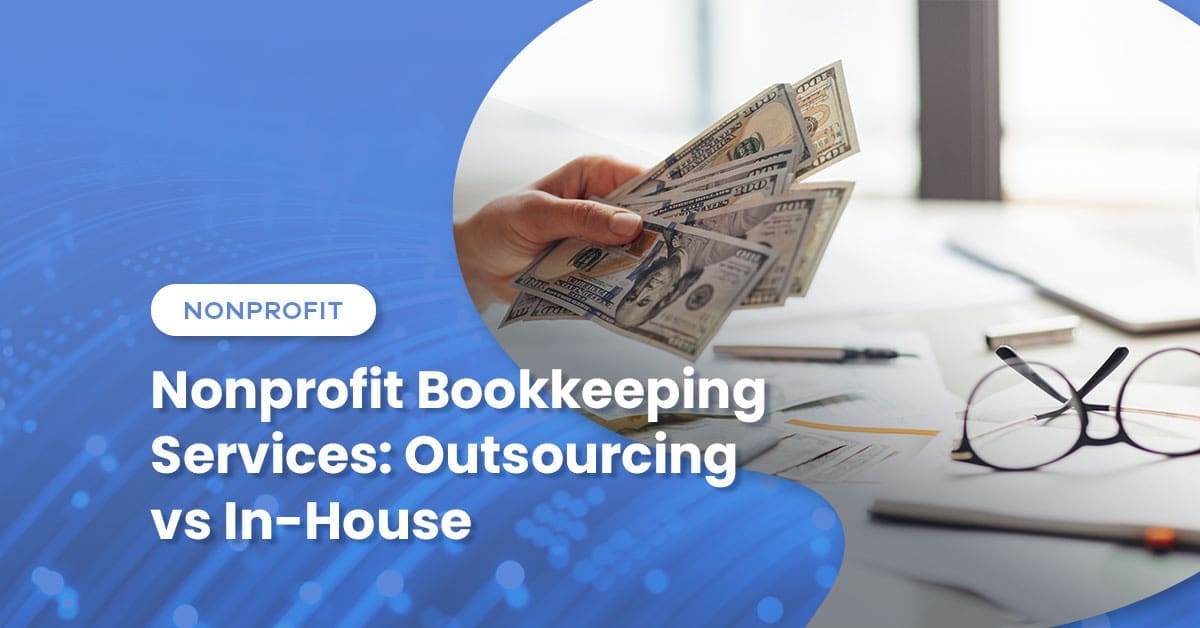
Nonprofit Bookkeeping Services: Outsourced vs. In-House
May 21, 2026



Key Takeaways
- A full-time nonprofit bookkeeper costs $45,000 to $65,000 annually in salary alone, before payroll taxes, benefits, software licensing, and training costs that rarely appear in the initial hiring discussion but quickly add up in a resource-constrained budget.
- Outsourced nonprofit bookkeeping services typically provide access to nonprofit-specialized expertise, fund accounting proficiency, and audit-ready documentation practices that a single in-house generalist cannot reliably replicate.
- The in-house model introduces a key-person risk that most organizations do not adequately plan for: when your sole accountant leaves, the institutional knowledge of your chart of accounts, grant-tracking systems, and reconciliation history often leaves with them.
- Organizations in active growth, audit preparation, or grant-compliance-heavy environments consistently benefit from outsourced or co-sourced models that scale with demand rather than requiring new hires at every inflection point.
- Bottom line: This is not a question of cost alone. It’s a question of what level of financial expertise your organization’s complexity actually requires — and whether a single in-house hire can deliver it.
The decision to hire an in-house bookkeeper feels like the responsible move. You’re building institutional knowledge, keeping financial operations close, and maintaining control. What most executive directors and CFOs don’t fully account for is everything that hiring doesn’t include — and what happens when that person has a bad quarter, or leaves.
Nonprofit bookkeeping services look different depending on organizational size, funding complexity, audit requirements, and growth trajectory. The right answer is not universal. But the framework for getting there is.
What In-House Nonprofit Bookkeeping Actually Costs
The budget line for an in-house bookkeeper typically reflects base salary. It rarely reflects the total cost of employment.
A nonprofit bookkeeper with meaningful fund accounting experience commands $45,000 to $65,000 annually in base compensation in most U.S. markets, according to data from Robert Half’s annual Accounting and Finance Salary Guide. Add employer payroll taxes (approximately 7.65% for FICA alone), health benefits (averaging $6,000 to $8,000 annually per employee for employer contributions, per Kaiser Family Foundation data), paid time off, and any accounting software licensing that falls under the role, and the fully burdened cost of that hire is frequently 25 to 35% above the salary figure.
That’s before training, professional development, and the time your leadership team spends managing, onboarding, and eventually replacing the role when turnover occurs, which in accounting functions it does regularly.
None of this makes in-house bookkeeping the wrong answer. It makes it a more expensive answer than most budgets acknowledge at the point of decision.
The Expertise Gap In-House Hires Often Create
Nonprofit accounting is not general bookkeeping. Fund accounting — tracking revenue and expenses by grant, program, or donor restriction — requires specialized knowledge that many general-practice bookkeepers lack at the level of nonprofit compliance demands. A bookkeeper who cannot distinguish between net assets with or without donor restrictions, or who lacks experience with FASB ASC 958 reporting requirements, creates downstream problems that surface at audit time rather than at hire time.
What Outsourced Nonprofit Bookkeeping Services Deliver
Outsourced nonprofit bookkeeping engagements provide access to a team rather than an individual. That distinction has meaningful operational implications.
When one staff member handles your bookkeeping, their availability, expertise, and continuity determine the quality of your financial operations. When an outsourced provider handles it, you have a team with documented processes, coverage for absences, and the combined expertise of specialists who work across multiple nonprofit clients. Reconciliation practices, grant compliance tracking, and monthly close procedures are standardized — not dependent on a single person’s judgment or habits.
For organizations managing multiple concurrent grants, restricted funds, or complex functional expense allocations, outsourced teams that specialize in nonprofit accounting provide audit-ready documentation as a standard output, not as an annual scramble.
Outsourced providers also scale. An organization heading into audit preparation, a multi-grant renewal cycle, or a significant revenue year can access additional capacity without having to go through a hiring process. When that period ends, the engagement scales back. Internal headcount cannot do that.
When In-House Makes Sense — and When It Doesn’t
The in-house model has genuine advantages in specific circumstances. Organizations with stable, simple financial structures, a single primary funding source, and no near-term audit obligations can reasonably manage bookkeeping internally, provided the person in the role has demonstrable experience in nonprofit accounting.
Organizations that should think carefully before defaulting to in-house include those managing more than five concurrent restricted grants, those approaching their first financial statement audit, those receiving federal funding above the Single Audit threshold, and those that have experienced significant staff turnover in their finance function in the past two years. In each of these scenarios, the in-house model introduces risk of non-compliance, of audit findings, of grant reporting errors — that an outsourced team with nonprofit specialization is better positioned to absorb.
The Co-Sourced Model: Frequently the Right Answer
Many nonprofits operate in a middle state: they have an internal staff accountant or bookkeeper handling day-to-day transactions, but lack the senior-level nonprofit expertise needed for complex grant reporting, audit preparation, or financial statement analysis. Co-sourcing addresses this gap directly.
A co-sourced model pairs your internal capacity with external nonprofit accounting expertise at the level you actually need it — without requiring a full-time senior hire. Your internal person handles transaction entry and routine tasks. The outsourced layer handles month-end review, grant compliance oversight, audit preparation support, and financial reporting that your board and funders require.
Making the Decision with the Right Variables
The in-house vs. outsourced question in nonprofit bookkeeping services should be evaluated against four factors: the complexity of your fund accounting requirements, your audit obligations, the stability of your finance function, and the total cost of employment relative to what an outsourced engagement would provide at comparable levels of expertise.
Wiss works with nonprofit organizations to assess their financial operations and structure accounting support — outsourced, co-sourced, or in-house advisory — around the organization’s actual needs. If your current bookkeeping model isn’t keeping pace with your grant portfolio, audit requirements, or financial reporting obligations, that’s a structural problem worth solving before year-end, making it urgent. Contact the Wiss nonprofit practice to discuss your organization’s needs.
 Previous


Share