


Key Takeaways
- According to the Fundraising Effectiveness Project, the average nonprofit donor retention rate hovers around 43%, meaning the majority of first-time donors never give again.
- The cost of acquiring a new donor is estimated to be five to ten times higher than retaining an existing one, making retention the highest-ROI activity in any development operation.
- Personalized, prompt acknowledgment, meaningful impact reporting, and consistent stewardship are the tactics with the strongest documented correlation to multi-year donor retention.
- Bottom line: Most donor attrition is not about donor dissatisfaction. It’s about donor neglect. The fix is structural, not creative.
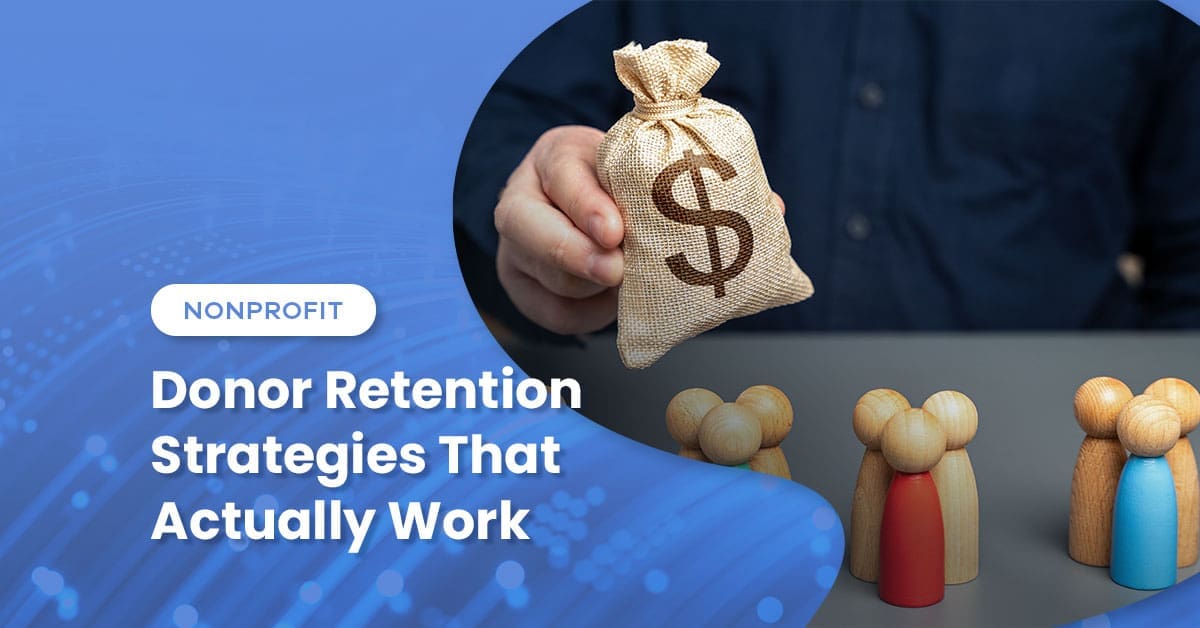
Most development directors don’t have a fundraising problem. They have a leaky bucket problem.
Donor retention strategies are the clearest lever in nonprofit fundraising, and among the most consistently underinvested. Research from the Fundraising Effectiveness Project’s annual report consistently shows sector-wide donor retention rates of approximately 43 to 46 percent, meaning that for every 100 donors an organization brings in, roughly half are gone within 12 months. The organizations outperforming that benchmark aren’t spending more on acquisition. They’ve plugged the leak.
First-Time Donor Retention Is Where the Math Falls Apart
The aggregate retention number looks bad. The first-time donor number is worse.
According to the Fundraising Effectiveness Project’s data, first-time donor retention rates averaged approximately 19 percent across the sector. That means eight out of ten new donors give once and never return. The organizations that treat every first gift as the beginning of a relationship — rather than a completed transaction—operate in a fundamentally different financial reality from those that don’t.
The single highest-impact intervention for first-time donors is the speed and quality of the initial acknowledgment. Research consistently shows that thank-you communications sent within 24 to 48 hours of a gift correlate with meaningfully higher rates of second-year giving. A templated email with the donor’s name and dollar amount is not an acknowledgment. It’s a receipt. An acknowledgment tells the donor what their specific contribution made possible. That distinction matters to the recipient, and the data confirms it matters to your retention rate as well.
The Upgrade Trap Development Teams Fall Into
Retention conversations often get conflated with upgrade conversations. They’re related but not the same. Donors who feel adequately stewarded at their current level retain at higher rates and upgrade organically. Donors who are solicited for upgrades before they feel recognized frequently lapse. The sequence matters.
Segmentation Isn’t Optional — It’s the Foundation
Most donor communication is broadcast communication dressed up as relationship management. Development teams that send the same newsletter, the same year-end appeal, and the same impact report to every donor in the database are operating as if all donor relationships are equivalent. They’re not.
Effective segmentation doesn’t require sophisticated technology. It requires intentional distinctions: first-time donors versus multi-year donors, lapsed donors, monthly sustainers, and major gift prospects each have different retention dynamics and should receive different communication cadences, content, and ask strategies.
Monthly sustainers, as an example, retain at dramatically higher rates than one-time donors across the sector. Research from Bloomerang and other sector sources indicates that monthly donors retain at rates exceeding 80-90 percent annually, compared with the sector-wide average for one-time donors. The structural shift from transactional annual giving toward recurring giving isn’t just a revenue diversification strategy — it’s the single most reliable retention mechanism available to most development operations.
Impact Reporting as a Retention Tool
Donors leave for reasons they often can’t articulate. When researchers ask them, the most common responses aren’t complaints about the cause or the organization’s values. They’re expressions of disconnection: they didn’t know their gift made a difference, they felt like a name on a list, and no one communicated what happened as a result of their support.
Impact reporting, done well, closes that gap. Done poorly, it’s organizational self-congratulation dressed as donor stewardship. The distinction lies in specificity and framing: not “we served 1,200 clients this year” but “your gift helped us expand our food distribution program, reaching 200 additional families in Bergen County this fall.”
This isn’t copywriting advice. It’s a retention strategy. Donors who can connect their gift to a specific, credible outcome are more likely to give again, according to research from Penelope Burk’s longitudinal donor satisfaction studies, which have documented this pattern across decades of donor survey data.
Lapsed Donor Reactivation Is Worth the Effort
Reactivating a lapsed donor — typically defined as a donor who has not given in 13 to 36 months — costs significantly less than acquiring a new one and succeeds at higher rates than many organizations assume. A targeted reactivation series that acknowledges the lapse, reestablishes the mission connection, and makes a specific, appropriately sized ask outperforms standard acquisition appeals in most documented cases.
Retention Requires Infrastructure, Not Just Intention
The development directors most frustrated by retention challenges are usually doing the right things inconsistently. The problem isn’t strategy. It’s systems.
Consistent acknowledgment timelines, structured touchpoint calendars, segmented communication workflows, and reliable reporting on retention metrics by donor cohort require the same kind of financial infrastructure investment that any well-run operation demands. Without fund accounting that accurately tracks donor designations, accurate donor records that support meaningful segmentation, and financial reporting that ties development activity to organizational outcomes, stewardship becomes reactive rather than systematic.
Building a Donor Retention Program That Holds
Retention improvements don’t happen through a single campaign. They happen when organizations make structural commitments: a 48-hour acknowledgment standard, a monthly stewardship touchpoint for donors above a defined threshold, a midyear impact update for all active donors, and a systematic lapsed donor reactivation protocol run twice a year.
The organizations with retention rates consistently above 60 percent tend to share a common characteristic: they treat donor relationships with the same rigor they apply to financial reporting. They track the numbers, review them regularly, and make operational adjustments when the data indicates a problem.
Wiss works with nonprofits to build the financial and operational infrastructure that supports effective development — from fund accounting and financial reporting to advisory support for organizational strategy. If your development results don’t align with your mission commitment, the conversation often starts with your systems. Contact Wiss to learn more.
 Previous


Share