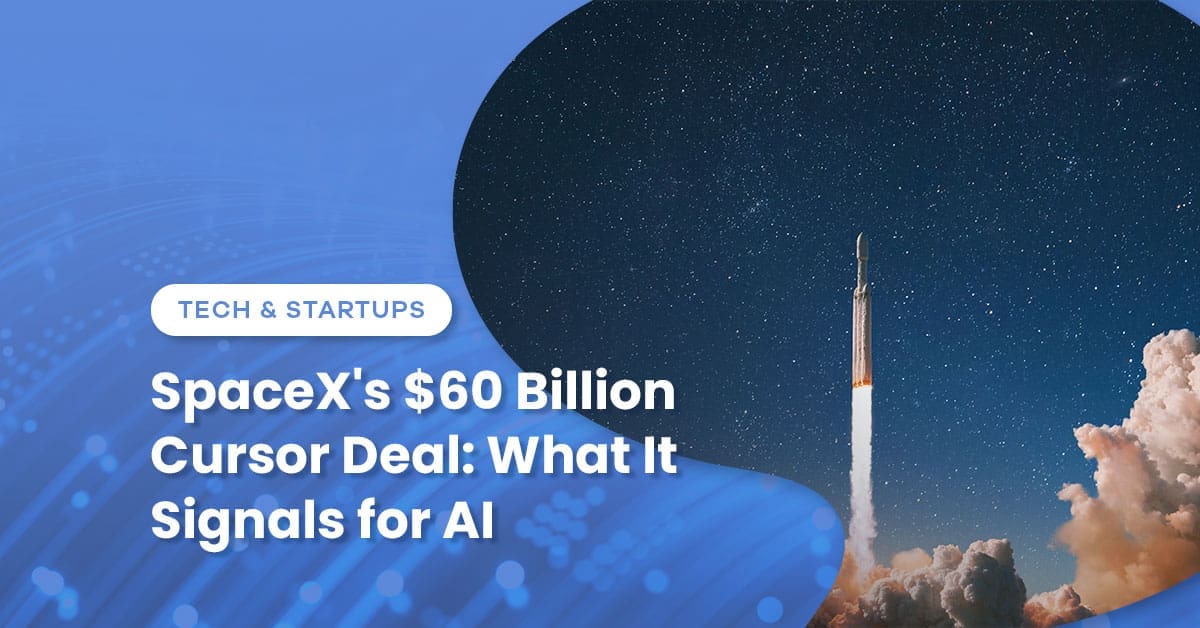



SpaceX has announced a deal with AI coding startup Cursor that gives the rocket company the option to acquire Cursor later this year for $60 billion, according to a report by Clara Colbert published by Yahoo Finance on April 23, 2026.
The announcement, made by SpaceX on Tuesday, described the arrangement as a close working partnership with Cursor aimed at building what the company called “the world’s best coding and knowledge work AI.” SpaceX said the combination of Cursor’s product and its distribution reach among software engineers, together with SpaceX’s Colossus training supercomputer, which the company describes as having capacity equivalent to one million H100 GPUs, would support development of what it termed “the world’s most useful models.”
Under the terms described in SpaceX’s announcement, the company has been given the right to acquire Cursor for $60 billion or to pay $10 billion for the collaborative work between the companies. Financial terms beyond those figures were not disclosed.
About Cursor and Its Developer
Cursor is an AI-assisted coding tool developed by Anysphere, a San Francisco startup founded in 2022. The company has raised more than $3 billion in funding and is reportedly in discussions to raise additional capital. The deal values Anysphere at $60 billion on a potential acquisition basis, a significant premium relative to its most recent funding rounds.
Context: SpaceX’s AI Ambitions
The Cursor deal is part of a broader strategic shift at SpaceX. CEO Elon Musk merged SpaceX with his xAI startup in February, positioning the combined entity as an AI company ahead of a planned IPO. That IPO, targeted for June, is reportedly aiming for a valuation between $1.75 trillion and $1.8 trillion, which would rank among the largest public offerings in history, according to Yahoo Finance.
A Wider Pattern of AI Consolidation
The SpaceX and Cursor arrangement reflects a pattern that has become increasingly prominent across the technology sector: AI startups seeking relationships with larger organizations to access the compute infrastructure needed to continue developing their models.
Yahoo Finance noted that Amazon announced a $5 billion investment in Anthropic earlier in the same week, giving the AI company broader access to Amazon’s Trainium chips. The two deals, announced in close proximity, illustrate the degree to which access to compute capacity has become a central constraint for AI development companies and a primary driver of partnership and acquisition activity.
For AI startups, the calculus is relatively straightforward. Training large models requires substantial and expensive GPU infrastructure that few startups can finance independently at scale. Partnerships with companies that own or can provision that infrastructure offer a path to continued model development without requiring equivalent capital raises.
What This Means for Business Leaders Tracking AI
For CFOs and technology leaders watching the AI market evolve, the pace and scale of these deals are notable for one reason. Capital is concentrating rapidly around a small number of compute-rich platforms, and the AI tools that enterprises will have access to over the next several years will increasingly be shaped by which startups secured those infrastructure relationships and which did not.
The practical implication is that enterprise AI adoption is not a static decision. The available tools, their capabilities, and the companies behind them are shifting quickly. Organizations that are building their AI strategies now should factor in not just the current capabilities of the tools they are evaluating but the stability and trajectory of the companies behind them.
Wiss tracks developments in enterprise AI adoption through Wiss Labs, its innovation division, with a focus on how AI tools are maturing in financial operations. The firm’s partnerships with Basis AI and Rillet reflect a deliberate approach to working with AI-native platforms that are building durable capabilities rather than just capitalizing on a moment. For business and finance leaders navigating which AI relationships and tools to invest in, that distinction is worth careful consideration.
Source: Clara Colbert, Yahoo Finance, April 23, 2026.
 Previous


Share