
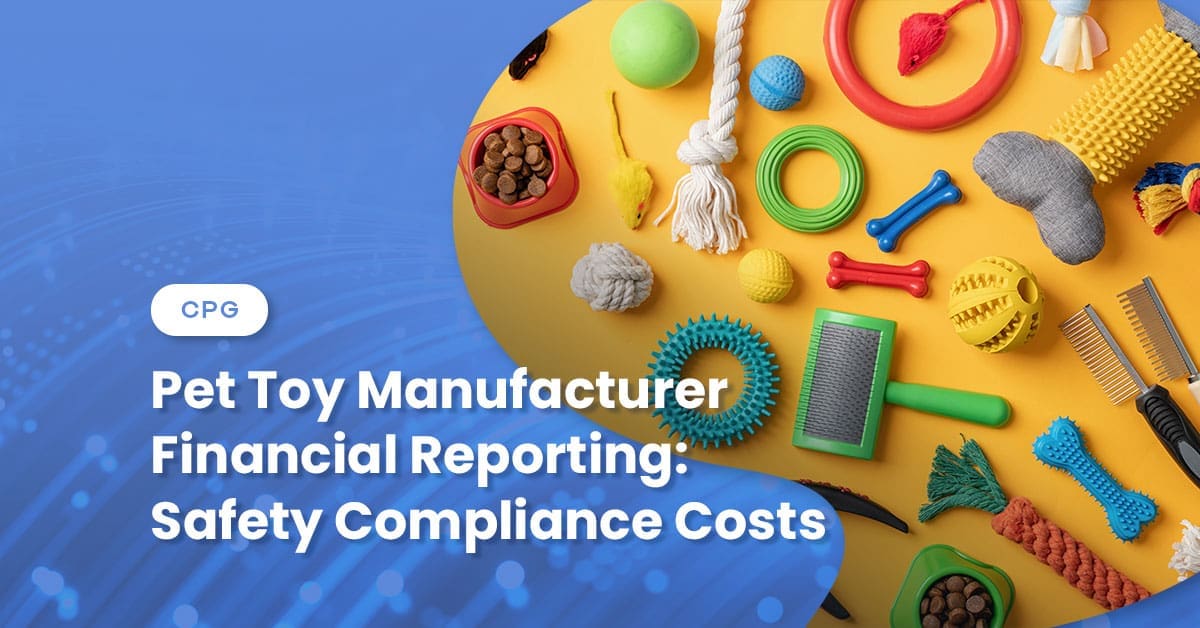
Pet Toy Manufacturer Financial Reporting: Safety Compliance Costs
May 22, 2026


Key Takeaways
- Safety compliance costs for pet toy manufacturers span testing, certification, quality control, and recall readiness, and each category is accounted for differently under U.S. GAAP. Treating them all the same way distorts both gross margin and operating expense analysis.
- There is no federal mandatory safety standard specifically governing pet toys. Pet toy manufacturers are subject to the Consumer Product Safety Act’s general safety requirements, TSCA chemical restrictions, California Proposition 65, and an expanding body of retailer-imposed testing requirements, none of which are administered through a single compliance framework.
- Bottom line: Safety compliance is a cost of doing business. Financial reporting that doesn’t reflect it accurately produces a gross margin figure that nobody, including the company’s own leadership, can rely on.
Pet toy manufacturers operate in a category that looks straightforward on paper and is considerably more complex in practice. The product is a physical good sold through pet specialty retail, mass market, and direct-to-consumer channels. The compliance environment is a patchwork of federal safety law, chemical regulations, state-level requirements, and retailer-imposed testing protocols, none of which fit neatly into a standard chart of accounts.
The accounting question, for CFOs and controllers managing pet toy businesses, is not whether safety compliance costs are real. They obviously are. The question is how to classify them correctly, report them consistently, and build financial statements that reflect the true cost structure of a regulated product business.
The Regulatory Framework Pet Toy Manufacturers Actually Operate Under
Understanding the compliance cost picture starts with what the law actually requires, because many pet toy companies make assumptions that don’t align with regulatory reality.
There are very few formal regulations specifically addressing pet toy safety. The ASTM F963 standard, which is the mandatory safety specification for children’s toys under the Consumer Product Safety Improvement Act of 2008 (CPSIA), applies to toys designed for children under 14. It does not apply to pet toys as a mandatory standard, though manufacturers may voluntarily adopt its requirements as a benchmark, and certain provisions, such as those governing products containing loose or separable magnets, can apply to pet products under separate CPSC rules.
What pet toy manufacturers are actually subject to includes:
- The Consumer Product Safety Act (CPSA): Requires that all consumer products, including pet products, not present an unreasonable risk of injury. The CPSC has the authority to pursue recalls and enforcement actions for products found to be unsafe.
- The Toxic Substances Control Act (TSCA): Governs the use of certain chemical substances in manufactured products, including dyes, coatings, and synthetic materials used in pet toys.
- California Proposition 65: Requires warning labels on products sold in California that contain chemicals listed by the state as known to cause cancer or reproductive harm. For pet toy manufacturers selling nationally, this is effectively a de facto product-composition requirement, since managing state-by-state labeling variations is operationally complex.
- Retailer-imposed testing requirements: Major pet specialty and mass-market retailers increasingly require third-party test reports and quality certifications before accepting products. These requirements vary by retailer, are not standardized, and create ongoing testing obligations that are a genuine business cost.
Third-party testing for chemical safety, durability, and toxin-free certification is a critical step in preventing recalls and safety violations. Manufacturers should conduct risk assessments early in production to identify weaknesses in material integrity, structural design, and chemical composition before products reach consumers.
The absence of a single mandatory standard does not make compliance simpler or cheaper. It makes it less predictable, more retailer-dependent, and harder to budget for in advance.
How to Classify Safety Compliance Costs Correctly
The accounting treatment of safety compliance costs depends on their relationship to production activity, not on their compliance-related nature. The same expense category, tested differently, can fall under either COGS or operating expenses depending on what it is and when it occurs.
Costs That Belong in COGS
Safety testing costs are includable in inventory cost, and therefore in COGS, when they are directly attributable to a specific production run or lot. These include:
- Third-party chemical testing (heavy metals, phthalates, substance restrictions) is performed on finished goods from a specific production batch before release to market
- Physical and mechanical testing conducted on production samples to verify that a specific lot meets structural and durability specifications
- Inbound quality inspection costs are tied to a specific purchase order or manufacturing run
- Certificate of conformance fees charged by a testing laboratory for a specific production lot
When these costs are incurred in connection with a particular batch of finished goods, they represent the cost of bringing that inventory to its saleable condition. Under ASC 330, inventory cost includes all costs necessary to bring inventory to its present location and condition. Testing that establishes that a production lot is fit for sale is part of that cost.
Costs That Belong in Operating Expenses
Not all compliance costs are production-run-specific, and the ones that are not belong in operating expenses in the period they are incurred. These include:
- Ongoing quality management system maintenance costs, including internal compliance staff and quality assurance infrastructure
- Annual retailer certification fees or supplier qualification program costs not tied to a specific production run
- California Proposition 65 compliance consulting and legal review costs
- Product development-phase testing conducted before production commences, including safety testing of prototypes and pre-production samples
- Regulatory monitoring, including fees for compliance advisory services that track changes to chemical restrictions or retailer requirements
The Misclassification Problem
The distinction matters because misclassifying operating-period compliance costs into COGS artificially depresses gross margin during periods of active compliance investment, and then creates an apparent margin improvement when those costs are reduced, without any actual change in product economics. A pet toy manufacturer that routes all safety compliance costs through COGS, regardless of their nature, will have a gross margin figure that fluctuates with compliance activity rather than production efficiency, making it nearly useless for trend analysis or performance benchmarking.
Product Recall Reserves: The Balance Sheet Obligation That Is Frequently Missing
The combination of immediate costs, long-term reputation damage, supply chain disruption, and regulatory consequences from a product recall creates a financial burden that can threaten business viability. That reality makes the accounting treatment of recall exposure one of the more consequential decisions for a pet toy manufacturer’s finance team.
Under ASC 450, a loss contingency must be accrued when it is probable that a liability has been incurred and the amount can be reasonably estimated. For a pet toy manufacturer with a distributed product in the market, the probability of some level of recall or product withdrawal over time is nonzero. The question is not whether to accrue for it, but how to estimate the exposure with reasonable precision.
A recall reserve methodology for a pet toy manufacturer should account for:
- Historical return and withdrawal rates by product category and distribution channel
- Estimated retrieval and destruction costs per unit, based on current logistics and disposal costs
- Customer notification and retailer relationship costs associated with a product withdrawal
- The cost of the replacement product or credit to retail partners
The reserve should be reviewed and updated at least quarterly. Recognizing recall costs only when an event actually occurs and carrying no reserve in interim periods overstate net income throughout the year and produce a large, unexplained charge when an event materializes. Lenders reviewing quarterly financial statements and acquirers conducting diligence will both identify the absence of a recall reserve as a gap.
Building the Financial Reporting Structure
The pet toy manufacturers whose financial statements hold up to investor or acquirer scrutiny share a common characteristic: they have built a compliance cost methodology that is documented, applied consistently, and separated by category in the chart of accounts.
Practically, this means:
- A separate account or cost center for production-run-specific quality testing that flows into COGS
- A separate operating expense account for ongoing quality system and certification costs
- A clearly defined cutoff between development-stage testing and production-stage testing, so that pre-production compliance costs are not capitalized into inventory
- A recall reserve line in accrued liabilities, supported by a documented methodology that is updated each reporting period
Wiss works with consumer product companies, including pet brands and hardgoods manufacturers, on COGS classification frameworks, reserve methodologies, and financial reporting structures to produce accurate, defensible financials. If your compliance costs are sitting in a single line without a defined policy behind them, the reporting is not giving you, or anyone reviewing your financials, an accurate picture of the business.
 Previous


Share


Related Posts
CPG Financial Reporting Automation: Reducing Month-End Close Time
June 26, 2026
Flavor Profitability Analysis for Food Companies: Rationalizing Your Portfolio
June 24, 2026
Pet Services Accounting: Why Subscription Revenue Models Fail
June 19, 2026
Fitness Bar Company Accounting: Co-Packing vs In-House Production
June 17, 2026