
Data Center Boom: The Financial Risks Utilities and Investors Are Watching Closely
April 16, 2026
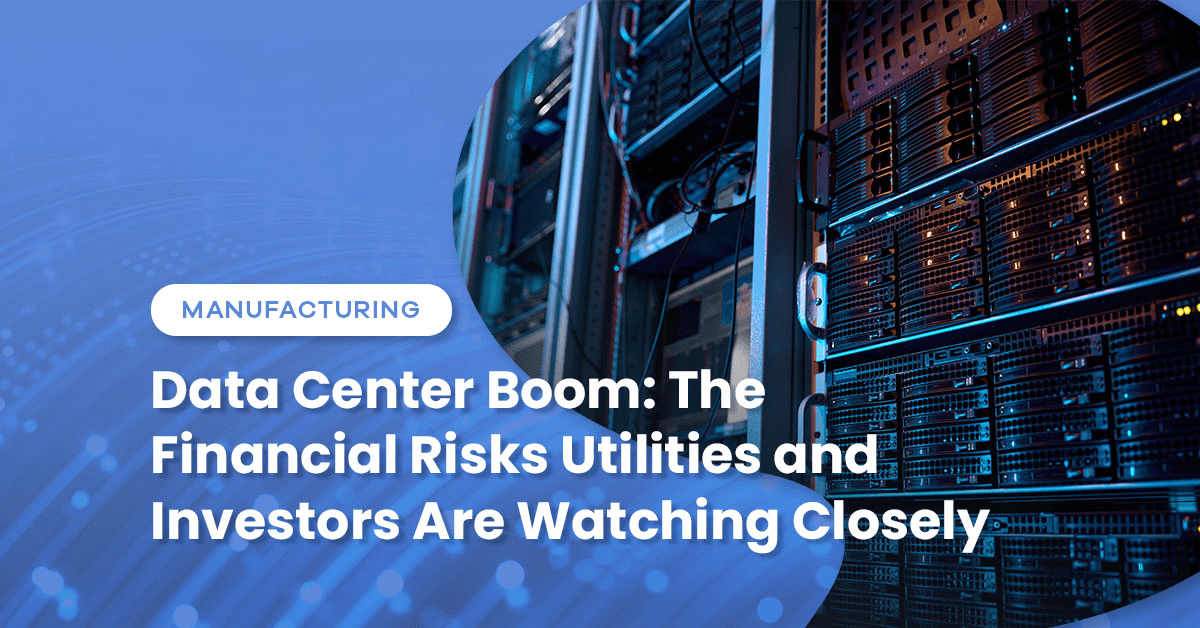


The capital commitments flowing into AI data center infrastructure are unprecedented in scale and speed. Utilities are racing to build new generation capacity and grid upgrades to serve a wave of large-load customers whose power requirements have arrived faster than any planning horizon could have anticipated. But alongside the investment case, a set of specific financial risks is drawing serious scrutiny from energy finance analysts, legal professionals, and industry observers. Those risks are worth understanding clearly.
The Planning Horizon Problem
The electric power industry is built around planning horizons measured in decades. The AI-driven surge in data center demand, by contrast, arrived in earnest in late 2022. That compression creates a structural mismatch, according to reporting by Utility Dive.
Utilities making long-term infrastructure commitments to serve data center load are doing so in an environment where the future power requirements of AI workloads are genuinely uncertain. The load profile of AI data centers differs fundamentally from earlier data center generations and from most commercial or industrial loads. If the volume or nature of AI inference demand shifts materially, infrastructure built to serve current projections may not serve future realities.
Stranded Asset Risk: The “Dark GPU” Question
The dot-com analogy appears repeatedly in industry commentary on the current buildout. After that cycle, millions of miles of fiber-optic cable were abandoned, only to be repurposed years later as demand for internet infrastructure eventually caught up. Whether data center hardware has a comparable second life is a question without a clear answer.
Advait Arun, senior associate for energy finance at the nonprofit Center for Public Enterprise, told Utility Dive that the fiber analogy breaks down when applied to data center assets. “With fiber optic, the Internet was still a thing, and it was the infrastructure on which you could build newer websites or new service models,” Arun said. “But it’s not really clear what the future of the inference services industry looks like, simply because we have all of these competing companies with fairly identical services.”
Arun also described the underlying business model as one that has not yet demonstrated stable, recurring revenue at scale, noting in a November 2025 paper that neocloud companies, the intermediaries that provide GPU capacity to hyperscalers like Google and Microsoft, carry disproportionate exposure to falling asset values in the event of a market correction. “In a market correction, it’s very possible that data centers will end up crashing out of their tariff arrangements,” he said.
Credit Risk and Counterparty Concentration
Scott Engstrom, chief customer officer at GridX, frames the issue as a credit risk question. Utilities signing large data center customers to long-term rate arrangements are effectively making a bet on the financial durability of those counterparties over 10 to 15 year periods.
“Who’s on the other side of signing up for, say, $100 million a year of minimum payments?” Engstrom told Utility Dive. “You have to be confident that the counterparty is going to be around for the period of time that they are committed to recover that infrastructure investment.”
Engstrom distinguishes between hyperscalers, the large cloud operators with established balance sheets and diversified revenue streams, and smaller neocloud operators with less established financial positions. “You certainly feel very good that they are going to have a lot of money 10, 15 years from now” for the former group, he said, while acknowledging that market conditions can change for any counterparty.
The Circular Investment Structure
Daniel Farris, a law partner at Foley & Lardner who works on data center and energy contracts, raises a related concern about the interconnectedness of investment flows in the AI infrastructure sector.
“The chip manufacturers are investing in neoclouds so that they can go secure data centers that are backstopped by those chip makers, so that they can turn around and spend money that they receive from the chip makers to buy chips from the chip makers,” Farris told Utility Dive. The circularity of that structure, he noted, is a factor that warrants attention. “Is there the potential for market correction? Yes, absolutely.”
What Professionals Are Not Saying
It is worth noting what this reporting does not contain. None of the professionals cited predict an imminent crash, and the demand signals driving data center investment remain strong by current measures. Hyperscaler capital expenditure commitments for 2026 are projected significantly above 2025 levels. Long-term lease commitments from well-capitalized tenants, including major AI companies, continue to be signed. The risk discussion in the Utility Dive report is a forward-looking one about the structure of commitments and what happens if demand assumptions prove wrong, not a characterization of present conditions.
The asymmetry in that risk, however, is the point: utilities and their ratepayers bear the cost of stranded infrastructure if demand falls short, while the upside of successful buildout accrues primarily to data center operators and their investors.
What This Means for Real Estate Investors and Developers
For developers, investors, and property owners with direct or indirect exposure to data center real estate, the financial questions raised in this report are relevant to underwriting, hold strategy, and counterparty assessment. Data center investments backed by hyperscaler tenants carry a materially different risk profile than those dependent on neocloud operators whose business models are less proven. Lease structure, minimum payment commitments, and the creditworthiness of the tenant entity, not just the brand name, are all worth examining carefully.
The infrastructure investment wave is real. The risk discussion happening alongside it is equally real. Both deserve a place in any serious analysis.
Wiss Real Estate Advisory
Wiss works with real estate developers, investors, and property owners on transaction structuring, tax planning, financial modeling, and strategic advisory across commercial and industrial asset classes, including properties with data center and infrastructure exposure. If you are evaluating data center investment opportunities or assessing risk within an existing portfolio, contact the Wiss Real Estate Advisory team.
AI Disclosure: This article was produced with AI writing assistance and reviewed by the Wiss editorial team. Original reporting by Diana DiGangi, Utility Dive, published March 6, 2026. Expert opinions cited are those of the individuals quoted and do not represent the views of Wiss & Company LLP.
 Previous


Share


Related Posts
Production Cost Accounting Best Practices for Manufacturers
July 21, 2026
Essential Manufacturing KPIs for Financial Performance
July 21, 2026
Manufacturing Capacity Utilization: Where Profitability Actually Lives
June 15, 2026
Production Scheduling Optimization: The Financial Impact Most Manufacturers Miss
June 15, 2026