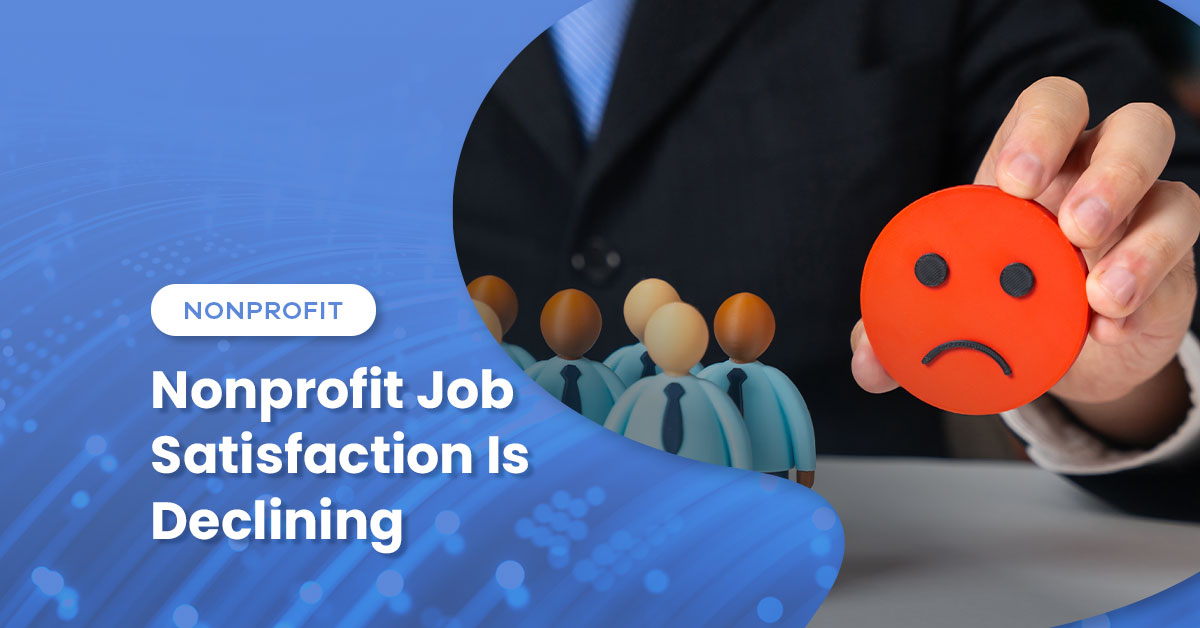


The organizations included in The NonProfit Times’ annual Best Nonprofits To Work For list are, by definition, among the strongest employers in the sector. They applied for evaluation, submitted to a 77-question staff survey across nine categories, and made the list. And yet, employee satisfaction at these organizations has declined for three consecutive years. That trend is worth paying attention to, because if it’s happening at the sector’s best employers, it’s happening more sharply everywhere else.
What the Survey Found
The NonProfit Times, working with Workforce Research Group, surveyed employees at nonprofits that applied for the Best Nonprofits To Work For designation. The 2026 report, based on responses submitted in late 2025, shows the overall “core employee experience” approval rating at 90%, down from a high of 95% reached in both 2023 and 2024.
The declines show up consistently across categories. Approval for “My Manager Treats Me Fairly” dropped from 98% in 2023 to 92% in 2025. “My Supervisor Handles My Job-Related Needs” fell from 97% in 2022 to 90% in this report. These are still strong numbers in absolute terms, but the direction matters. Peter Burke, president of Workforce Research Group, offered useful context: overall U.S. employee engagement has fallen from 35% to 31% across all industries. Even at 90%, nonprofit-sector winners are performing well above the national average.
The two lowest-scoring statements in the survey cut to the financial core. Only 68% of respondents approved of the statement “I Am Paid Fairly For The Work I Perform,” and 73% approved of “I Don’t Worry About The Security Of My Position.” Those are the lowest scores in the entire 12-statement “Your Job” category, and they point directly to the financial pressures most nonprofit leaders already know they’re carrying.
Compensation Is the Underlying Problem, Not Just a Symptom
Mary Rizzuti, a partner at Compensation Resources, clearly identified the pattern. Looking at declining satisfaction scores, she noted her first instinct was to check compensation data, followed by senior leadership and communication. Her read was correct on all three.
The report shows that organizations working to address the compensation gap have taken some steps. The percentage of nonprofits covering 100% of employee health insurance premiums ticked up to 34% in 2026, recovering from a low of 31% in 2024, though still below the 38% that provided full premium coverage in 2020.
The compensation challenge in nonprofits is structural, not incidental. Rizzuti noted that some organizations reward longevity with above-market salary increases, while others cap salaries based on position value and use alternative incentives, including work-life balance considerations and lump-sum bonuses. What makes the difference, she said, is transparency: clearly communicating compensation philosophy and career progression paths improves retention even when base pay cannot be increased significantly.
For nonprofit finance leaders, that observation has a direct operational translation. Compensation transparency requires more than good intentions. It requires a clear compensation framework, documented salary bands, and consistent application, all of which depend on financial modeling of what the organization can sustain across budget cycles.
Leadership and Professional Development Are the Gaps Separating Winners From Everyone Else
The largest disparities between organizations that made the Best Nonprofits To Work For list and those that did not were in two categories: Leadership Of This Organization, where winners led by nine percentage points, and Training, Technology And Professional Development, where the gap was eight points.
Only 74% of all respondents approved of the statement “This organization assists me in following a well-aligned career path,” and the approval for “I Am Rewarded For Doing A Good Job” was just 73%. Deb Taft, CEO of global executive search firm Lindauer, connected these results directly to management quality. “Leadership still matters. And yet, we still aren’t training managers well enough,” she said in the report. “I think it’s about clear and clarity. People will choose different cultures, but paying attention and putting voice and words around your culture matters.”
Taft also addressed the job security numbers directly, noting that anxiety about job stability undermines the quality of daily work. Her recommendation for managers: honest, direct communication about organizational health and what staff can control, rather than false reassurance. “We can’t promise everybody that they’re going to have a job next month or next year,” she said. “But you can certainly have conversations about how the organization’s doing and what they control and what they can do.”
That kind of transparency starts with organizational financial clarity. Leaders cannot credibly communicate about the organization’s trajectory if they don’t have timely, accurate financial information themselves.
What This Means for Nonprofit Finance and Operations Leaders
The satisfaction data reflects pressures that ultimately land on the finance function. Compensation improvements require budget capacity. Benefits enhancements require cost modeling. Professional development investment requires line-item justification. Staff turnover, which dissatisfaction drives over time, carries real financial costs in recruiting, onboarding, and lost institutional knowledge that rarely appear explicitly in a nonprofit budget but absolutely affect the bottom line.
The organizations performing best in this survey are not necessarily the ones with the largest budgets. They are the ones whose leadership has clarity about financial position, communicates it to staff, and makes deliberate decisions about where to invest in people. That requires financial infrastructure that many nonprofits, particularly those with under $10 million in revenue, still lack.
Wiss Nonprofit Advisory
Wiss works with nonprofit organizations on accounting, financial operations, compensation advisory, and the co-sourced financial leadership that gives executive directors and boards the financial clarity their people-related decisions require. If your organization is managing the pressures reflected in this survey and working to build a more sustainable financial foundation, contact the Wiss nonprofit team at wiss.com.
AI Disclosure: This article was produced with AI writing assistance and reviewed by the Wiss editorial team. Original reporting by Paul Clolery, The NonProfit Times, published April 1, 2026. Survey data compiled by Workforce Research Group in partnership with The NonProfit Times’ Best Nonprofits To Work For program; responses collected in late 2025.
 Previous


Share