
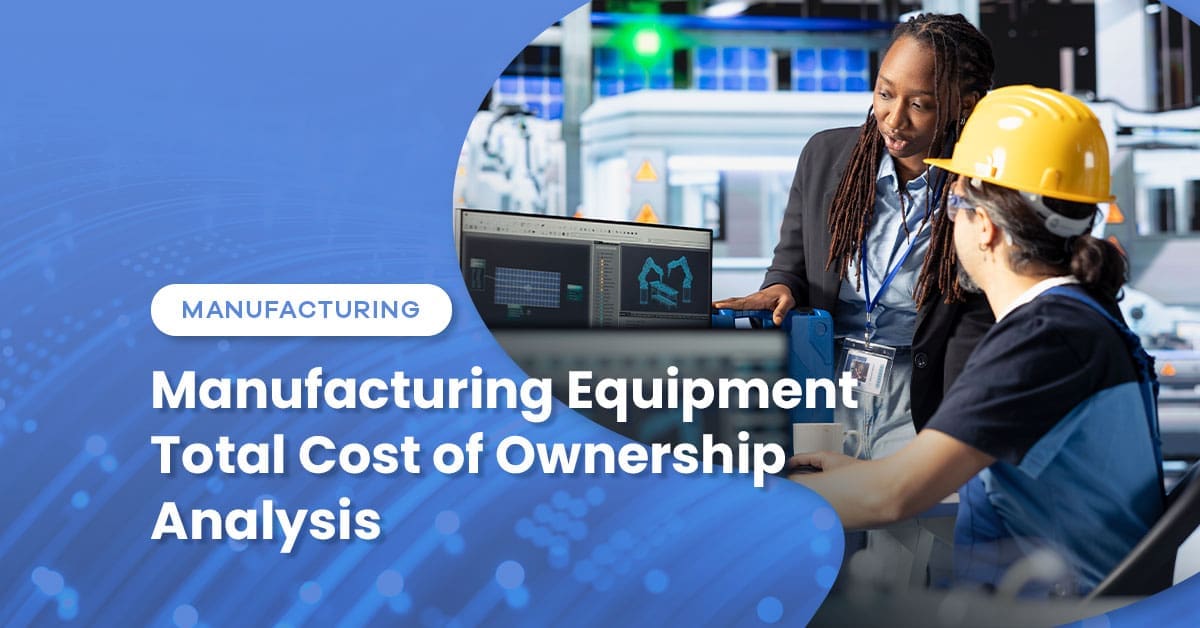



Key Takeaways
- Purchase price typically represents somewhere between a third and half of the true total cost of ownership for capital manufacturing equipment, depending on asset type, utilization intensity, and maintenance requirements, which means acquisition cost alone is a poor basis for capital investment decisions.
- A rigorous total cost of ownership analysis accounts for at least six cost categories beyond sticker price: installation and commissioning, ongoing maintenance and consumables, energy and utilities, operator training and labor, downtime risk, and end-of-life disposition.
- Under current tax law, the restored 100% bonus depreciation provision (for assets placed in service after January 19, 2025) and the increased Section 179 limit of $2.56 million affect the after-tax cost calculation in ways that can meaningfully shift the comparison between financing options and asset classes.
- Bottom line: Two pieces of equipment with the same purchase price can have dramatically different total cost-of-ownership profiles. CFOs who don’t model the difference are making capital decisions on incomplete information.
Equipment vendors are paid on the purchase price. Your P&L gets paid on everything that comes after.
That gap — between what a piece of capital equipment costs to buy and what it actually costs to own — is where manufacturing CFOs frequently find margin they didn’t expect to lose. The sticker price is just the opening act. Total cost of ownership analysis tells the full story and is the analytical foundation for any capital equipment decision that deserves to be made with confidence.
Why Purchase Price Is the Wrong Starting Point
Consider two CNC machining centers at similar acquisition costs. On paper, they look comparable. In practice, one requires proprietary tooling that runs at a premium, carries longer lead times for replacement parts, and draws significantly more power per cycle. The other uses widely available consumables, has a dense service network, and runs on a more efficient drive system.
Over a useful life of seven to ten years, the difference in operating costs between the two machines could exceed the original purchase price of either machine. That’s not a hypothetical designed to make a point. It’s a pattern that recurs when manufacturers build full-lifecycle models rather than compare line items on capital approval forms.
The purchase price orientation is understandable. It’s the number that shows up in the capex request, drives the depreciation schedule, and anchors the approval conversation. But it measures only one moment in the asset’s life. Total cost of ownership analysis measures the whole thing.
The Cost Categories a Complete TCO Model Must Include
A defensible total cost of ownership model for manufacturing equipment works through six categories beyond acquisition cost.
Installation and commissioning covers site preparation, utility connections, integration with existing equipment and control systems, and the internal labor consumed during setup. For complex or large-format equipment, this category can add meaningfully to the upfront outlay, and it’s frequently underestimated in capex proposals that treat “installed cost” as a line item rather than a detailed estimate.
Maintenance and consumables is often the most variable and most undermodeled category. Scheduled preventive maintenance costs can be estimated from manufacturer data and historical benchmarks. Unscheduled maintenance is harder to model, but not impossible — equipment age curves, historical failure rates for similar asset classes, and vendor service contract terms all provide inputs. A manufacturer evaluating two similar assets should request service history data and, where possible, speak with existing owners rather than relying solely on vendor documentation.
Energy and utilities deserve more attention than they typically receive in mid-market capex analysis. For energy-intensive manufacturing processes, the difference in power consumption between two machines with similar throughput can translate into meaningful cost differences over a multi-year period. Modeling this requires knowing the machine’s rated power draw, expected utilization hours, and the plant’s actual blended electricity cost per kilowatt-hour.
Operator training and labor captures the cost of training staff on new equipment, productivity ramp time during the learning curve, and any ongoing certification or recertification requirements. This category tends to be larger when equipment involves new technology, new control systems, or safety requirements that differ from the existing fleet.
Downtime risk is the most difficult category to quantify and the most costly to ignore. A machine that runs reliably at 90 percent uptime generates materially more throughput than one that runs at 80 percent, even if both are nominally rated for the same output. Downtime has a direct cost in lost production and an indirect cost in expediting, overtime, and customer service implications. Where the manufacturer has data on a specific asset’s uptime performance, that data should drive the model.
End-of-life disposition is the category most commonly omitted entirely. Some equipment retains meaningful residual value and can be sold or traded. Other equipment costs money to decommission and dispose of, particularly where environmental or hazardous materials handling requirements apply. A complete TCO model accounts for both the anticipated residual value and the disposal cost, discounted to present value.
How the Tax Environment Affects the TCO Calculation in 2026
The restored 100% bonus depreciation provision under current tax law, available for qualifying assets placed in service after January 19, 2025, changes the after-tax cost profile of capital equipment acquisitions in ways that a pre-tax comparison won’t capture. A manufacturer that can fully expense an equipment purchase in the year of acquisition recovers the tax benefit immediately rather than spreading it over the asset’s depreciable life.
The Section 179 expensing limit provides an alternative for companies that prefer to target specific assets for immediate expensing rather than apply bonus depreciation to all eligible property.
The practical implication for TCO analysis is that two assets with different purchase prices may have similar after-tax acquisition costs depending on which assets qualify for accelerated deductions and how the company’s current tax position affects the value of that timing benefit. A manufacturer with significant taxable income in the current year benefits more immediately from accelerated deductions than one carrying loss carryforwards. That’s a CFO-level variable, not a capex spreadsheet variable, and it belongs in the model.
Lease vs. Buy Under the Current Tax Environment
The TCO comparison between leased and owned equipment also shifts under the current depreciation rules. Ownership captures the full benefit of bonus depreciation and Section 179 expensing. Operating leases offer distinct tax advantages worth understanding. Unlike finance leases, operating lease payments are generally deductible as ordinary business expenses, which can improve your tax position depending on how your entity is structured.
However, it’s important to note that under GAAP financial reporting, operating leases are not off-balance-sheet arrangements — a right-of-use asset and corresponding lease liability are recorded on the books, representing the present value of all future lease payments. If your financials are prepared under GAAP, those assets and liabilities will also appear on Schedule L of your tax return, where book amounts are reported.
The strategic value of an operating lease is real, but it lives in the tax treatment, not the balance sheet optics. The right answer depends on the company’s specific tax position, debt structure, and capital allocation priorities — not on a generalized preference for one structure over the other.
Building the Model and Using It
A credible TCO analysis doesn’t require elaborate financial modeling software. It requires discipline in identifying all relevant cost categories, honest estimation of the inputs, and sensitivity analysis on the variables most likely to be wrong.
The most useful sensitivity analysis for manufacturing equipment TCO typically tests three variables: maintenance cost assumptions (because these are hard to estimate with precision and materially affect the total), energy cost trajectory over the asset’s useful life, and utilization rates. If the investment case holds up across a range of maintenance cost scenarios, that’s a useful finding. If the decision flips based on whether maintenance runs at the low or high end of the estimate range, that’s a finding too.
Making the Numbers Work for You, Not Just Through You
Equipment selection decisions shouldn’t be driven by the number that’s easiest to find. They should be driven by the number that matters — and in manufacturing, that number is the total cost of ownership across the asset’s working life, not the figure on the vendor quote.
Wiss works with manufacturing CFOs to build financial frameworks that support capital investment decisions, including full-lifecycle cost modeling, tax planning for equipment acquisitions, and CFO advisory for mid-market manufacturers evaluating significant capex. If your organization is approaching a meaningful equipment decision and wants rigorous analysis behind it, contact Wiss to start the conversation.
 Previous

Share


Related Posts
Production Cost Accounting Best Practices for Manufacturers
July 21, 2026
Essential Manufacturing KPIs for Financial Performance
July 21, 2026
Manufacturing Capacity Utilization: Where Profitability Actually Lives
June 15, 2026
Production Scheduling Optimization: The Financial Impact Most Manufacturers Miss
June 15, 2026