
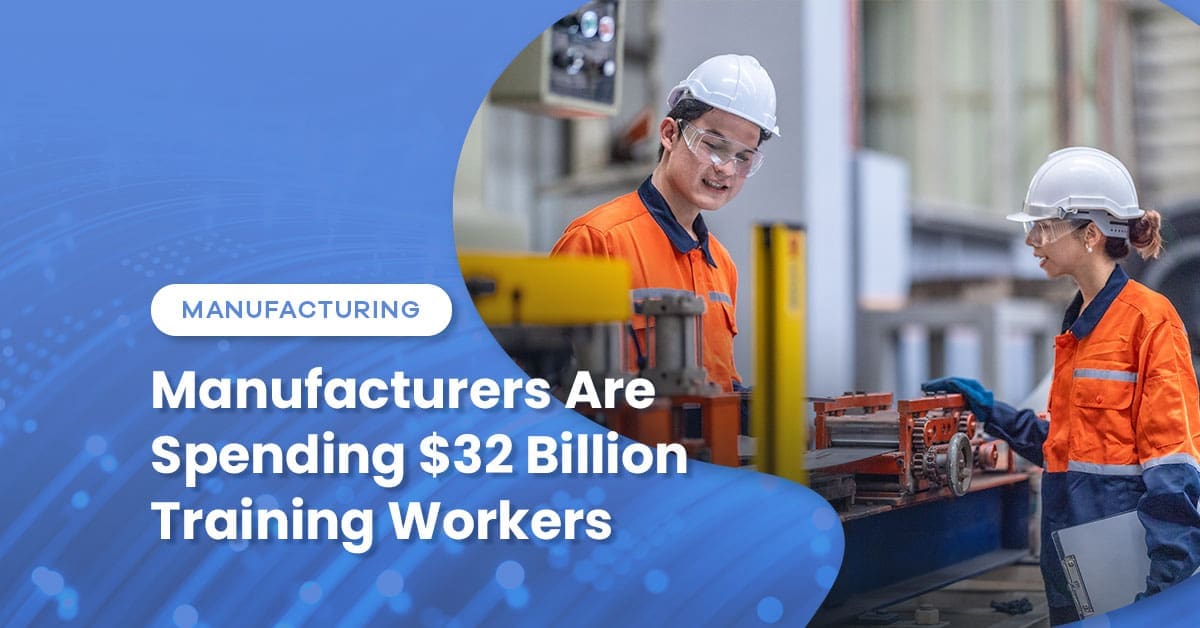



A new workforce survey from the Manufacturing Institute, released the week of April 15, 2026, puts a dollar figure on something manufacturing finance leaders have felt in their cost structures for years: workforce training has become a major capital commitment, not a line item.
U.S. manufacturing companies spent approximately $32 billion training and upskilling employees through internal and external programs, according to the survey. That represents a 22% increase from the MI’s baseline survey in 2019, which measured $26.2 billion. Average training hours per existing employee also rose, from 42.9 hours in 2019 to 47.6 hours today.
The numbers reflect a sector under genuine pressure to build the workforce it needs because the market is not producing one at a sufficient scale.
What Is Driving the Investment
The survey points to several converging forces behind the increase in spending.
Technology adoption is outpacing available skills. Manufacturers are deploying advanced equipment, automation systems, and AI-assisted production tools at a rate that existing workforce training pipelines were not designed to support.
Companies are filling that gap internally, using virtual and augmented reality training environments to reduce on-the-job risk while accelerating skills transfer. These tools, largely experimental in 2019, are now standard at a meaningful share of facilities.
Apprenticeship programs are scaling. Nearly one-third of manufacturers surveyed said their companies use apprenticeship programs. Registered apprentices in the advanced manufacturing industry reached 97,500 in 2025, a 20% increase over five years, according to Apprenticeship USA.
The Manufacturing Institute’s Federation for Advanced Manufacturing Education program, which operates an industry-standard apprenticeship curriculum, counts approximately 15% of its enrollment in formally registered, Department of Labor-validated apprenticeships. The remainder are employer-based programs that function similarly but outside the federal registration system.
The specialized skills gap is not closing on its own. MI President Carolyn Lee was direct about the rationale in an interview with Manufacturing Dive: “Employers need to lead investments in especially specialized training that is specific to their operations.” The implication is that community colleges, vocational programs, and traditional workforce pipelines are not producing workers ready to operate facility-specific equipment and systems. The employer is the solution of last resort.
The Obstacles Have Not Gone Away
The survey did not present workforce training as a solved problem. Despite the increased investment, manufacturers identified persistent friction:
- 69% said training interrupts work hours
- 65% cited scheduling conflicts as a significant challenge
- 48% identified cost as a barrier
For smaller manufacturers, all three of these obstacles are more acute. A mid-sized operation running lean shifts cannot pull two machinists off the floor for a training block without affecting production output. The financial capacity to absorb that disruption, or to fund an external training program, correlates directly with company size. Larger manufacturers are building internal training infrastructure and absorbing the cost. Smaller ones are competing for the same trained workers afterward.
The Finance Function Implication
The $32 billion figure is an aggregate. What matters to individual manufacturing finance leaders is whether their training investment is treated as a strategic capital allocation or a recurring operating expense that is difficult to justify during tight periods.
The distinction matters for two reasons.
First, workforce training costs that develop skills specifically attributable to specific equipment or processes may qualify for treatment as capital expenditures or may support R&D credit claims under IRC Section 41, depending on the nature of the activity and the degree to which it involves process improvement or experimental development. This is not automatic, and it requires documentation, but it is a question worth asking before training budgets are finalized.
Second, the ROI framework for workforce training belongs in the same analysis as capital equipment decisions. A manufacturer spending $400,000 annually on training programs that reduce scrap rates, improve machine utilization, and retain skilled workers who would otherwise cost $25,000 to $40,000 each to replace is making a quantifiable investment. The financial case for that spending should be documented as such, rather than treated as overhead that floats below the management reporting threshold.
Lee’s framing to Manufacturing Dive is worth noting here: “There’s so much rapid change in technology and exciting developments happening, particularly in the space of advanced manufacturing, that we can’t say it’s one and done.”
That is not a training philosophy. That is a description of a permanent line item that will grow as production technology advances and belongs in the long-range financial model, not just the annual budget.
Wiss works with manufacturing companies on cost structure analysis, R&D credit qualification, and financial planning that connects operational investment to tax and reporting strategy. If your company’s training spend has grown materially and has not been evaluated for tax treatment or ROI modeling, contact Wiss to start that conversation.
Source: Manufacturing Dive, “Manufacturers spent about $32B training workers: MI survey,” by Sara Samora, published April 22, 2026. Survey data from the Manufacturing Institute, conducted January 22 to February 6, 2026. Apprenticeship data from Apprenticeship USA, 2025.
 Previous


Share


Related Posts

Production Cost Accounting Best Practices for Manufacturers
July 21, 2026
Essential Manufacturing KPIs for Financial Performance
July 21, 2026
Manufacturing Capacity Utilization: Where Profitability Actually Lives
June 15, 2026
Production Scheduling Optimization: The Financial Impact Most Manufacturers Miss
June 15, 2026