
Leasing vs. Buying Construction Equipment: What CFOs Need to Get Right
May 19, 2026


Key Takeaways
- Buying can unlock significant upfront tax savings in today’s environment — but only if you can use them.
- Leasing prioritizes flexibility and cash flow, often at the expense of accelerated deductions.
- There is no default answer — the right structure depends on income, liquidity, and how you plan to use the equipment.
For construction companies, equipment decisions don’t sit neatly in “operations” or “finance.” They sit in both.
And in today’s tax environment, those decisions carry more weight than usual.
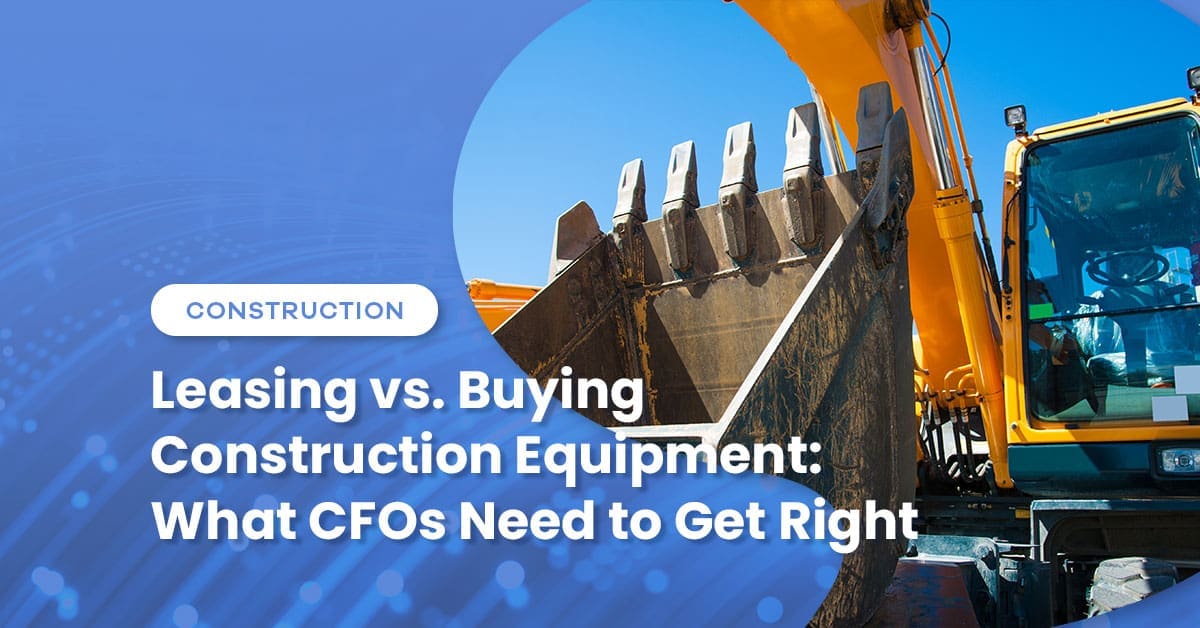
With 100% bonus depreciation restored and Section 179 expensing expanded, purchasing equipment can create substantial first-year deductions. At the same time, leasing remains a critical tool for managing cash flow and operational flexibility.
The question isn’t “Should we lease or buy?”
It’s: Which structure produces the best overall outcome for how this equipment will actually be used?
Where Buying Has the Advantage
When profitability is strong
If your company expects meaningful taxable income, buying equipment can be a powerful tax strategy.
A financed purchase may allow you to deduct most — or all — of the cost in year one through Section 179 and bonus depreciation, while also deducting interest expense (subject to limitations).
That creates a real cash benefit:
a capital investment that also reduces current-year tax liability.
When the equipment is core to your business
If you know the asset will be used consistently across projects for years, ownership is usually the better economic fit.
Leasing builds in a premium for flexibility. If you don’t need that flexibility, you’re paying for something you’re not using.
This is typically the case for:
- Excavators
- Loaders
- Paving equipment
- Other high-utilization assets
When you’re comfortable owning the asset long-term
Ownership means taking on residual value risk — but also capturing the upside.
For widely used equipment with stable resale markets, that risk is often manageable and aligned with how construction companies operate.
Where Leasing Still Makes Sense
When cash flow matters more than tax timing
Construction companies don’t operate in a vacuum — retainage, billing cycles, and project timing all affect liquidity.
Leasing can:
- Reduce upfront cash requirements
- Preserve borrowing capacity
- Provide predictable payment structures
Even if the tax benefit is less aggressive, cash preservation can be the more important outcome.
When demand is uncertain
If equipment needs are tied to a project that isn’t fully secured — or a backlog that could shift — leasing reduces the risk of owning underutilized assets.
It allows you to scale capacity without locking in long-term capital.
When flexibility has real value
In some cases, the ability to return, upgrade, or replace equipment matters more than owning it.
This comes up when:
- Entering a new service line
- Using specialized or niche equipment
- Dealing with evolving technology
Leasing transfers more of that risk to the lessor.
When accelerated deductions aren’t fully usable
Buying only creates value if you can actually use the deductions.
Limitations around taxable income, Section 179, or ownership structures can reduce the immediate benefit of accelerated depreciation.
In those cases, spreading deductions through lease payments may be more practical.
The State Tax Factor Most Companies Miss
One of the most common mistakes we see is modeling this decision based only on federal tax impact.
Many states — including New Jersey — do not fully conform to federal bonus depreciation. That means the large first-year federal deduction from a purchase may not translate at the state level.
The result:
Overstated tax savings if the analysis stops at federal.
The right approach models both federal and state outcomes together.
A Practical Way to Think About It
Before making a decision, pressure-test five things:
- Taxable income: Can you actually use accelerated deductions?
- Liquidity: Is preserving cash more important right now?
- Utilization: Will the equipment be used consistently over time?
- Risk: Are you comfortable owning and disposing of the asset?
- Capacity: Do you have room to finance — and deduct the interest?
The answer isn’t driven by one factor. It’s how they come together.
The Real Risk Isn’t Leasing or Buying — It’s Not Deciding Intentionally
The biggest issue we see isn’t choosing the “wrong” structure.
It’s making the decision too late.
Once equipment is acquired and placed in service, most of the tax outcome is already locked in. The opportunity to optimize — whether through structure, timing, or elections — is significantly reduced.
Bottom Line
In today’s environment, buying often delivers the strongest tax acceleration for profitable construction companies.
But leasing remains the right choice when cash flow, flexibility, or risk management take priority.
The companies that get this right aren’t always buying or always leasing.
They’re evaluating both — before the deal is done — and choosing the structure that fits their full financial picture.
 Previous

Share


Related Posts
Data Centers Are Raising Neighborhood Temperatures, New Research Shows
June 12, 2026
Calculated Industries Adds AI Assistant to CMPro App
June 12, 2026
World Cup 2026 NJ Construction Boom: What Contractors Need to Know
June 11, 2026
Construction Labor Shortage: Financial Impact and CFO Responses
May 29, 2026