
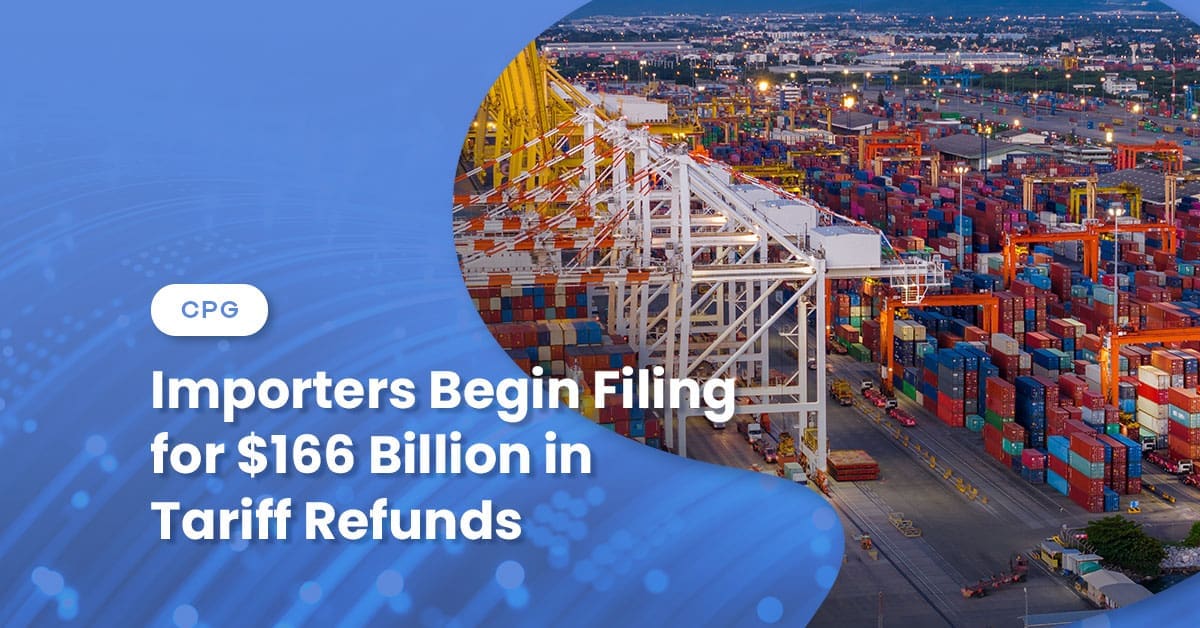


U.S. importers took their first steps this week toward recovering a combined $166 billion in duties collected under President Trump’s emergency tariffs, as U.S. Customs and Border Protection opened a new portal allowing companies to formally submit refund requests following the Supreme Court’s February ruling striking down the tariffs as unlawful.
The Court’s 6-3 decision in Learning Resources v. Trump found that Trump had exceeded his authority under the International Emergency Economic Powers Act (IEEPA) in imposing sweeping reciprocal tariffs on most imported goods. The ruling left open the question of how to return hundreds of billions of dollars already collected, and CBP has spent the intervening weeks building out the repayment mechanism, called the CAPE Declaration system, as an add-on to its existing Automated Commercial Environment (ACE) portal.
Early Reports Are Cautiously Positive
According to reporting by The Hill, the system launched Monday, with early users describing the experience as functional. Rick Woldenberg, CEO of Learning Resources, the toy company whose case gave rise to the Supreme Court ruling, said his company submitted more than $10 million in refund requests on the first day without significant problems.
“CBP did a good job and was conscientious and operated in good faith in developing the CAPE system,” Woldenberg told The Hill.
Eric Parnes, a partner at Blank Rome specializing in trade issues, said the process went smoothly for his first client. He cautioned, however, that wider usage would be the real test. “Whether that will be the case as everyone rushes to use the system, I think, is an open question,” Parnes said.
Not everyone has had a seamless experience. Some importers have reported account access issues and technical glitches, though CBP’s decision to build the refund functionality onto an existing system rather than constructing something entirely new has been cited as a stabilizing factor.
Scale of the Refund Process
The numbers involved are substantial. Roughly 330,000 importers are owed a share of the $166 billion in duties, plus interest. As of last week, more than 56,000 importers had signed up for electronic refunds through the system, representing approximately $127 billion of the total owed, according to CBP data cited by The Hill.
CBP has cautioned that the process is not instantaneous. The agency’s website indicates refund requests could take 60 to 90 days to process if they do not require additional review. Some cases will require more time. The system currently accepts requests only for goods that were liquidated within the last 80 days. Older entries, as well as those involving complicating factors such as antidumping duties, require a separate manual process.
Importers must first ensure they have an active account in the ACE portal and have submitted their bank account information before filing a CAPE Declaration. CBP has published guides and instructions, and the agency has warned that submissions using nonconforming document formats will not be validated.
Political Complications
The refund process is unfolding against a politically charged backdrop. President Trump, whose administration has publicly stated it will not contest the refunds in court, nonetheless publicly suggested this week that companies forgo the money. In an appearance on CNBC’s “Squawk Box,” Trump called it “brilliant” if companies chose not to seek refunds, adding, “If they don’t do that, I’ll remember them.”
The remarks drew attention but have not, so far, appeared to deter the filing activity already underway.
Adam Hanover, managing director of restructuring and dispute resolution at CohnReznick, told The Hill he had anticipated the Trump administration might invoke a geopolitical rationale to slow the process. “I was expecting it, actually,” Hanover said, adding that he thought the administration might argue that the timing of refunds conflicted with broader international concerns. That argument has not materialized, at least publicly.
What Importers Need to Do Now
For companies that have paid IEEPA tariffs and have not yet registered in the ACE portal, the immediate priority is to confirm system access and bank account enrollment before the filing queue grows. Given CBP’s warning that manual review significantly extends processing timelines, submitting accurate, conforming documentation at the outset is essential.
Companies with entries liquidated more than 80 days ago will need to work through the separate process that CBP has indicated is still being developed. Importers managing complex scenarios involving antidumping or countervailing duties should work with qualified customs counsel before filing.
It is also worth noting that these refunds cover only the IEEPA-based tariffs invalidated by the Court. Section 232 tariffs on steel and aluminum, Section 301 tariffs on Chinese goods, and other duties imposed under separate statutory authority remain in effect and are not part of the current refund process.
 Previous


Share


Related Posts
CPG Financial Reporting Automation: Reducing Month-End Close Time
June 26, 2026

Flavor Profitability Analysis for Food Companies: Rationalizing Your Portfolio
June 24, 2026

Pet Services Accounting: Why Subscription Revenue Models Fail
June 19, 2026

Fitness Bar Company Accounting: Co-Packing vs In-House Production
June 17, 2026