Construction Business Succession Planning: Your Exit Strategy Guide
March 3, 2026


Key Takeaways
- Start earlier than you think necessary: Most advisors recommend initiating succession planning 5–10 years before an anticipated exit — not 5–10 months.
- Tax structure determines net proceeds: The difference between an asset sale and a stock sale can result in a six- or seven-figure difference in after-tax proceeds. Structure is not a formality.
- Bonding capacity transfers — but not automatically: Surety relationships, work-in-progress schedules, and contractor licensing must be addressed explicitly in any transition plan.
- Valuation multiples in construction are earnings-dependent: EBITDA-based valuations range widely, with significant variance driven by backlog quality, customer concentration, and owner dependency.
- Bottom Line: A construction business succession plan is not a document. It is a coordinated, multi-year financial, legal, and operational strategy — and it requires advisors who know the difference between a retainage receivable and a revenue recognition adjustment.
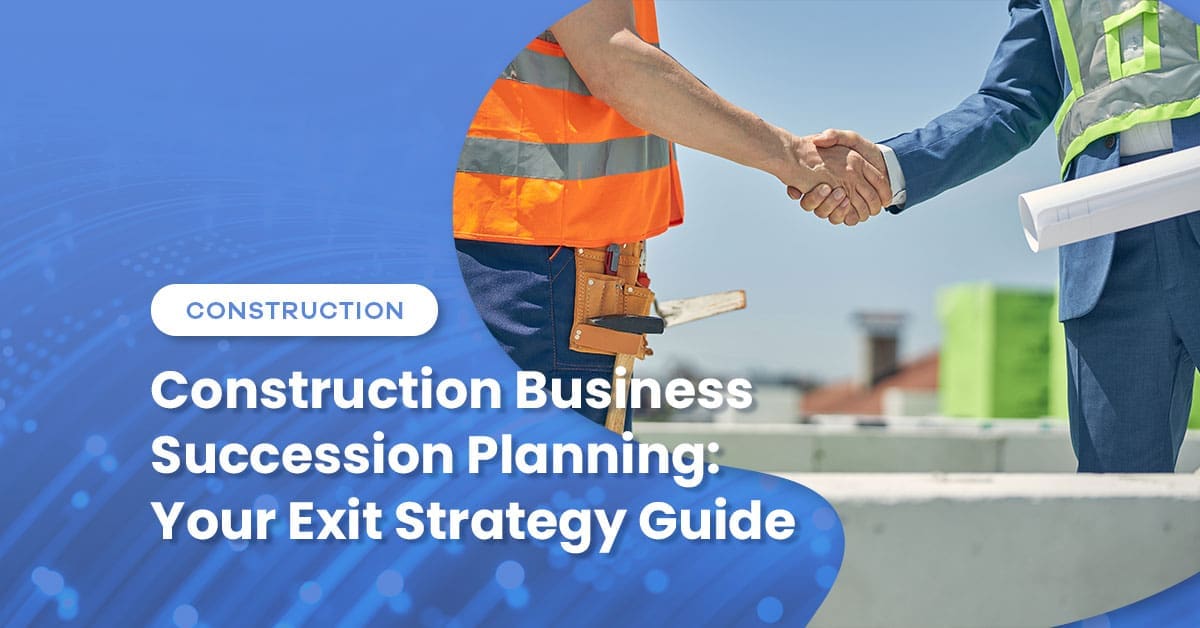
You built something real. Literally. Your name is on projects that changed skylines, subdivisions, and infrastructure across your region. The question isn’t whether that work has value — it’s whether you’ve done the financial and structural work to realize that value when you’re ready to step back.
Construction business succession planning is one of the highest-stakes financial decisions a contractor will ever make. Done well, it preserves generational wealth, protects your workforce, and transfers the business on your terms. Done poorly — or started too late — it can produce a fraction of the outcome your business actually earned.
Here’s what the exit process actually looks like, and where the critical decision points live.
Know What You’re Actually Selling
Before any conversation about price, structure, or timeline, you need an accurate picture of what your business is worth — and why.
Construction company valuations are driven primarily by adjusted EBITDA (earnings before interest, taxes, depreciation, and amortization). But in construction, normalized EBITDA requires careful adjustments: owner compensation above or below market rate, personal expenses run through the business, non-recurring project write-offs, equipment depreciation schedules that don’t reflect actual replacement costs, and rent normalization when real estate is leased from a related party.
Backlog is equally significant. A well-documented, contractually secured backlog — broken down by project type, margin profile, and stage of completion — is one of the most persuasive data points a buyer or successor evaluates. Unsupported backlog projections are not a substitute.
Customer concentration is a discount factor. If 40% or more of your revenue comes from a single client relationship, that creates transition risk—and buyers price it accordingly.
Choose Your Exit Path — and Understand the Tax Consequences of Each
There is no universal exit structure. Each path carries distinct tax treatment, operational implications, and financing requirements.
Internal succession (family or key employees) is common in construction, particularly in family-owned firms. It preserves culture and continuity, but it typically requires seller financing, an ESOP structure, or a combination of both — since internal buyers rarely arrive with the capital to fund a full purchase at fair market value. Estate and gift tax planning becomes critical when transferring ownership to the next generation, and the IRS treats below-market transfers with a level of scrutiny proportional to the value involved.
Third-party sale — to a strategic acquirer or private equity — typically yields the highest gross purchase price, but the net proceeds depend almost entirely on the transaction structure. Asset sales and stock sales produce materially different tax outcomes for the seller. This is not the place for approximation.
Recapitalization involves selling a partial interest, often to a PE firm, while retaining an equity stake and a management role. This allows the owner to take chips off the table while participating in a second liquidity event—a structure that has become increasingly common in the construction and specialty trades sectors.
Address the Issues Unique to Construction
Generic succession planning frameworks miss the issues specific to contractors. Three deserve direct attention.
Bonding capacity: Surety bonds are underwritten on the financial strength, experience, and continuity of the business and its principals. A change of ownership — or the departure of a qualifying individual — can trigger a reassessment or suspension of bonding lines. This must be coordinated with your surety broker well in advance of any transition.
Licensing and contractor registration: Contractor licenses in most states are not automatically transferable. Some are individual to the qualifier; others are tied to the entity. A transition plan that ignores licensing requirements can create a gap in legal authority to bid and perform work.
Work-in-progress schedules: Buyers and lenders evaluate WIP schedules to assess the accuracy of percentage-of-completion accounting. Consistent, well-documented WIP reporting — reconciled monthly, reviewed by your CPA — is a credibility signal. Inconsistent reporting is a red flag that suppresses valuation.
Build the Advisory Team Before You Need It
Succession planning in construction requires a coordinated team: a CPA with construction industry experience, a transaction attorney, an estate planning attorney, a financial planner, and, in most cases, a business valuator and a surety professional. These are not sequential engagements. The tax strategy, legal structure, bonding transition, and estate plan must be developed in parallel — because decisions made in one area have direct consequences in others.
At Wiss, we work with construction companies across all phases of their business lifecycle — including the one that matters most. Our construction practice encompasses tax advisory, transaction advisory, audit and assurance, and wealth management services, providing ownership teams with a single, coordinated advisory relationship rather than a collection of disconnected advisors working from incomplete information.
If you’re within five years of a planned exit — or if you’re not sure when you’ll want to exit but you know it won’t be forever — the right time to start is now. The exit you want doesn’t happen by accident. It happens because you planned it.
Contact the Wiss Construction Practice Team to begin the conversation.
 Previous


Share


Related Posts
Residential Construction Accounting: What Separates Builders Who Grow from Those Who React
March 31, 2026
Construction Equipment Financing: Options and Tax Strategies
March 30, 2026

Cash Flow Management for Construction Contractors
March 24, 2026
Employee Retention Strategies for Construction Companies
March 13, 2026