

Key Takeaways
- Donor-advised funds (DAFs) allow a same-year charitable deduction for cash contributions up to 60% of adjusted gross income (AGI), while deductions for contributions to private foundations are generally limited to 30% of AGI — a gap that has real dollar consequences for high-income donors in high-income years.
- Private foundations are subject to a 1.39% excise tax on net investment income under IRC §4940, along with mandatory annual distributions of at least 5% of net asset value, strict self-dealing rules under IRC §4941, and Form 990-PF filing requirements that are publicly available.
- The One Big Beautiful Bill Act (OBBBA, enacted July 4, 2025) introduced a new 0.5% AGI floor on itemized charitable deductions starting in 2026 — a provision that affects contributions to both vehicles and warrants review of existing giving strategies.
- Bottom line: DAFs win on simplicity and cost; private foundations win on control, visibility, and multi-generational infrastructure. The right answer depends on what you actually need your philanthropy to do.
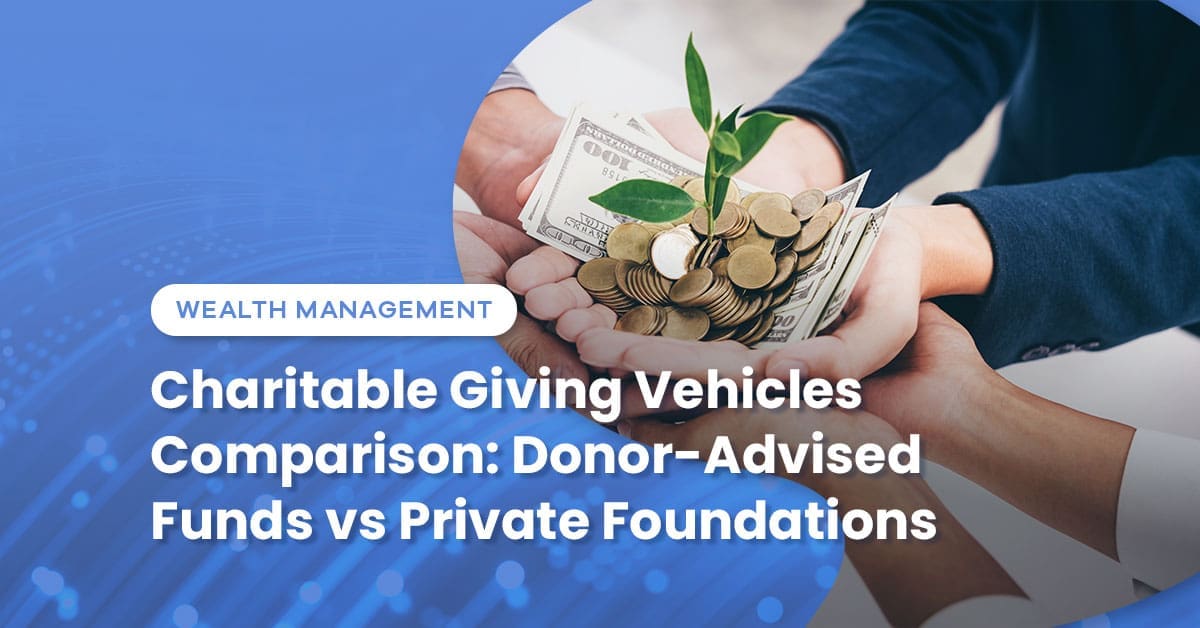
Most conversations about charitable giving vehicles start in the wrong place. They open with a list of features and end with a recommendation that ignores what the donor actually wants. The more useful starting point is this: a donor-advised fund and a private foundation are two structurally different tools that suit two structurally different donors. Choosing the wrong one does not mean you gave less generously. It means you gave less efficiently.
Here is how the tax treatment, compliance burden, and practical trade-offs actually align for high-net-worth individuals deciding among charitable giving vehicles.
How DAFs and Private Foundations Differ at the Tax Level
A donor-advised fund is a charitable account held within a sponsoring organization—typically a public charity affiliated with a financial institution or community foundation. The donor contributes assets, takes an immediate charitable deduction, and then recommends grants to qualifying organizations over time. The sponsoring organization retains legal control of the assets; the donor holds advisory privileges, not ownership.
A private foundation is an independent legal entity, typically organized as a corporation or trust, funded and controlled by the donor or donor family. It files its own tax return, maintains its own governance, and operates under its own set of legal obligations.
The deduction treatment reflects this structural difference. Cash contributions to a DAF qualify for a deduction up to 60% of AGI, with a five-year carryforward for any excess. Cash contributions to a private foundation are generally limited to 30% of AGI. For appreciated property, the limits are 30% of AGI for DAF contributions versus 20% for private foundation contributions. In a high-liquidity year — following a business sale, for instance — that gap in AGI limits is not theoretical. It can represent a substantial difference in the tax benefit actually realized in year one.
The OBBBA’s New 0.5% AGI Floor
Starting in 2026, the OBBBA introduced a new requirement that limits itemized charitable deductions to contributions exceeding 0.5% of AGI. For a donor with $2 million in AGI, the first $10,000 in charitable contributions no longer generates a deduction. This applies to contributions to both DAFs and private foundations and should be factored into any giving strategy that relies heavily on maximizing the deduction in a single year.
The Compliance Reality for Private Foundations
A private foundation comes with a compliance infrastructure that a DAF does not. The requirements are not burdensome for donors who plan for them, but they are real, ongoing, and non-negotiable.
Private foundations are required to distribute at least 5% of the fair market value of their non-charitable-use assets annually. They are subject to a 1.39% excise tax on net investment income under IRC §4940. Self-dealing transactions between the foundation and disqualified persons (including the donor, family members, and substantial contributors) are strictly prohibited under IRC §4941, with penalties for violations. And Form 990-PF filings, which disclose grants, compensation, and investment activity, are publicly available.
A DAF has none of these requirements. There are no mandatory distribution timelines, no excise tax on investment income, no self-dealing rules to monitor, and no public disclosure of individual grant activity.
For donors who want to give strategically over time without creating an administrative apparatus, the DAF is structurally more appropriate.
When a Private Foundation Actually Makes Sense
Control and legacy are the reasons donors choose private foundations over DAFs — and for the right donor, those reasons are compelling.
A private foundation allows the family to employ staff, make grants directly to international organizations (with additional compliance steps), fund operating programs, and engage the next generation in formal governance roles. A family foundation with paid staff and a defined grant-making strategy is a vehicle for institutional philanthropy. A DAF is not.
Private foundations also allow the donor to maintain a named, visible presence in the philanthropic community in a way that a DAF account does not. For donors building a public charitable identity — funding a university endowment, establishing a named scholarship program, or coordinating with other foundations on shared initiatives — the private foundation structure provides the necessary infrastructure.
The trade-off is cost and complexity. Annual legal, accounting, and administrative costs for a private foundation typically run from several thousand to tens of thousands of dollars per year, depending on size and activity level. DAFs, by contrast, typically charge a modest administrative fee assessed against the account balance with no additional compliance cost to the donor.
How the Two Vehicles Work Together
The choice between a DAF and a private foundation is not always exclusive. Donors with significant philanthropic intent sometimes use both: a private foundation for formal grant-making programs and family governance, and a DAF for efficient, flexible giving in high-income years where maximizing the deduction matters.
Appreciated stock or closely held business interests can be contributed to a DAF in a liquidity year to capture the higher AGI deduction limit, with the proceeds then available for grant recommendations over time. The private foundation handles the long-term institutional work. The two vehicles serve different functions in the same overall strategy.
Making the Right Decision for Your Situation
Selecting between charitable giving vehicles is ultimately a question about what you want philanthropy to accomplish in your financial plan and your family’s legacy. The tax rules are the starting point, not the destination.
Wiss works with high-net-worth individuals and families to evaluate charitable giving strategies within the full context of their estate plan, income tax position, and long-term wealth goals. If you are considering a DAF, a private foundation, or a combination of both, contact Wiss to speak with our team.
 Previous


Share