
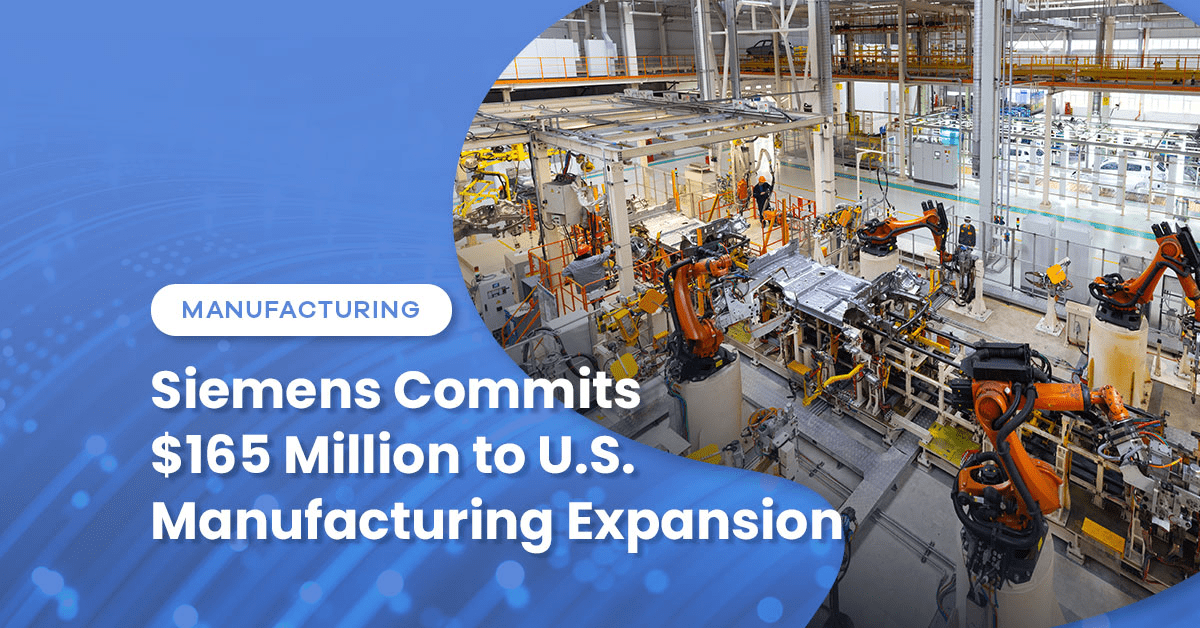



“The AI infrastructure buildout is driving real domestic production demand, and real financial complexity. Profitable scaling requires accurate forecasting, smart incentive strategy, and early advisory engagement.”
-Laura Zindel
The data center construction boom is not just a real estate story or a technology story. It is a manufacturing story. And Siemens’ announcement of more than $165 million in new U.S. manufacturing investment across North and South Carolina puts a dollar figure on exactly how large the supply-side response to AI infrastructure demand is becoming.
What Siemens Is Building and Why
Siemens is opening and expanding five facilities across North and South Carolina, collectively adding 350 new manufacturing jobs and significant production capacity for electrical infrastructure products.
In North Carolina, a new 131,000-square-foot facility in Raleigh will assemble integrated power delivery systems, adding 100 jobs by year-end. A new 101,000-square-foot site in Wendell will produce medium voltage protection and automation devices, adding 50 roles. Siemens’ existing Wendell headquarters will expand switchgear production, creating more than 200 additional jobs there by 2028.
In South Carolina, a new 120,000-square-foot facility in Spartanburg will house lighting panel production and distribution. The existing Roebuck facility adds 22,000 square feet, expanding busway production capacity along with new fabrication capabilities. The two South Carolina sites together add 150 manufacturing jobs to Spartanburg County.
The investment joins nearly $700 million Siemens has committed to U.S. manufacturing expansion over the past several years, including facilities in California and Texas.
The stated driver is demand. Ruth Gratzke, President of Siemens Smart Infrastructure U.S., described customer demand as being “at an all-time high” as data center and AI factory operators require upgrades to electrical infrastructure to handle increasing AI workloads.
The Capital Expenditure Wave Behind the Investment
Siemens’ announcement reflects a broader pattern playing out across the U.S. manufacturing sector. The AI infrastructure buildout requires enormous quantities of electrical equipment, from switchgear and busway systems to medium voltage protection devices and prefabricated power delivery solutions. Those products have to be manufactured somewhere, and the supply chain for specialized electrical infrastructure is under sustained pressure.
Earlier reporting cited projections that hyperscalers would spend roughly $450 billion on AI infrastructure in 2025, with estimates reaching $700 to $725 billion in 2026. That capital has to flow through physical infrastructure, and physical infrastructure requires electrical components produced at scale.
The result is a capital expenditure environment for manufacturers in the electrical and power infrastructure space that is unlike anything seen in recent years. Firms with production capacity aligned to data center requirements are carrying substantially more backlog than the broader manufacturing market. Those without that alignment are competing in a segment where demand trends are considerably more muted.
The Financial Planning Implications for Manufacturers
Large-scale capital investment announcements like Siemens’ carry specific financial planning dimensions that mid-market manufacturers evaluating their own capacity expansions should recognize.
Facility construction and expansion at this scale involves decisions about depreciation schedules, bonus depreciation eligibility, Section 179 treatment for qualifying equipment, and state and local tax incentive structures. Siemens’ facilities are described as all-electric and carbon-neutral, which may carry additional implications for federal and state clean energy incentive eligibility depending on the applicable tax years and program structures.
The jobs dimension is equally relevant. Adding 350 manufacturing roles across multiple facilities entails workforce incentive programs, employment tax credit opportunities, and payroll infrastructure decisions with meaningful bottom-line implications over a multi-year hiring ramp.
For mid-market manufacturers evaluating smaller-scale capacity expansions in response to the same demand environment, these considerations apply at proportionally smaller but no less consequential scale. A $5 million equipment investment and a new production line are not the same as building five facilities, but the financial planning questions are structurally identical: timing of depreciation benefits, state incentive qualification, cash flow modeling for the construction and ramp-up period, and cost accounting integration as new capacity comes online.
What This Means for U.S. Manufacturers Right Now
The Siemens investment is a leading indicator, not a lagging one. Companies committing hundreds of millions to U.S. manufacturing capacity have typically conducted demand analysis and are betting that the AI infrastructure buildout continues at pace. Manufacturers in adjacent supply chains, including electrical components, cooling systems, construction materials, and specialized fabrication, are operating in an environment where the demand signal is real and durable, at least in the near term.
The financial challenge for manufacturers in this environment is not finding demand. It is building the financial infrastructure to evaluate and execute capacity decisions quickly enough to capture them, manage the working capital implications of rapid growth, and avoid the cost accounting breakdowns that often accompany production scale-ups.
Wiss Manufacturing Advisory
Wiss works with mid-market manufacturers on the financial strategy behind growth decisions: capital expenditure analysis, cost accounting, cash flow forecasting, tax planning for equipment and facility investments, and outsourced or co-sourced CFO advisory. If your manufacturing company is evaluating capacity expansion or navigating the financial complexity of rapid growth in the current environment, our manufacturing practice is a practical next step.
Contact Laura Zindel or the Wiss manufacturing team.
AI Disclosure: This article was produced with AI writing assistance and reviewed by the Wiss editorial team. Original announcement published March 17, 2026 by Siemens Corporation.
 Previous


Share


Related Posts
Production Cost Accounting Best Practices for Manufacturers
July 21, 2026
Essential Manufacturing KPIs for Financial Performance
July 21, 2026
Manufacturing Capacity Utilization: Where Profitability Actually Lives
June 15, 2026
Production Scheduling Optimization: The Financial Impact Most Manufacturers Miss
June 15, 2026