
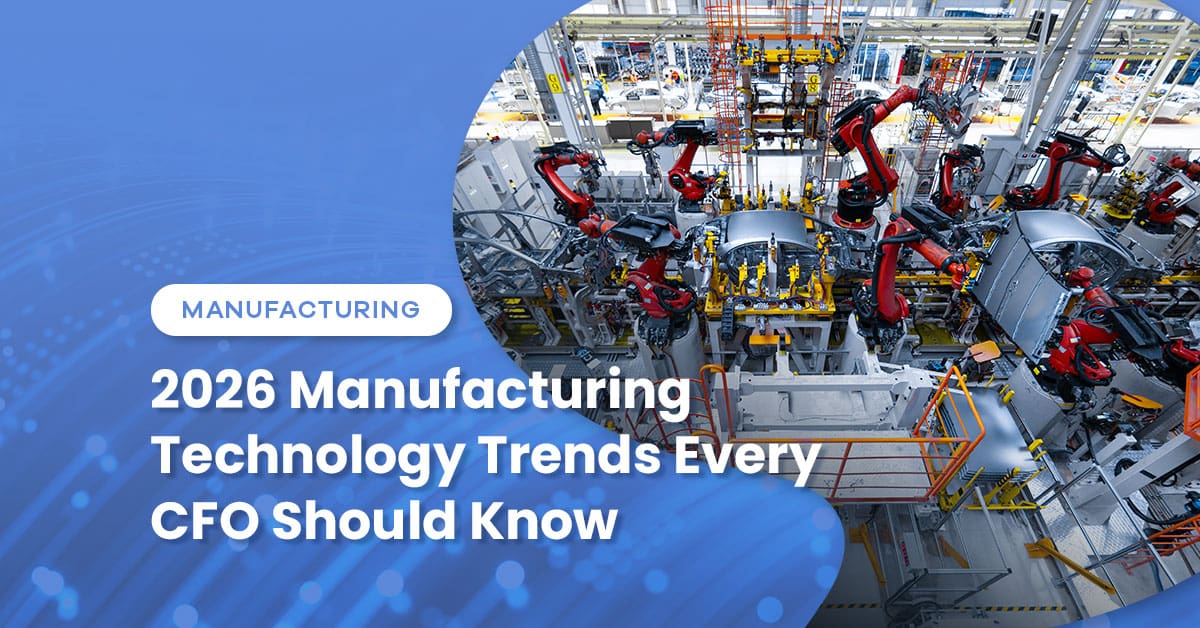
2026 Manufacturing Technology Trends Every CFO Should Know
April 10, 2026



Key Takeaways
- Five manufacturing technology shifts are materially affecting cost structures and capital allocation decisions in 2026: AI-driven financial operations, agentic automation on the shop floor, supply chain visibility platforms, tariff-driven reshoring investment, and real-time ERP integration.
- Manufacturers who have not yet connected operational technology systems to financial reporting are carrying a hidden reconciliation cost that compounds with every expansion and acquisition.
- The Section 174 R&E capitalization rules in effect since 2022 affect how manufacturers treat software and process automation development costs, making the accounting treatment of technology investments a CFO-level decision, not just an IT one.
- Bottom line: The technology decisions manufacturers make in 2026 will shape their financial structure for the next five years. CFOs who treat these as IT decisions are already behind.
Technology trends lists are usually written for IT directors. This one is written for CFOs because the five trends reshaping manufacturing in 2026 all carry direct financial implications for your cost structure, capital allocation, audit exposure, and competitive position over the next three to five years.
Some of these manufacturing technology trends are already in your building. The question is whether they’re being managed strategically or tolerated reactively.
AI Is Hitting the Shop Floor, and the Finance Team at the Same Time
Most coverage of AI in manufacturing focuses on production applications: computer vision for quality control, predictive maintenance, and autonomous material handling. Those are real and worth attention. But for CFOs, the more immediate story is what AI is doing to the finance function inside manufacturing companies.
AI-native accounting platforms are compressing monthly close cycles from weeks to days. Automated reconciliation between production data and financial records is eliminating a category of manual work that most manufacturing finance teams have simply accepted as fixed overhead.
The financial case is straightforward. A mid-sized manufacturer carrying three to five finance staff whose primary work is data entry, reconciliation, and report assembly can redeploy significant capacity toward analysis and forecasting once AI handles the mechanical work. That’s not a technology upgrade. That’s a structural change to the finance organization’s output.
What the Accounting Treatment Looks Like
Under ASC 350-40, software implementation costs may be capitalized during the application development stage, then amortized over the system’s useful life. CFOs implementing AI-powered financial operations tools need to track costs by project phase from day one, not retrofitting cost allocation after go-live. The accounting decisions made at implementation directly affect reported earnings and debt covenant ratios.
Supply Chain Visibility Has Become a Financial Reporting Issue
The supply chain disruptions of 2020 through 2023 prompted manufacturers to invest in real-time supply chain visibility platforms. In 2026, those investments are maturing, and the financial implications are clearer.
Manufacturers with integrated supply chain visibility can now model inventory carrying costs, supplier lead time variability, and landed cost impacts with much greater precision than those relying on ERP data alone. That precision matters for financial reporting because inventory valuation, cost-of-goods calculations, and working capital projections all depend on data quality that supply chain systems either provide or don’t.
The CFOs who invested in visibility platforms during the disruption years are now reporting faster close cycles and more accurate cost-of-goods reporting. Those who deferred the investment are still manually bridging the gap between operational and financial data.
Reshoring Is Creating a New Class of Capital Investment Decisions
Tariff policy in 2026 has accelerated reshoring activity that was already underway. For manufacturing CFOs, reshoring is not primarily a political or operational story. It is a capital allocation story with specific financial planning requirements.
New domestic manufacturing capacity carries a different depreciation profile, tax treatment, and financing structure than offshore production relationships. Bonus depreciation under the One Big Beautiful Bill Act and Section 179 deductions affect the timing of tax benefits from domestic equipment investment. Manufacturers evaluating reshoring scenarios need financial models that capture the full cost comparison: not just per-unit production costs, but also working capital impact, tariff exposure under each scenario, and the carrying costs of additional domestic inventory.
The manufacturers making the best reshoring decisions right now are running those comparisons with specific numbers. The ones making the worst decisions are running them with assumptions.
Modern ERP Is No Longer Optional Infrastructure
The manufacturing companies still running legacy ERP systems face a compounding problem in 2026. The gap between what modern ERP platforms can do and what older systems actually do has grown wide enough to affect competitive positioning in measurable ways.
Modern manufacturing ERP platforms provide real-time production costing, integrated financial reporting, and connection points for AI and analytics tools that legacy systems simply cannot support without expensive customization. More practically, manufacturers on modern ERP close their books faster, produce more accurate job cost reports, and catch margin erosion earlier than those on legacy systems.
The investment case for ERP modernization is increasingly a margin-defense argument, not a capability-expansion argument. The longer the delay, the wider the performance gap between your financial operations and those of competitors who have already made the transition.
The CFO’s Role in Technology Decisions Has Changed
Five years ago, most manufacturing CFOs owned the technology budget and approved the business case. The actual decisions about what to buy and how to implement it were delegated to IT and operations. That model is no longer adequate.
The technology decisions manufacturers are making in 2026 sit at the intersection of financial reporting, tax strategy, capital allocation, and operational performance in ways they didn’t before. Whether to capitalize or expense AI development costs, how to model the ROI of a reshoring investment, what financial reporting capabilities an ERP platform must support before it gets approved, whether a supply chain visibility platform changes your inventory accounting methodology — these are CFO-level questions, not IT-level questions.
The manufacturing CFOs adding the most value right now are the ones who have moved from approving technology spend to actively shaping technology strategy.
Where Trends Become Decisions
The five manufacturing technology trends that matter most in 2026 all require CFO engagement, not just CFO awareness. AI in financial operations changes your organizational structure. Supply chain visibility changes your reporting accuracy. Reshoring changes your capital structure. ERP modernization changes your competitive position. Expanding CFO involvement in technology strategy changes your firm’s ability to capture value from all four.
Wiss works with mid-market manufacturers to structure technology investment decisions, manage the accounting and tax implications of major system changes, and build the financial frameworks that turn technology trends into measurable operational outcomes. If your organization is weighing significant technology investment in 2026 and wants rigorous financial analysis alongside the strategy, contact Wiss to start the conversation.
 Previous

Share


Related Posts
Production Cost Accounting Best Practices for Manufacturers
July 21, 2026
Essential Manufacturing KPIs for Financial Performance
July 21, 2026
Manufacturing Capacity Utilization: Where Profitability Actually Lives
June 15, 2026
Production Scheduling Optimization: The Financial Impact Most Manufacturers Miss
June 15, 2026