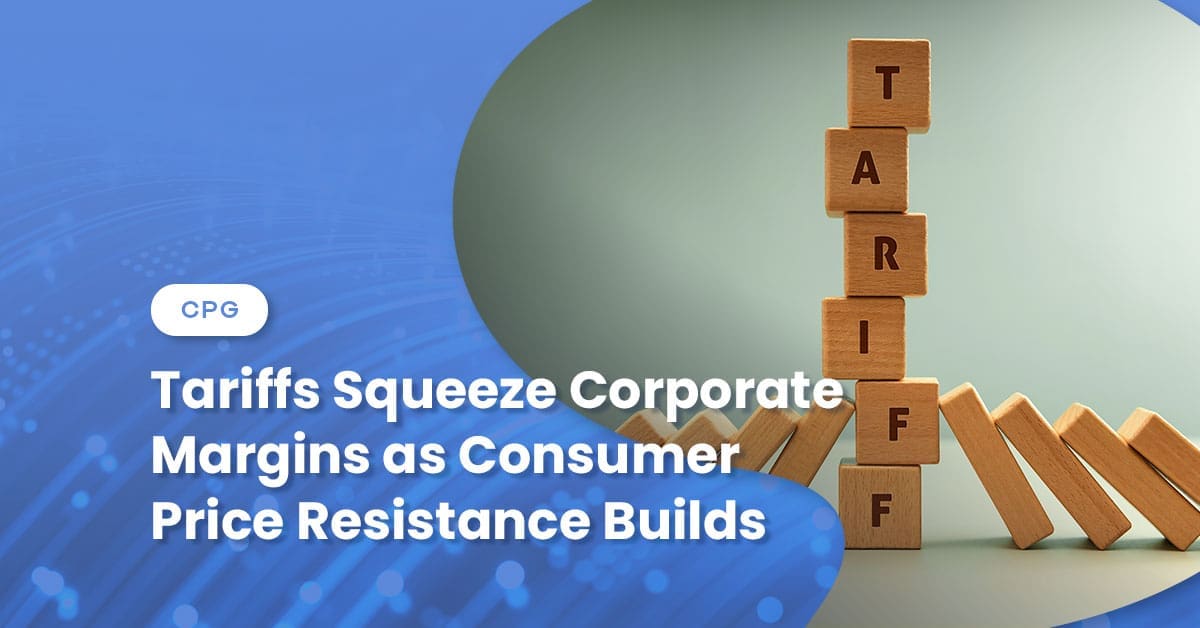
Tariffs Squeeze Corporate Margins as Consumer Price Resistance Builds
February 4, 2026


“Tariffs are exposing which companies truly understand their cost structure. The story we keep seeing — especially across CPG, food & beverage, and global supply chains — is that pricing power has limits. Once consumers push back, margins erode fast. With the U.S. already signaling selective tariff rollbacks, like the recent adjustments to India, CFOs can’t rely on static models or outdated assumptions. The winners are the companies treating tariff exposure like any other financial variable: modeling multiple scenarios, redesigning supply chains with tax efficiency in mind, and building disciplined pricing strategies that align with real consumer elasticity. Those that wait for clarity will feel the squeeze the longest.”
– Paul Lembo, Partner, CPG, Wiss
U.S. companies are publicly calling tariffs manageable, while earnings reports reveal margin compression and consumer pushback against price increases, according to Reuters analysis of early-earnings-season commentary. The gap between reassurance and reality suggests profit pressure will intensify as businesses exhaust strategies to absorb tariff costs without alienating price-sensitive customers.
The Margin Pressure Reality
Bellwether companies, including Procter & Gamble, Fastenal, and 3M, have flagged tariff-related challenges during earnings calls. Amazon CEO Andy Jassy told CNBC at the World Economic Forum in Davos that the company is seeing prices increase on its e-commerce platform as sellers exhaust inventories purchased before tariff implementation.
P&G raised U.S. prices by 2% to 2.5% to offset tariffs and weak sales, yet still reported a fifth consecutive quarterly margin decline. The consumer goods giant’s experience illustrates the fundamental tension: tariff costs require price increases, but consumers increasingly resist paying more.
McCormick & Company faced tariff-related costs exceeding expectations in the fourth quarter, compressing gross profit margins by approximately 130 basis points year over year. The spice maker noted that roughly 50% of incremental tariffs on its products remain in place, creating sustained inflationary pressure. CEO Brendan Foley acknowledged the company is raising prices to offset these costs, joining numerous companies attempting similar strategies.
Consumer Resistance Intensifies
While broader consumer spending has held up, buyers have become notably selective, particularly lower- and middle-income earners who are gravitating toward value offerings. Brian Jacobsen, chief economic strategist at Annex Wealth Management, noted that while some consumers are less price-sensitive than others, most remain upset about current price levels and won’t accept further increases without resistance.
Harvard University professors Alberto Cavallo, Paola Llamas, and Franco Vazquez tracked approximately 360,000 products across major online and brick-and-mortar retailers. Their research estimates that as of year-end, domestic goods cost about 4.3 percentage points more than expected under pre-tariff conditions, while imported goods are roughly 5.8 percentage points more expensive.
As of mid-November, the effective tariff rate on U.S. consumers, accounting for product substitution, reached 14.4%—the highest level in 85 years, according to Yale Budget Lab analysis. This represents a substantial cost burden that companies must either absorb through margin compression or pass through via price increases that risk demand destruction.
Strategic Adjustments and Limitations
Tractor Supply, which reports on Thursday, exemplifies the cautious approach many companies are taking. According to Telsey Advisory Group analysis, the gardening and farm equipment seller expects tariff-related price increases to materialize this year. However, executives indicated they would be “surgical” with price increases after observing value-focused buying behavior over the past year.
Levi Strauss warned in October that tariffs would reduce margins by 0.7%, up from its previous estimate of 0.5%. The apparel company has raised some prices while attempting to diversify its supply chain, but also cautioned about a softer consumer environment when reporting holiday-quarter results.
Industrial supplies distributor Fastenal reported that tariffs inflated prices and reduced demand. CFO Max Tunnicliff indicated the company would pursue additional pricing in 2026, but acknowledged that the strategy depends on input costs and customer behavior—variables outside the company’s control.
The pattern suggests companies are reaching the limits of their pricing power. Initial price increases may have been absorbed when consumers possessed pandemic-era savings or when inflation expectations were elevated. As those conditions normalize, additional price increases face stronger resistance.
The Legal Wildcard
The current tariff regime could be disrupted if the U.S. Supreme Court rules against President Trump’s use of the International Emergency Economic Powers Act (IEEPA) to implement existing tariffs in a February hearing. Such a ruling could potentially open the door to massive refunds for companies that paid duties under the emergency-powers regime.
However, that process could take years, and the White House plans to use alternative tariff authority to maintain import duties regardless of the Supreme Court’s decision. General Electric CEO Larry Culp noted that everyone has spent the last eight months working through how to navigate the new trade environment—suggesting companies are planning for sustained rather than temporary tariff conditions.
Earnings Week Implications
More than 100 S&P 500 companies report next week, according to LSEG data, including numerous businesses with substantial global footprints: General Motors, Caterpillar, Colgate-Palmolive, and Kimberly-Clark. Their results will provide a broader perspective on how different industries are managing tariff impacts and whether consumer resistance to price increases is industry-specific or economy-wide.
The shipping and logistics indicators offer early warning signals. Shipping containers loaded at the Port of Los Angeles reflect inventory strategies as companies balance bringing in goods before potential tariff increases against carrying costs of excess inventory if tariffs are reduced or eliminated.
CFO Planning Challenges
The tariff environment creates substantial financial planning complexity for CFOs. Unlike normal cost inflation, where trends are relatively predictable, tariff costs can shift rapidly based on policy decisions. Companies must decide whether to:
- Absorb costs through margin compression, protecting market share but reducing profitability
- Pass through costs via price increases, maintaining margins but risking volume declines
- Diversify supply chains to lower-tariff jurisdictions, requiring capital investment and operational disruption
- Front-run potential tariff changes through inventory purchases, consuming working capital and creating obsolescence risk
Each strategy involves trade-offs without a clear optimal solution, particularly given uncertainty about the duration and magnitude of tariffs. Companies that absorbed initial tariff costs expecting temporary conditions, now face questions about how long margins can remain compressed before impacting investment capacity or shareholder returns.
The earnings season commentary suggests most companies are pursuing hybrid approaches: some price increases, some margin compression, some supply chain adjustments. Whether that balanced strategy proves sustainable depends primarily on consumer spending resilience and competitive dynamics within industries.
For companies already facing margin pressure from labor costs, logistics expenses, and commodity inflation, tariffs represent an additional burden that arrives when pricing power may already be exhausted. The gap between public statements about manageability and actual earnings results suggests tariff impacts may be more severe than companies initially projected—or are willing to acknowledge publicly.
Trade Policy & Supply Chain Advisory
Tariff environments create complex financial planning challenges requiring scenario modeling, supply chain optimization, pricing strategy analysis, and working capital management. Wiss’s International Tax Advisory Services help companies navigate trade policy impacts, evaluate supply chain restructuring, model tariff cost scenarios, and optimize tax positions across global operations.
Whether you’re evaluating supply chain diversification, assessing tariff cost-absorption strategies, or modeling the financial impacts of policy scenarios, our team provides strategic advisory grounded in cross-border tax and operational expertise.
Contact Wiss Tax Advisory to discuss tariff impact planning and supply chain strategy.
Source: Reuters – “Tariffs linger over earnings, even as companies get used to them” by Juveria Tabassum, January 26, 2026
Editorial Note: This article provides general information about tariff impacts and corporate financial strategy. It does not constitute tax, legal, or investment advice. Companies navigating tariff environments should consult qualified tax, legal, and supply chain advisors regarding specific strategies and compliance requirements. Wiss & Company LLP provides accounting, tax, and advisory services to companies managing international operations and trade policy impacts.
 Previous


Share


Related Posts
Real-Time Data Dashboards for CPG: CFO Decision-Making Tools
April 6, 2026
Product Margin Optimization for Consumer Goods: Data-Driven Decisions
April 6, 2026
Pet Product Company Financial Services: Scaling Pet Care Businesses
April 6, 2026

Fitness Supplement Company Accounting: From Production to Profit
April 6, 2026