

Key Takeaways
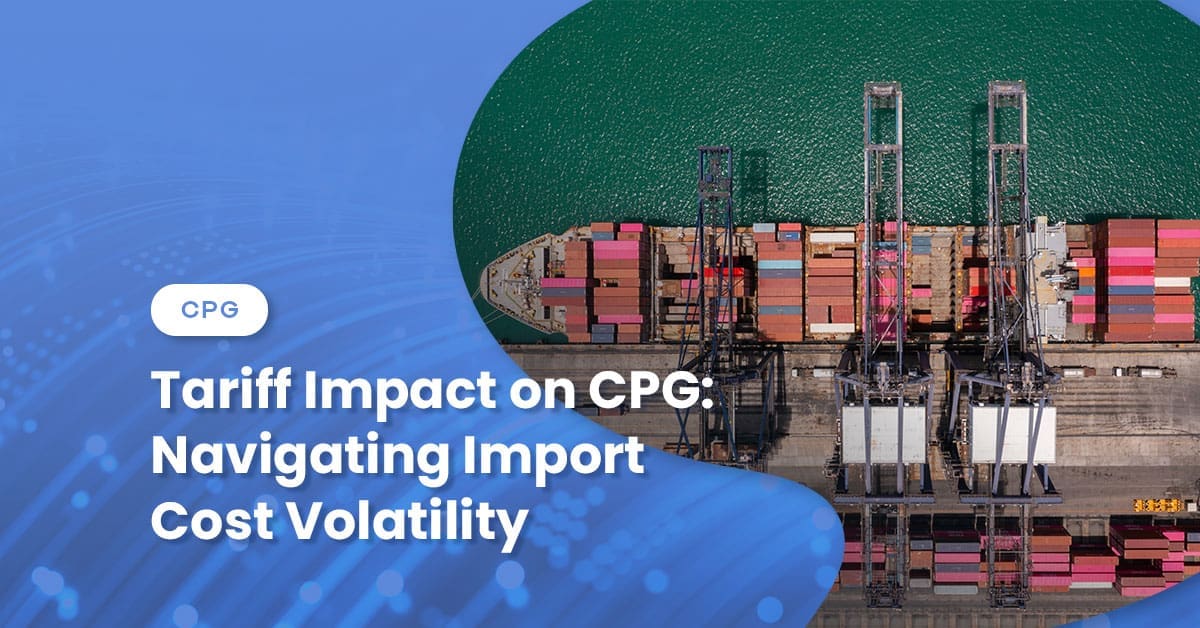
- 43% of CPG companies report 1-5% gross margin compression: April 2025 tariffs hit packaging metals, ingredients, and finished goods—creating margin pressure that spreadsheet adjustments can’t solve
- CPG companies are passing up to 50% of tariff costs to consumers, but price elasticity means every 5% increase triggers 8-12% volume declines in value-sensitive categories
- CPG firms are trapped by existing supplier contracts: Source diversification sounds strategic until you discover 18-month contract minimums lock you into tariff-exposed supply chains
The tariff environment introduced by the Trump administration in April 2025 isn’t a temporary disruption—it’s a structural shift forcing CPG companies to rethink cost models, pricing architecture, and supply chain strategy simultaneously.
Most CPG finance teams are treating tariffs as a procurement problem: call suppliers, negotiate pricing, raise consumer prices proportionally, and move on. That approach misses the strategic complexity. Tariffs don’t just increase costs—they create competitive asymmetry where companies with China-heavy sourcing face different economics than competitors using domestic or nearshore suppliers.
Why Tariff Impact Varies Dramatically Across Your Portfolio
The aggregate statistic “tariffs increased our costs 3%” obscures the reality that the impact varies 10x across your SKU portfolio based on sourcing footprint, ingredient composition, and packaging specifications.
The Portfolio Asymmetry Finance Teams Miss
Your canned goods face 15-20% cost increases from aluminum tariffs, while plastic-packaged products see 2-3% increases. When you raise prices uniformly across the portfolio, you’re making canned products uncompetitive while leaving margin on the table for plastic-packaged SKUs that could absorb minimal increases.
Center-store categories using imported ingredients—such as soybean oil, certain spices, and condiments—face direct tariff hits and secondary price umbrella effects when domestic suppliers raise prices to match import costs. Your tomato-based products might see an 8% increase in ingredient costs, while your grain-based products stay flat.
Finished goods importers face immediate increases in landed costs, while domestic manufacturers with domestic supply chains face no direct impact. If you’re competing against a domestic frozen-food manufacturer, tariffs just handed them a cost advantage they didn’t earn through operational excellence.
The CPG companies navigating this successfully aren’t modeling average cost increases—they’re building SKU-level tariff exposure maps showing which products face 20% cost shocks versus 2% nudges, then making strategic decisions about where to take pricing, where to absorb costs, and where to reformulate.
The Four Strategic Response Frameworks
KPMG and GEP research identify four distinct approaches CPG companies are taking to tariff pressures. Each represents different trade-offs between margin protection and market share preservation.
Approach 1: Reactive (Margin Absorption)
Companies protecting “magic price points”—the $1.99 bread loaf, the $5.99 QSR combo—accept near-term margin erosion to maintain volume. This works for categories with high price elasticity and immediate brand switching.
The financial reality: You’re betting that domestic suppliers won’t exploit price umbrella effects and that tariffs will moderate before margins become unsustainable. If domestic suppliers raise prices 8-10% matching import costs, your margin protection strategy fails, and you’ve sacrificed profitability without gaining volume advantage.
Finance should model the break-even timeline: At current tariff levels and assuming X% domestic price increases, how many quarters can we absorb costs before needing pricing action? If the answer is 2-3 quarters, you’re not building strategy—you’re hoping policy changes before economics force your hand.
Approach 2: Driven (Aggressive Cost Management)
Companies deploying war rooms, should-cost analysis, and teardown studies to offset tariff impacts through procurement excellence. This includes third-party buy-hold-sell models for volatile ingredients, AI-powered continuous cost monitoring, and rapid reformulation to substitute tariff-exposed ingredients.
The operational challenge: Speed matters more than precision. If it takes 6 months to reformulate products and secure new suppliers, you’ve absorbed half a year of tariff costs before solutions take effect. The CPG companies winning here have cross-functional teams with pre-approved authority to make sourcing and formulation changes without layers of approval.
Finance’s role becomes scenario modeling: If we reformulate Product A to reduce imported ingredient content by 40%, what’s the all-in cost, including R&D, production trials, packaging changes, and potential consumer acceptance risk? Is the 4% margin improvement worth the execution risk?
Approach 3: Proactive (Strategic Pricing)
Companies are raising prices to protect shareholder value while accepting temporary market share losses. This works for B2B-focused CPG, premium brands with low price sensitivity, and categories where all competitors face similar tariff exposure.
The risk: Asymmetric competitive impact. If your sourcing footprint is China-heavy and competitors source domestically or from nearshore markets, you’re raising prices into competitors who don’t need to—systematically ceding share. Your board presentation shows “We protected margins,” but omits “We gave competitors 8 points of share because our cost structure became uncompetitive.”
Finance should conduct a competitive cost structure analysis before implementing pricing strategies. Map competitor sourcing footprints, estimate their tariff exposure, and model likely competitive pricing responses. If you’re raising prices 6% and competitors only need 2%, that’s not a strategy—it’s surrender.
Approach 4: Strategic (Structural Transformation)
Companies using tariff pressure as a catalyst for long-term supply chain restructuring: nearshoring, vertical integration, design-to-value reformulation, and trade flow optimization. This approach protects long-term competitiveness but requires capital investment and 12-18 month execution timelines.
The financial requirement: You need balance sheet capacity to finance dual operations during transition (maintaining current suppliers while building new capabilities), working capital to front-load inventory during changeovers, and board patience to accept near-term margin pressure for structural improvements.
Finance’s critical role: Building business cases that quantify not just tariff savings but competitive positioning, supply chain resilience value, and geopolitical risk mitigation. The pitch isn’t “This saves 3% on COGS”—it’s “This makes us structurally competitive versus imports for the next decade.”
Where Wiss Helps CPG Companies Navigate Tariff Complexity
Wiss partners with CPG companies to build the scenario modeling, cash flow forecasting, and variance analysis capabilities that transform tariff management from crisis response to strategic advantage. Our FP&A advisory services help CFOs and business owners implement the analytical frameworks that drive better decisions under uncertainty.
Contact Wiss to discuss how FP&A advisory services can help your CPG company build the scenario modeling capabilities, SKU-level cost visibility, and strategic planning processes that turn tariff volatility into a competitive advantage.
 Previous


Share