
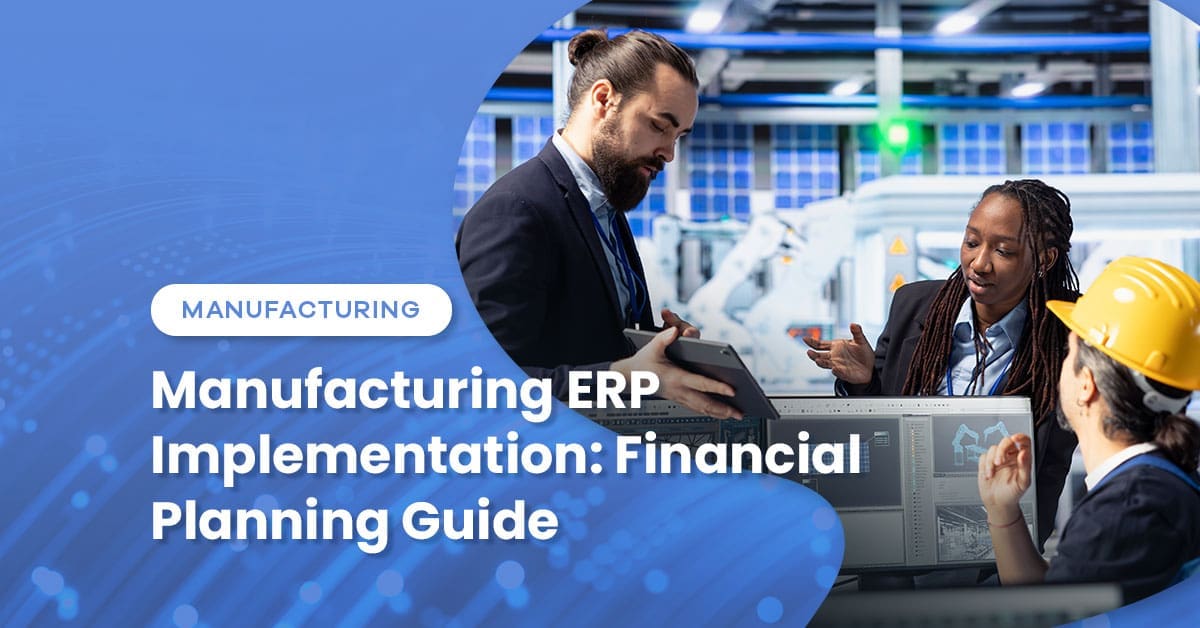
Manufacturing ERP Implementation: Financial Planning Guide
April 27, 2026



Key Takeaways
- A manufacturing ERP implementation carries financial planning requirements that generic implementations don’t — specifically around standard cost migration, inventory valuation method transitions, bill of materials integrity, and production order accounting — and these must be owned by the finance team, not delegated to IT.
- The total cost of a manufacturing ERP implementation typically runs well beyond software licensing once you account for data migration, customization, integration with production systems, and the internal finance team capacity consumed during the project.
- Inventory valuation is the highest-stakes financial decision in a manufacturing ERP transition: the method you carry forward (FIFO, weighted average, standard cost) must be explicitly chosen, documented, and signed off before configuration begins, not discovered as a gap during testing.
- Bottom line: A manufacturing ERP that isn’t built around accurate standard costs and production-integrated financial controls doesn’t replace your financial infrastructure. It adds complexity to it.
Most ERP implementation guides are written for companies that sell things. Manufacturing companies don’t just sell things; they make them, and that distinction creates a category of financial planning requirements that generic implementation roadmaps either gloss over or miss entirely.
When a manufacturer implements an ERP, the finance team isn’t just configuring a general ledger and an accounts payable module. They are rebuilding the cost accounting system, the inventory valuation methodology, and the financial controls around production, simultaneously, under time pressure, while operating a facility that cannot stop producing. The financial planning for that project deserves more rigor than it typically receives.
The Financial Scope Most Manufacturing ERP Budgets Underestimate
The total cost of ownership for a manufacturing ERP implementation has layers that are gradually discovered if they aren’t identified up front.
Software licensing is the number that appears in the initial proposal and tends to anchor the budget conversation. It is rarely the largest number in the final accounting.
Implementation and configuration services for a manufacturing environment are substantially more complex than for a service business or a pure distribution operation, because manufacturing ERP requires configuration of production-specific modules: bill of materials structures, routings, work center definitions, production orders, capacity planning, and shop floor data collection, in addition to the standard financial and procurement modules.
Manufacturers who budget implementation costs based on the licensing fee alone frequently discover mid-project that the scope of manufacturing-specific configuration work was not captured in the initial estimate.
Data migration for manufacturing carries a burden that non-manufacturing implementations don’t face. In addition to migrating customers, vendors, and the chart of accounts, a manufacturer must migrate or rebuild every bill of materials, every routing, every work center definition, and every item master record, with the standard cost for each item either carried forward or recalculated. A mid-sized manufacturer with several thousand active SKUs and multi-level bills of materials is looking at a data migration project of considerable scope.
Assigning named owners to each master data domain and requiring formal acceptance criteria before cutover is not an optional discipline. It is the mechanism that prevents costing errors from entering the new system on day one.
Integration costs are another area that is frequently underestimated. Manufacturing environments typically include production systems such as MES platforms, shop-floor data-collection terminals, quality management systems, and warehouse management systems that must exchange data with the ERP. Each integration requires scoping, development, testing, and validation.
The cost compounds quickly, and integrations that fail silently are among the most dangerous failure modes in a manufacturing ERP. Financial records that appear complete but are missing production transactions can go undetected for an entire period.
Internal capacity cost is real but rarely appears in the implementation budget. The production planner, the cost accountant, the controller, and the IT staff who contribute meaningfully to an ERP implementation are not fully available for their normal work during that contribution. For a mid-sized manufacturer, the internal capacity consumed by a twelve-month ERP project is a material cost even if it doesn’t appear on an invoice.
Standard Costing: The Financial Decision That Drives Everything Else
Standard cost accounting is the method most manufacturing ERP systems are designed around, and the decisions made about standard costs before the system goes live shape the accuracy of financial reporting, the usefulness of variance analysis, and the integrity of inventory valuation for years afterward.
A standard cost is a predetermined cost for each unit of production: what materials should cost, how much labor a unit should require, and how overhead should be absorbed at a given volume. In an ERP, standard costs are embedded in the item master for each manufactured SKU and flow through every production order, every inventory transaction, and every cost of goods calculation.
If the standard costs loaded into a new ERP are wrong — because they were carried forward from a legacy system without review, or because the bill of materials used to calculate them contained errors — the system will produce cost of goods figures and inventory valuations that are systematically off from the first day of operation. Variance analysis will generate noise rather than a signal. Product profitability reports will mislead rather than inform.
The right approach is to treat standard cost development as a parallel workstream to ERP configuration, not an activity that happens at the end. Before go-live, the standard cost for each manufactured SKU should be calculated from a validated bill of materials and a verified routing, reviewed by someone who understands both the manufacturing process and the cost accounting methodology, and formally accepted by the controller. That process takes time. Budgeting for it and scheduling it properly are financial planning decisions, not IT decisions.
Inventory Valuation Method: Commit Before You Configure
The choice of inventory valuation method, whether standard cost, FIFO, or weighted average cost, is a financial accounting decision with GAAP implications, tax implications, and operational reporting implications. In a manufacturing ERP implementation, this decision must be made, documented, and reflected in system configuration before testing begins. It cannot be revisited after go-live without triggering a change in accounting method that requires IRS notification under IRC Section 446 and consistency with GAAP under ASC 330.
If a manufacturer is transitioning from one method to another as part of the ERP implementation, the financial planning work includes calculating the cumulative adjustment required under the new method, assessing the tax impact of the change, and confirming with auditors that the transition is appropriately documented and disclosed. Controllers who treat this as a configuration question rather than an accounting decision sometimes discover its implications at year-end audit, which is a difficult time to be surprised.
Production-Integrated Financial Controls
The financial controls that matter most in a manufacturing ERP govern the interface between production activity and financial records. These differ from the controls in a service business or distribution environment and require deliberate design rather than default configuration.
Production order accounting determines how costs flow from raw material issuance through work in process (WIP) to finished goods. In a manufacturing ERP, production orders are the vehicle through which material costs, labor charges, and overhead absorption are accumulated and then relieved when production is completed. The controls around production order closing, WIP balance aging, and the treatment of scrap and yield losses are manufacturing-specific and need to be designed by someone who understands both the production process and the cost accounting implications.
Segregation of duties in the production environment presents challenges that don’t exist in financial modules. The people who issue materials from inventory, record production completions, and close production orders are often in operations, not finance. Designing access controls and approval workflows that enforce financial segregation of duties without creating operational friction requires an understanding of both the factory floor and the financial control framework.
Inventory count and reconciliation procedures need to be redesigned around the new ERP’s cycle-count functionality, rather than simply carried over from legacy procedures. The timing of physical inventory counts relative to production order status, the treatment of material in transit between work centers, and the reconciliation of perpetual records to physical counts are all areas where manufacturing-specific guidance from the finance team is essential during configuration.
The CFO’s Role Is to Own the Financial Architecture
The technology decisions in a manufacturing ERP implementation are largely reversible during the project. The financial architecture decisions are not. Standard costs, inventory valuation methods, cost center structures, production order accounting rules, and the chart of accounts design are the foundation on which all subsequent financial reporting is built.
Those decisions belong to the CFO and controller, not to the implementation partner, IT, or operations. The implementation partner brings knowledge of what the system can do. Finance must determine what to do based on the company’s accounting policies, reporting requirements, and control framework.
Wiss works with manufacturing CFOs and controllers through ERP selection, implementation planning, standard cost development, and post-launch financial optimization. If your organization is planning a manufacturing ERP implementation and wants finance leadership engaged at the architecture level from the start, contact Wiss to discuss how we can support the project.
 Previous

Share


Related Posts
Production Cost Accounting Best Practices for Manufacturers
July 21, 2026
Essential Manufacturing KPIs for Financial Performance
July 21, 2026
Manufacturing Capacity Utilization: Where Profitability Actually Lives
June 15, 2026
Production Scheduling Optimization: The Financial Impact Most Manufacturers Miss
June 15, 2026