Managing 1042-S Requirements: A Guide to International Contractor Compliance
January 26, 2026
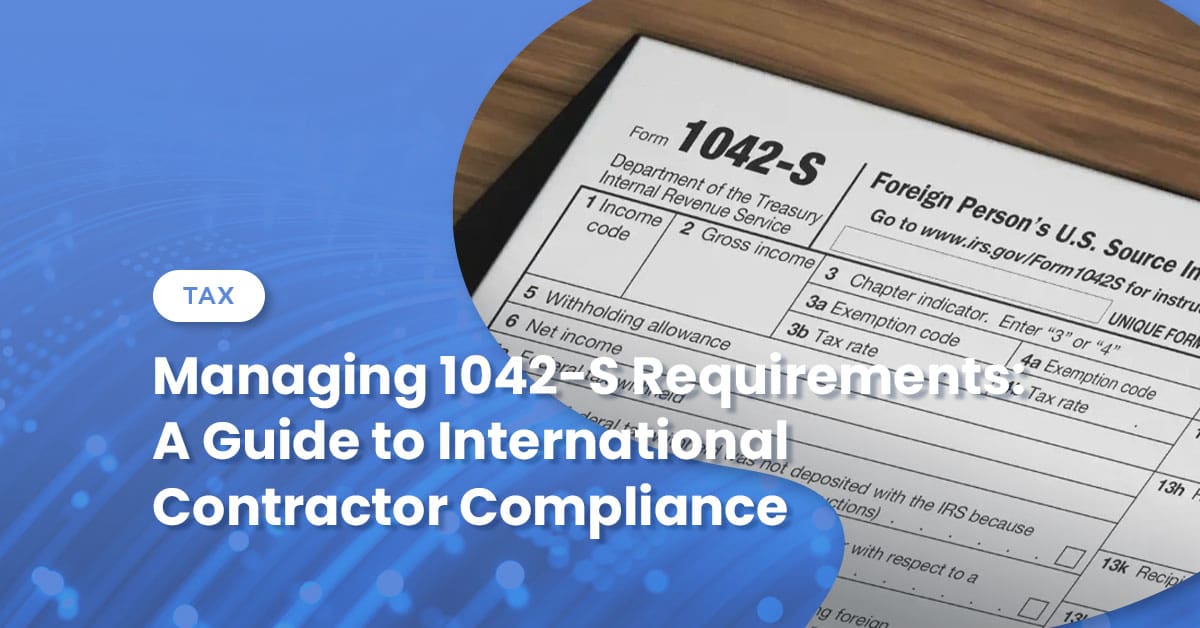


Construction firms increasingly rely on international contractors and specialized foreign talent. When you pay these workers, IRS Form 1042-S becomes your critical compliance document—and getting it wrong triggers penalties that compound across multiple filing years.
Key Takeaways
- Filing deadline: March 15, 2026 for 2025 payments—extensions are requested via Form 8809 (file by the original due date)
- Mandatory e-filing: Construction firms making 10+ information returns must file electronically; IRIS system required for 2026 forms due March 15, 2027
- Withholding rates: Many U.S.-source payments to foreign persons are subject to 30% withholding unless reduced/exempt (e.g., applicable tax treaty), depending on income type and documentation
- Penalty structure: Penalties are inflation-adjusted annually; for returns due in 2024, the ‘not filed/very late’ tier was up to $310 per return (higher for intentional disregard)
- Bottom Line: Proper documentation before payment protects your firm from liability—treaty benefits require advance submission of Form W-8BEN, not retroactive paperwork.
What Form 1042-S Actually Reports
Form 1042-S reports U.S.-source income paid to foreign persons—including the independent contractors, engineers, and specialized trades workers that many construction companies now engage globally. The form documents both the payment amount and any tax withheld under Chapter 3 (standard withholding) or Chapter 4 (FATCA provisions).
You must file 1042-S when the payment is U.S.-source income reportable to a foreign person and a treaty benefit or exemption is claimed. Many construction CFOs assume no withholding means no filing—this creates compliance gaps the IRS targets during audits. However, if services are performed outside the U.S., the payment is generally foreign-source and normally not reportable on Form 1042-S.
When Construction Firms Must File
Your company becomes a withholding agent when you have control, receipt, custody, disposal, or payment of amounts subject to withholding or reporting. This includes:
Compensation for services performed in the United States. A structural engineer from Canada working on your New Jersey project requires 1042-S reporting, even for short-term assignments. The critical factor: where the work was performed, not where the payment originated.
Fees paid to international specialty consultants. Geotechnical analysis, environmental assessments, or design work performed in the U.S. by foreign firms triggers reporting requirements. If the services are performed outside the U.S., the payment is generally foreign-source and normally not reportable on Form 1042-S, even if your U.S. firm makes the payment.
Rental payments on equipment or facilities. Leasing heavy machinery from foreign-owned companies creates reporting obligations that many construction firms overlook until audit time—when the equipment is used within U.S. projects.
The March 15 deadline applies universally. Construction projects often span multiple years with phased payments—you must file 1042-S annually based on the calendar year payments were made, not when contracts were signed or projects completed.
Common Construction Industry Scenarios
Subcontractors from treaty countries. Many nations have tax treaties with the U.S. reducing withholding rates below the standard 30%. Your firm can apply reduced rates if foreign contractors provide proper documentation (typically Form W-8BEN) before payment, but you still file 1042-S showing the reduced withholding amount.
Foreign-owned U.S. subsidiaries. Payments to domestic entities owned by foreign parents generally don’t require 1042-S filing—but confirming the entity’s U.S. tax status through Form W-9 protects you from presumption rules that default to 30% withholding.
Mixed-source income. Projects straddling borders create allocation challenges. When foreign contractors perform work both in the U.S. and abroad, only U.S.-source income (work performed in the U.S.) requires 1042-S reporting. Your accounting systems must track work location precisely, not just payment timing or contract origin.
Short-term assignments. Foreign workers present in the U.S. for brief periods may qualify for treaty exemptions under “dependent personal services” articles—but only with advance W-8BEN submission documenting treaty eligibility. Retroactive claims don’t protect you from withholding liability.
Electronic Filing Requirements Now Mandatory
The IRS announced that FIRE (Filing Information Returns Electronically) is expected to be retired on December 31, 2026, and the Information Returns Intake System (IRIS) must be used for e-filing 2026 Forms 1042-S due March 15, 2027. Construction firms must use IRIS for all 2026 1042-S submissions.
Financial institutions must e-file regardless of volume. Other construction firms exceeding 10 information returns annually face the same requirement. Paper filing invites processing delays and penalty assessments even when the information is accurate.
The transition creates compliance gaps. Firms that successfully used FIRE for 2025 forms due March 2026 must establish new IRIS accounts before the 2027 filing deadline. Test submissions and account setup should happen in Q4 2026, not February 2027.
Penalties for Non-Compliance
Penalties are inflation-adjusted annually. For returns due in 2024, the IRS assessed up to $310 per form in the ‘not filed or filed very late’ category, with higher amounts for intentional disregard. The penalty structure includes reduced amounts for corrections made within 30 days ($60 per form for 2024) or by August 1 ($120 per form for 2024).
More problematic: failure to withhold when required makes your company liable for the full tax amount plus interest and penalties. The IRS can assess trust fund recovery penalties against responsible individuals within your organization who willfully failed to collect or remit withholding.
Construction firms face particular scrutiny because international contractor relationships often lack the formal documentation structure that office-based industries maintain. Project-based hiring creates gaps that allow temporary workers to slip through compliance systems—particularly when field supervisors approve contractors without routing through finance for W-8BEN collection.
Documentation That Protects Your Firm
Form W-8BEN collection before the first payment. Treaty benefits require advance documentation. The “I’ll get the paperwork later” approach leaves you liable for 30% withholding you didn’t collect. Finance must block payment until W-8BEN is on file.
Service location tracking. Your project management system should capture where work was performed, not just contract value allocation. When contractors work across multiple job sites or perform preliminary design work abroad before U.S. installation, source determination requires detailed location records.
Treaty provision verification. Not all treaties provide the same exemptions. A contractor from India receives different treaty treatment than one from Canada. Your compliance system must cross-reference the treaty country, income type, and assignment duration to determine the correct withholding.
Annual W-8BEN refresh. Forms generally remain valid for three years from signing unless circumstances change. Build W-8BEN expiration tracking into your vendor management system—don’t discover expired forms during year-end 1042-S preparation.
How Wiss Tax Advisory Protects Construction Firms
Wiss structures international contractor compliance systems that integrate with your project management workflows. Our tax advisors review contractor documentation before payments are processed, confirming treaty eligibility, proper withholding rates, and service location sourcing while projects are active—not during year-end scrambles.
We design withholding procedures that protect your firm from liability while minimizing cash flow disruption to foreign contractors who depend on predictable payment schedules. Our team handles IRIS registration, test filing protocols, and deadline management so your finance team focuses on project execution, not IRS system navigation.
Ready to eliminate international contractor compliance risk? Contact Wiss Tax Advisory Services for a consultation on your construction firm’s specific international payment structures and filing obligations.
 Previous


Share


Related Posts

Working Capital Management for Construction Companies
February 13, 2026

Digital Transformation in Construction: What CFOs Actually Need to Know
February 9, 2026

Tax Tips for Construction Companies in 2026
January 26, 2026
Managing 1042-S Requirements: A Guide to International Contractor Compliance
January 26, 2026