
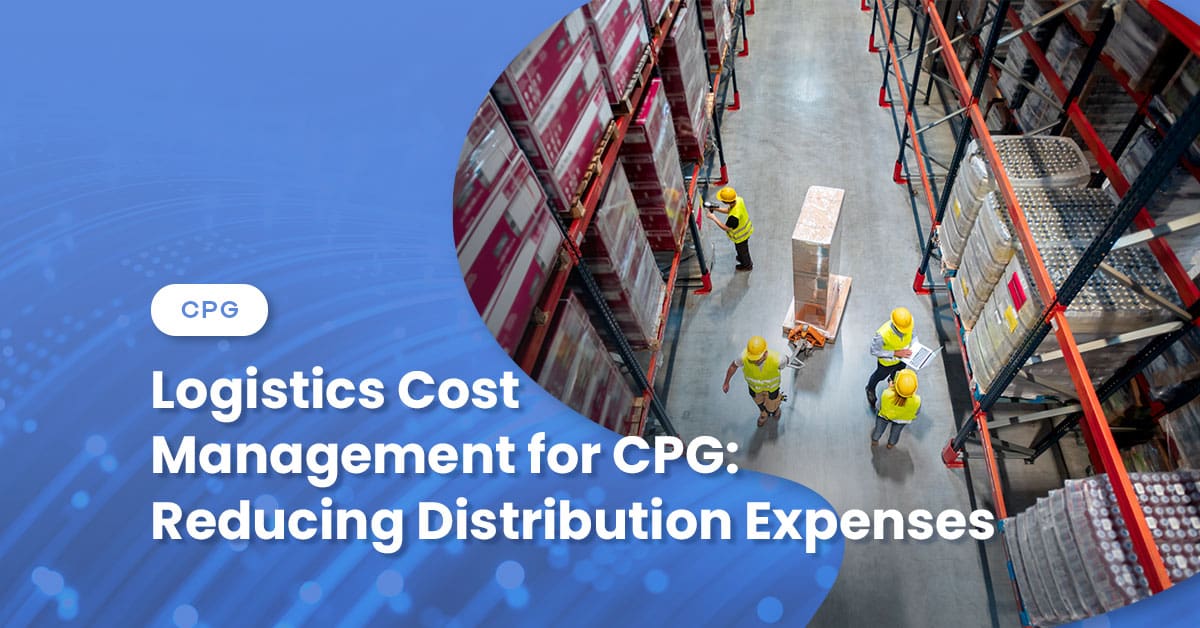
Logistics Cost Management for CPG: Reducing Distribution Expenses
March 4, 2026



Key Takeaways
- Freight is a margin line, not just an operational expense. CPG companies typically report freight costs at 8–9% of cost of sales — a figure with direct bottom-line impact. (Source: FreightWaves industry analysis of publicly reported CPG earnings)
- Transportation can swing profitability by up to 5 percentage points in either direction, according to Boston Consulting Group research on CPG supply chains.
- The pricing lever is largely exhausted. Price increases drove approximately 75% of CPG revenue growth in 2023 and 2024 (Bain & Company). With consumers shifting to private labels, cost structure is now the primary growth variable.
- Network redesign is no longer a differentiator — it’s table stakes.
- Bottom line: Logistics cost reduction is not a supply chain project. It’s a financial strategy. The CFOs who treat it that way tend to win.
Here’s something that gets glossed over in most supply chain conversations: freight isn’t a logistics problem. It’s a finance problem.
For CPG companies, distribution expenses sit somewhere between 8–9% of cost of sales — a number large enough to meaningfully move gross margin, yet small enough to escape the level of scrutiny it deserves. When business is growing and price increases are flowing through, logistics inefficiencies are absorbed. When neither of those conditions holds, the cost structure becomes impossible to ignore.
We are firmly in that second scenario.
Why This Moment Is Different
Bain & Company’s 2024 CPG research found that price increases drove roughly 75% of CPG revenue growth in 2023 and 2024. That’s not a growth story — that’s inflation dressed up as a business strategy. And consumers have noticed. Private label market share has expanded meaningfully across grocery categories as shoppers respond to shelf prices that rose approximately 30% since 2020.
The implication for CFOs is clear: the cushion that absorbed operational inefficiencies over the past several years is gone. What remains is the cost structure — and within it, logistics is one of the most consequential and improvable line items on the P&L.
BCG’s research on CPG transportation put a specific number on the stakes: freight can move the bottom line by up to 5 percentage points. That is not a rounding error. For a mid-market CPG company doing $50 million in revenue, a 2-point improvement in distribution cost efficiency translates into $1 million in operating income. Treated that way, logistics stops being a supply chain discussion and starts being a CFO priority.
The Four Levers Worth Pulling
There is no shortage of supply chain advice in the market. What CPG finance leaders actually need are the specific levers with documented impact, sequenced by effort-to-return ratio.
Carrier contract management. Most CPG companies negotiate freight contracts periodically and then leave them on autopilot. Carrier rates, accessorial charges, and fuel surcharge structures all shift, and contracts that were competitive two years ago frequently are not today. A structured annual review of carrier agreements — comparing contracted rates against current market benchmarks — consistently identifies savings without requiring operational changes. The savings are recoverable through renegotiation; they just require someone to initiate it.
Load optimization and freight consolidation. Less-than-truckload (LTL) shipments are, on a per-unit basis, materially more expensive than full truckload (FTL). For CPG companies with multiple SKUs shipping to overlapping retail customers, consolidating orders into full truckloads is one of the fastest ways to reduce freight spend per case. Bumble Bee Foods, for example, piloted a freight consolidation program that combined its products with three other companies shipping to the same retailer, achieving 2% savings on total freight costs with no service degradation. (Source: BCG CPG Transportation Report)
Distribution network design. This is the highest-effort, highest-return lever. Network design involves evaluating whether your current mix of distribution centers, regional warehouses, and carrier lanes is actually configured to serve your current customer base at minimum cost. Companies that reposition facilities on high-volume lanes and reduce the number of delivery stops per route consistently report meaningful freight savings. It is not a quick project, but it is durable.
Retailer compliance and chargeback reduction. This one is underrated. Retailer routing guides — the specific delivery and labeling requirements imposed by major retail customers — generate chargebacks when violated. Those chargebacks are distribution costs hiding in the revenue line. A disciplined compliance function that actively monitors routing guide requirements and validates outbound shipments reduces chargebacks without changing freight rates. For CPG companies doing significant volume through mass retail, the financial impact is not trivial.
Where Finance Should Be Sitting in This Conversation
The most common structural problem in CPG logistics cost management is that finance shows up too late. Carrier contracts are negotiated, network decisions are made, and fulfillment partnerships are established — and then the invoices land in accounts payable. By that point, the cost is already committed.
CFOs and controllers who reduce distribution expenses most effectively are the ones who participate in the decision upstream: reviewing carrier agreements before renewal, stress-testing network design proposals against actual freight data, and building logistics KPIs into the monthly financial close. Freight cost per case, cost per shipment by lane, and chargeback rate as a percentage of gross revenue are the metrics that connect supply chain activity to financial outcomes.
The data, frankly, is not complicated. Most CPG companies already have it. The gap is usually in who is looking at it and how often.
The Takeaway
Logistics cost management for CPG is not a technical challenge. The strategies are known, the levers are documented, and the data is generally available. What it requires is a finance function that treats distribution expenses with the same rigor it applies to raw materials, labor, and overhead.
The CPG companies navigating margin pressure most effectively right now are not doing anything exotic. They are running disciplined carrier reviews, optimizing load configurations, rationalizing their distribution networks, and keeping chargebacks in check. None of that requires a transformation program. It requires someone in finance to own the number.
If your logistics cost structure hasn’t been formally reviewed in the last 12 months, that’s the starting point. The savings are in there. Reach out to learn how we can help you gain clarity.
The Wiss CPG advisory team works with mid-market consumer brands on financial operations, cost structure analysis, and advisory services. Reach out to learn more about how we support CFOs and controllers in the CPG space.
 Previous


Share


Related Posts
CPG Financial Reporting Automation: Reducing Month-End Close Time
June 26, 2026
Flavor Profitability Analysis for Food Companies: Rationalizing Your Portfolio
June 24, 2026
Pet Services Accounting: Why Subscription Revenue Models Fail
June 19, 2026
Fitness Bar Company Accounting: Co-Packing vs In-House Production
June 17, 2026