

Key Takeaways
- The Supreme Court ruled 6-3 that IEEPA does not authorize the president to impose tariffs, invalidating tariffs on goods from China, Canada, Mexico, and others.
- IEEPA tariffs were terminated effective February 24, 2026 — but a new global 10% tariff under Section 122 took effect the same day.
- Refunds for previously paid IEEPA tariffs — estimated at approximately $170 billion — are possible, but the process remains legally unresolved.
- Sections 232 and 301 tariffs covering roughly 30% of all U.S. imports are unaffected and remain in force.
- Bottom Line: Trade policy uncertainty has not ended — it has shifted. Businesses should document their IEEPA tariff payments now and build flexible scenario plans for what comes next.
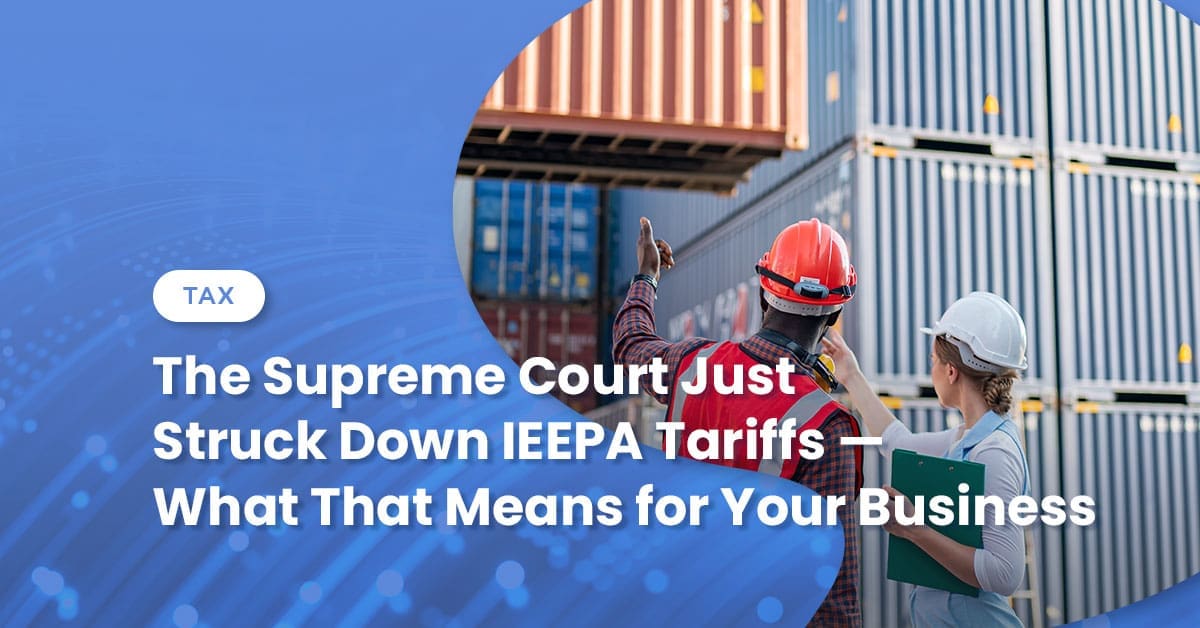
In a landmark 6-3 decision authored by Chief Justice John Roberts, the U.S. Supreme Court ruled that the International Emergency Economic Powers Act (IEEPA) does not grant the president the authority to impose tariffs. The ruling invalidated tariffs that had been levied on imports from China, Canada, Mexico, Brazil, and several other countries — including the broad global reciprocal tariffs that had disrupted supply chains across nearly every industry.
For business owners, CFOs, and finance leaders who have been navigating tariff volatility over the past year, this is a significant development. But it does not mean the trade environment has cleared.
What the Court Actually Decided
The majority opinion held that the Constitution reserves taxing authority — including the power to set tariffs — to Congress. Past delegations of tariff power to the executive branch have always been explicit and subject to defined limits. The Court found that IEEPA’s broad language granting authority to “regulate importation” falls short of that standard.
What the Court did not decide is equally important: the justices declined to address whether importers are entitled to refunds for tariffs already paid under IEEPA. That question has been remanded to lower courts, with estimated refund exposure in the range of $170 billion. As Justice Kavanaugh noted in his dissent, the refund process is expected to be administratively complex.
What Changed on February 24 — and What Didn’t
The administration moved quickly following the ruling. A new Executive Order terminated IEEPA tariff collection effective February 24, 2026. However, on the same date, President Trump invoked Section 122 to impose a global 10% tariff on nearly all U.S. imports, with a social media post signaling an intent to raise that rate to 15%. That Section 122 tariff expires on July 24, 2026 — a window the administration appears to be using to establish alternative tariff authorities.
Critically, tariffs enacted under Sections 232 and 301 — covering steel and aluminum, auto parts, lumber, copper, semiconductors, and a range of other categories — were not touched by the ruling and remain in full effect. New expedited Section 301 investigations are expected to be launched against most major trading partners in the coming months.
The Refund Question: What Businesses Should Do Now
The possibility of recovering previously paid IEEPA tariffs is real, but early action matters. Before courts or customs agencies establish formal refund procedures, companies should take the following steps:
Document everything. Gather your entry data, payment records, and Harmonized Tariff Schedule (HTS) classification details tied to IEEPA-covered imports. You will need this documentation to support any refund claim.
Confirm your ACE access. CBP has signaled that electronic refund processes through the Automated Commercial Environment (ACE) portal will be the required mechanism. Ensure your company — or your customs broker — has active ACE access and that your importer of record information is up to date.
Identify indirect payment situations. If your company received goods through a vendor or carrier that acted as the importer of record and passed tariff costs along to you, you will need to coordinate with that intermediary. The path to recovery may be more complicated in those situations.
Quantify your exposure. Work with your tax and trade advisors to calculate the total IEEPA tariffs paid by the legal entity and HTS line. Understanding your refund potential — and its materiality — will help you prioritize next steps as the legal process develops.
The Bigger Picture: Trade Uncertainty Continues
The Supreme Court’s decision does not signal a return to pre-2025 trade norms. The administration has made clear it will pursue its trade agenda through other statutory authorities, and businesses should plan accordingly.
Section 232 investigations are ongoing across pharmaceuticals, drones, robotics, medical equipment, wind turbines, and polysilicon — with presidential action expected on several of these before mid-year. New Section 301 investigations against major trading partners will add another layer of tariff risk over a longer time horizon.
Data shows that companies with scenario-based financial models and flexible supply chains are better positioned to absorb these shifts. CFOs and finance leaders should be pressure-testing pricing models, vendor contracts, and sourcing strategies against multiple tariff outcomes — not just the current rates.
Financial Reporting Considerations
From an accounting standpoint, the Supreme Court ruling constitutes a change in law that should be recognized in the period it occurs. For entities whose balance sheet date preceded the ruling, this is treated as a Type II subsequent event requiring disclosure but not recognition. Companies should assess disclosure needs in their financial statements and any regulatory filings, including MD&A sections. Recording refund receivables will require additional guidance from courts and customs agencies before amounts can be reliably measured.
How Wiss Can Help
Wiss’s Tax Advisory team works directly with business owners, CFOs, and finance leaders to navigate complex regulatory changes like this one. Whether you need help assessing your IEEPA tariff exposure, developing documentation to preserve refund rights, or building scenario plans for alternative tariff regimes under Sections 122, 232, or 301, our advisors are ready to help you move from reaction to readiness.
Note: Trade policy developments are evolving rapidly. This article reflects information available as of February 26, 2026. Businesses should consult with qualified tax and trade counsel regarding their specific circumstances.
Contact Wiss today to discuss your tariff exposure and next steps.
 Previous


Share


Related Posts
Manufacturing ERP Software: Selection and Implementation Guide
March 27, 2026

ERP Consulting: How to Choose the Right Implementation Partner
March 26, 2026

QBI Deduction for Real Estate Professionals: Maximizing Section 199A Benefits
March 26, 2026

The Evolution of Accounting Technology: Where We Are in 2026
March 26, 2026