
Coworking Growth Drives First Office Vacancy Decline Since Pandemic
February 20, 2026
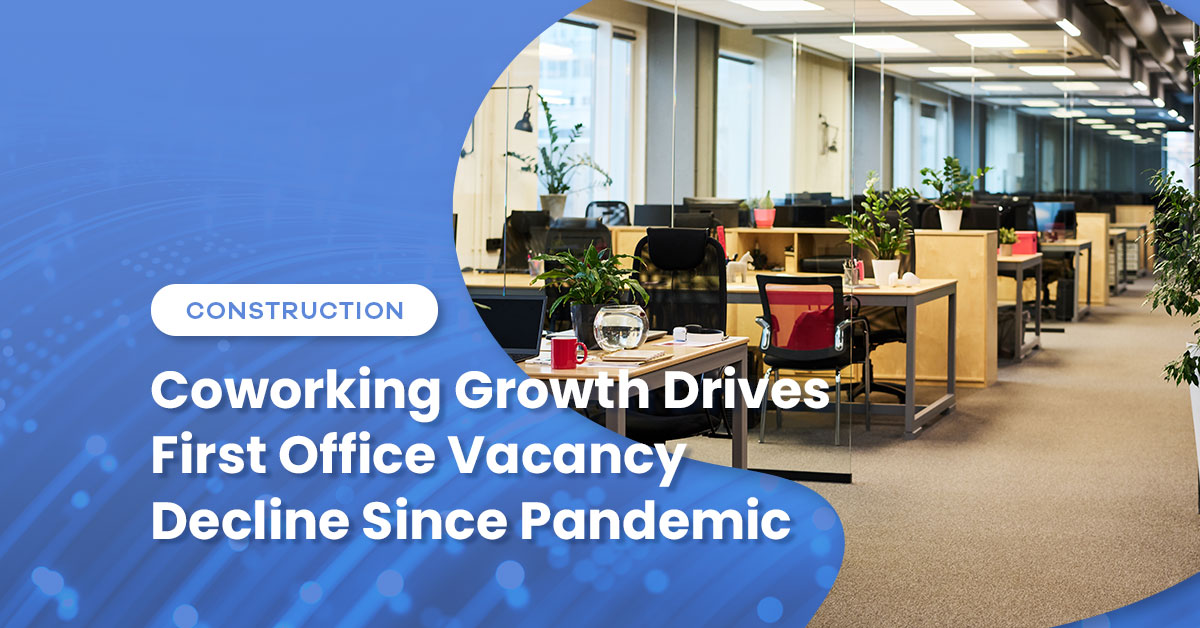


National office vacancy dropped to 18.4% in December 2025, marking a 140-basis-point improvement year-over-year and the first sustained decline since vacancy rates peaked in March 2025. The shift signals potential stabilization in a sector that’s been hemorrhaging tenants since 2020, though pre-pandemic occupancy levels remain a distant prospect.
The Coworking Factor
More than 1,000 coworking locations opened in 2025, pushing the sector’s share of the total office market to 2.2%. That growth isn’t coincidental to vacancy improvement—it’s directly connected. Coworking provides a landing zone for companies unwilling to commit to traditional long-term leases but also not planning fully remote operations.
For landlords facing extended vacancies in buildings that no longer align with tenant preferences, coworking operators offer a path forward. Rather than waiting for a single tenant to lease 50,000 square feet, partnering with coworking operators fills space with multiple smaller users while maintaining flexibility.
“Increases in investment activity and occupier demand, coupled with a leveling off or reduction of total office space, have led to more office optimism than we have seen since 2020,” noted Peter Kolaczynski, Director at Yardi Research. “Significant challenges remain in the form of physical occupancy, but we’re expecting improvement in more locales than just New York City.”
Manhattan’s 300-Basis-Point Drop
Manhattan led the recovery, with vacancy falling to 13.6%—the lowest among major U.S. markets and a 300-basis-point year-over-year improvement. The market peaked above 17% vacancy in 2023, making the current decline particularly notable.
Manhattan office transactions totaled $7.75 billion in 2025, exceeding all other markets by substantial margins. Average sale prices hit $498 per square foot—more than double the national average of $192. Asking rents averaged $68.36 per square foot, down just 0.1% year-over-year, suggesting pricing has stabilized even as vacancy improved.
The market maintains 2.34 million square feet under construction, reflecting continued institutional confidence in premium office development despite the permanence of hybrid work. Projects moving forward target “jewel-box properties”—smaller, amenity-rich buildings rather than large conventional towers.
Regional Performance Splits
Of 25 major markets analyzed, 17 saw vacancy decreases in 2025. San Francisco dropped 370 basis points to 25.2% vacancy, while the Bay Area fell 320 basis points to 23.2%. Both markets still face elevated vacancy but show improvement trajectories.
West Coast markets generally maintained vacancy rates above 21%, except in Los Angeles (14.9%) and Phoenix (17%). Seattle hit 27.2% vacancy—the highest in the region—while Denver sat at 23.5%.
Southern markets showed mixed results. Miami and Tampa both achieved 13.9% vacancy, among the tightest nationally. Austin struggled at 27.3% vacancy despite strong asking rents of $45.93 per square foot. Dallas improved 290 basis points to 21.1% vacancy.
Midwestern markets remained most affordable. Detroit averaged $21.46 per square foot asking rents with 23.3% vacancy. Twin Cities achieved 18% vacancy—the only Midwestern market below the national average. Chicago averaged 18.6% vacancy with asking rents of $28.31 per square foot.
Transaction Volume and Pricing
Annual office sales nationwide exceeded $53 billion, averaging $192 per square foot. While below historical peaks, pricing has slowly climbed toward Q2 2020 levels, suggesting valuation stabilization.
The Bay Area posted 119 transactions totaling $4.7 billion—the highest sales activity since 2021. Average prices hit $392 per square foot, marking a 35% year-over-year increase and the first year-over-year price increase in four years for Bay Area office space.
Washington D.C., recorded $3.77 billion in sales at $172 per square foot. Dallas followed with $3.04 billion at $312 per square foot—second only to Miami’s $360 per square foot average.
Chicago, Portland, and Philadelphia were the only major markets averaging below $100 per square foot in closed sales. Chicago’s $65 per-square-foot price represented roughly one-third of the national average, reflecting continued distress in secondary Midwestern markets.
Construction Pipeline Contraction
Just 31 million square feet of office space was under construction nationally—representing 0.4% of stock and marking a 44% year-over-year decline from 55 million square feet. Construction starts leveled at 13.2 million square feet in 2025, roughly matching 2024’s 13.5 million.
Boston led construction with 4.44 million square feet under development. Combined with Manhattan’s 2.34 million, these two Northeast markets accounted for 22% of the national pipeline. Dallas (2.27 million) and Los Angeles (2.02 million) were the only other markets with more than 2 million square feet under construction.
The contraction reflects funding challenges as corporations embrace hybrid work and demand concentrates in higher-quality assets. Large conventional office buildings without significant amenity investments increasingly struggle to compete.
Employment Trends Matter
Office-using employment (information, financial activities, professional and business services) gained just 42,000 jobs nationally in 2025—a 0.1% increase. December alone saw job losses of 35,000, led by the professional services and information sectors. Financial activities added 6,000 jobs.
Charlotte led office employment growth at 3.3% in September 2025, driven by low cost of living and business-friendly environment, including plans to eliminate corporate taxes entirely by 2030. The growth substantially outpaced other major metros.
The disconnect between modest employment growth and space demand reflects productivity gains, the adoption of remote work, and reductions in space per employee. Companies maintaining or growing headcount while shedding office space represent structural change, not temporary adjustment.
What Vacancy Improvement Actually Means
A decline in vacancies from peak levels doesn’t necessarily indicate an occupancy recovery. The metric measures available space, not physical utilization. Many buildings showing improved vacancy statistics still have significantly lower daily occupancy than before 2020.
Companies are consolidating into smaller, higher-quality spaces rather than expanding footprints. Sublease space availability has moderated as tenants right-size, but direct leasing often involves downsizing from previous commitments.
The shift toward coworking represents adaptation rather than reversal. Flexible space addresses current market reality: companies want access to office amenities without long-term financial commitments, and landlords need occupancy without waiting for traditional tenant demand that may never return to previous levels.
The 2026 Question
Whether the vacancy rate continues to improve depends on several variables: employment growth in office-using sectors, corporate return-to-office policies, economic conditions affecting business expansion, and continued coworking sector growth.
Construction pipeline contraction should support improvements in occupancy as new supply decreases. But existing vacant space remains substantial—18.4% nationally represents millions of square feet that need tenants.
Properties that can’t attract coworking operators or convert to alternative uses face extended vacancy or disposition at significant discounts. The bifurcation between trophy assets in prime locations and secondary buildings in less desirable submarkets will likely accelerate.
For investors, the question isn’t whether office markets have bottomed—vacancy improvement suggests they may have. It’s whether current pricing adequately compensates for permanently altered demand patterns and whether specific properties can compete in an environment where tenants have abundant options and reduced space requirements.
Commercial Office Property Advisory
The office market recovery creates opportunities for repositioning strategies, coworking conversions, and selective acquisitions. Wiss’s Real Estate Advisory Services help property owners evaluate conversion feasibility, structure coworking operator partnerships, optimize tax positions through cost segregation and strategic planning, and navigate transactions in evolving markets.
Whether you’re assessing repositioning investments, evaluating operator partnerships, or managing portfolio strategy through market transitions, our team provides strategic financial and tax advisory services.
Contact the Wiss Real Estate Team to discuss your office property strategy.
Editorial Note: This article provides general information about commercial office real estate trends and does not constitute investment, tax, or legal advice. Property owners and investors should consult qualified advisors regarding specific investment decisions, repositioning strategies, and tax planning. Wiss & Company LLP provides accounting, tax, and advisory services to commercial real estate owners, developers, and institutional investors nationally.
 Previous


Share


Related Posts

Data Centers Are Raising Neighborhood Temperatures, New Research Shows
June 12, 2026

Calculated Industries Adds AI Assistant to CMPro App
June 12, 2026

World Cup 2026 NJ Construction Boom: What Contractors Need to Know
June 11, 2026

Construction Labor Shortage: Financial Impact and CFO Responses
May 29, 2026