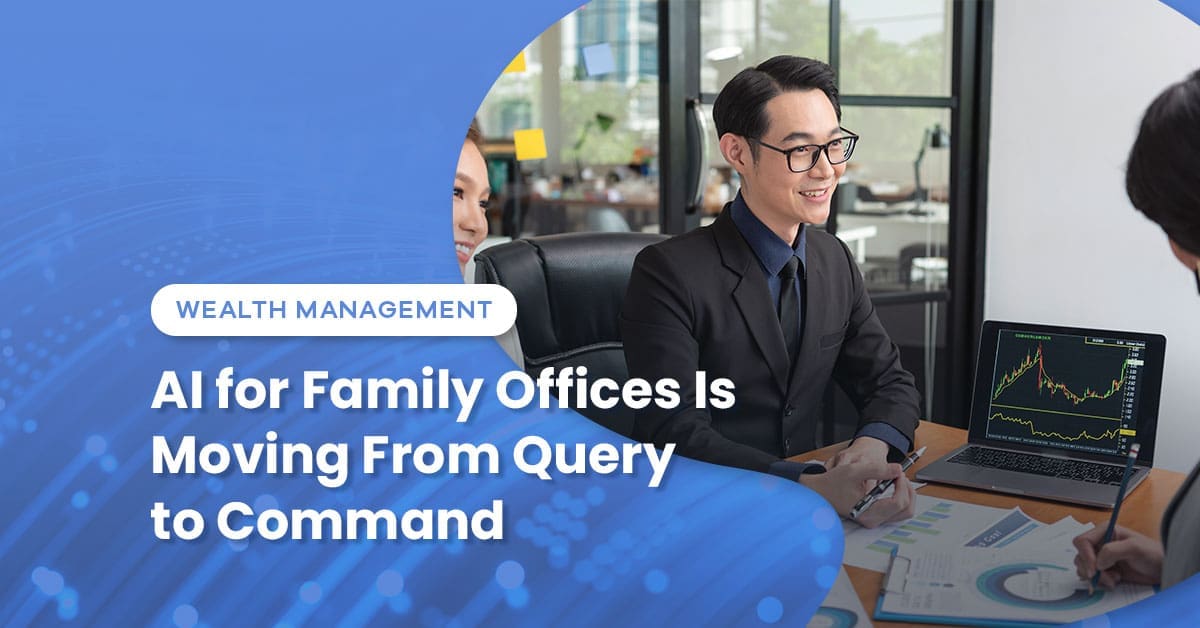
AI for Family Offices Is Moving From Query to Command
May 13, 2026



Key Takeaways
- At the Family Wealth Report Family Office Fintech Forum in April 2026, industry executives reached a clear consensus: the bottleneck in family office AI adoption is not the AI itself. It is the fragmented, unstructured data underneath it.
- AI agents can now execute workflows, not just answer questions. Platforms connected via the Model Context Protocol (MCP) can rebalance portfolios, flag tax implications, and draft memos autonomously, but only when the underlying data is clean, owned, and structured.
- Industry leaders uniformly cautioned against deploying public AI models with client data, and against purchasing AI software before resolving data architecture problems.
- Bottom line: Family offices that structure their data first and define their use cases second will deploy AI that actually works. Those who buy AI hoping it solves a data problem will pay for the lesson twice.
The conversation at the Family Wealth Report Family Office Fintech Forum in New York this April started with a question that should give every family office principal pause: Who actually owns your data? Not in a philosophical sense, but a practical one. If your financial data lives inside a closed vendor platform, you get the vendor’s features, not your strategy. That distinction, according to Aleta CEO Ken Gamskjaer, is exactly why so many family offices are watching AI from the sideline while others are beginning to move.
The Infrastructure Shift That Changed Everything in the Last Six Months
The speed of change in AI infrastructure has been significant. According to Gamskjaer, the underlying architecture that now makes sophisticated AI deployment possible for family offices did not exist six months ago. Since then, OpenAI, Google, Microsoft, AWS, and Anthropic have adopted the Model Context Protocol (MCP) as a universal standard for connecting AI to external data. Platforms including Morningstar, PitchBook, and LSEG have launched MCP integrations, making private market intelligence, public market data, and portfolio analytics accessible to AI agents.
What that means practically: AI has moved from answering questions to executing workflows. Instead of asking an AI system about the workflow, a family office can now instruct it to rebalance, flag tax implications, and draft a memo. The capability leap is real. The catch, according to every executive at the forum, is that it only works if your data is in order.
The Data Problem Is the Real Problem
Forum speakers were unambiguous on this point. “Dirty data means dirty results,” said one strategic marketing executive. “Fix your data before you buy AI,” Gamskjaer said in his keynote. Data scattered across custodians, advisors, PE manager reports, and spreadsheets, some manual and some automated, creates a bottleneck that no AI system can resolve on its own.
The analogy offered by one panelist is useful: family office data is like books in a library. The books may all exist, but unless they are organized and accessible, they are not useful. AI does not organize a library. It reads one.
For family offices that have already consolidated their data into a clean, open architecture, the opportunity is real and immediate. For those still operating on fragmented source data locked inside vendor systems, buying AI software is a premature step. The sequencing matters: structured data first, AI second.
How Family Offices Should Actually Deploy AI
The forum’s practical guidance converged around a sequence that most organizations instinctively want to skip. Define your end state before selecting any tool. Identify which workflows are the most manual and the most repeatable. Set a security and privacy policy before any system goes live. Vet vendors carefully, demand proof of concept, and ask what the system cannot do as explicitly as you ask what it can.
“A common mistake is to not ask what the system can’t do that you might want it to do in the future,” said Janet Welch, managing director of operations at family office Trove. That framing applies equally to AI platforms, vendor selection, and the underlying data architecture decisions that shape what any AI deployment can eventually accomplish.
Forum speakers also issued a consistent warning about AI bias: the models are trained to please. “AI just wants to be like a Golden Retriever and bring you back what will make you happy,” said Greg Kammerer, CFO of multifamily office 61 Holdings. Prompts need to specify what the AI should not do, not just what it should.
One point of broad agreement: AI deployment in a family office is a leadership decision, not an IT project. If the principals are not driving the strategy, the implementation will default to whatever the vendor recommends.
What This Means for Family Office Principals and Their Advisors
The family office profile, small teams, high complexity, recurring workflows, and fragmented source data are well-suited to AI once the data foundation is in place. The firms making real progress right now are not the ones with the most advanced AI deployments. They are the ones that spent the prior 12 months getting their data structured, their ownership model clarified, and their use cases defined.
For principals evaluating where AI fits in their family office, the most productive starting point is not a software demo. It is an honest assessment of your current data architecture: what you own, what a vendor controls, what is clean, and what is not.
Wiss Family Office works with high-net-worth families and multi-entity family offices on the tax, estate, and financial operations questions that sit at the center of that complexity. If your family office is evaluating how AI-era changes in financial services affect your planning, reporting, or advisory structure, contact Wiss to start the conversation.
Investment advisory services offered through Wiss Private Client Advisors, LLC.
𝘞𝘪𝘴𝘴 𝘗𝘳𝘪𝘷𝘢𝘵𝘦 𝘊𝘭𝘪𝘦𝘯𝘵 𝘈𝘥𝘷𝘪𝘴𝘰𝘳𝘴 𝘪𝘴 𝘢𝘯 𝘚𝘌𝘊‑𝘳𝘦𝘨𝘪𝘴𝘵𝘦𝘳𝘦𝘥 𝘪𝘯𝘷𝘦𝘴𝘵𝘮𝘦𝘯𝘵 𝘢𝘥𝘷𝘪𝘴𝘦𝘳 𝘢𝘯𝘥 𝘢 𝘸𝘩𝘰𝘭𝘭𝘺 𝘰𝘸𝘯𝘦𝘥 𝘴𝘶𝘣𝘴𝘪𝘥𝘪𝘢𝘳𝘺 𝘰𝘧 𝘞𝘪𝘴𝘴. 𝘙𝘦𝘨𝘪𝘴𝘵𝘳𝘢𝘵𝘪𝘰𝘯 𝘥𝘰𝘦𝘴 𝘯𝘰𝘵 𝘪𝘮𝘱𝘭𝘺 𝘢 𝘤𝘦𝘳𝘵𝘢𝘪𝘯 𝘭𝘦𝘷𝘦𝘭 𝘰𝘧 𝘴𝘬𝘪𝘭𝘭 𝘰𝘳 𝘵𝘳𝘢𝘪𝘯𝘪𝘯𝘨. 𝘛𝘩𝘪𝘴 𝘤𝘰𝘯𝘵𝘦𝘯𝘵 𝘪𝘴 𝘧𝘰𝘳 𝘦𝘥𝘶𝘤𝘢𝘵𝘪𝘰𝘯𝘢𝘭 𝘱𝘶𝘳𝘱𝘰𝘴𝘦𝘴 𝘰𝘯𝘭𝘺 𝘢𝘯𝘥 𝘴𝘩𝘰𝘶𝘭𝘥 𝘯𝘰𝘵 𝘣𝘦 𝘤𝘰𝘯𝘴𝘪𝘥𝘦𝘳𝘦𝘥 𝘱𝘦𝘳𝘴𝘰𝘯𝘢𝘭𝘪𝘻𝘦𝘥 𝘪𝘯𝘷𝘦𝘴𝘵𝘮𝘦𝘯𝘵 𝘢𝘥𝘷𝘪𝘤𝘦.
Source: Family Wealth Report, “From Query To Command: AI’s Rapid Evolution,” Charles Paikert, April 13, 2026.
 Previous


Share