


“AI isn’t just about technology. It’s about reclaiming time for mission-critical work. The organizations that adopt it thoughtfully will unlock capacity where it matters most.”
-Diana Miller
Nearly half of nonprofits still rely on manual data entry and spreadsheets for compliance documentation, meeting summaries, case notes, and other core operations, according to research from IDC cited at the 2026 Microsoft Global Nonprofit Leaders Summit. That statistic, presented to more than 1,500 nonprofit executives gathered in Bellevue, Washington, framed the rationale for the program Microsoft announced at the event: a structured pathway to help mission-driven organizations close the AI adoption gap.
What Microsoft Announced
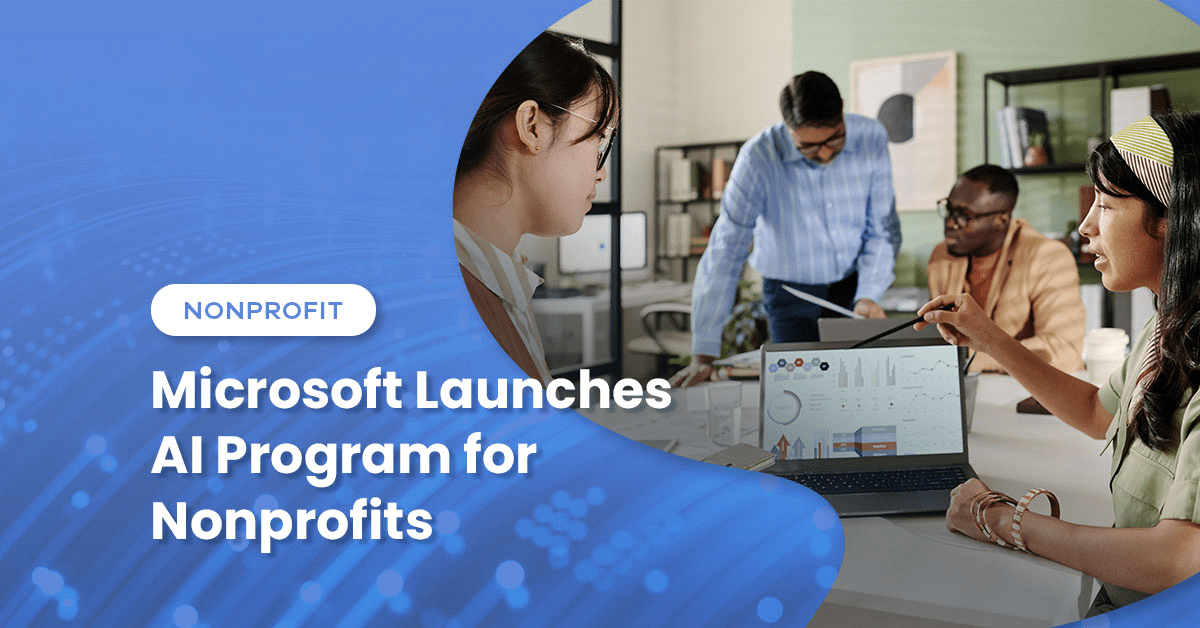
Microsoft used the three-day summit to unveil Microsoft Elevate for Changemakers, a new initiative within its broader Microsoft Elevate commitment. Justin Spelhaug, president of Microsoft Elevate, described the program as part of a $5 billion enterprise that provides nonprofit leaders with AI credentials, access to a peer community, and role-based capacity-building resources.
The program has three components. The first is an AI for Nonprofits credential, a professional certificate developed in partnership with LinkedIn and nonprofit technology organization NetHope. The credential is designed to provide participants with a structured learning path tailored to nonprofit work, with LinkedIn recognition upon completion.
The second component is live and on-demand AI training built around practical nonprofit workflows rather than generic AI content. According to Microsoft, every module is designed to simplify workflows and address real operational tasks rather than theoretical applications.
The third is a Changemaker Fellowship, a global program open to nonprofit professionals at organizations with specific AI projects ready to advance. Fellows receive resources, investment, expert guidance, and connection to a worldwide cohort of nonprofit AI leaders. Microsoft’s launch partners for the fellowship include EY and Caribou. Nonprofits can register interest at the Microsoft Elevate for Changemakers website.
The Operational Problem the Program Is Addressing
Spelhaug’s reference to the IDC research points to a well-documented gap. Nonprofits are resource-constrained by design, and administrative overhead. The time staff spend on manual data entry, grant compliance documentation, reporting, and operational tasks that don’t require human judgment consumes capacity that could otherwise go toward mission delivery.
Microsoft cited ARCare, a healthcare provider serving underserved communities across Arkansas, Kentucky, and Mississippi, as an example of what AI adoption can look like in practice. By using AI tools to handle administrative tasks, ARCare staff redirected time from data collection toward patient care, with an estimated reduction of six to eight hours of manual work per day.
Spelhaug also noted that the technology is only part of the story. The organizations advancing AI adoption in the nonprofit sector are being driven by individuals “stepping forward to lead transformative change, often without formal recognition or an official mandate,” he said. The willingness to learn new tools and advocate for their use internally, rather than the existence of a formal technology strategy, is what’s actually propelling adoption.
What This Means for Nonprofit Leaders
Microsoft’s program addresses one of the most persistent barriers to nonprofit AI adoption: the absence of sector-specific, accessible training that connects technology tools to the actual work of running a nonprofit. Generic AI content, however well produced, does not translate easily into fund accounting, grant compliance, donor management, or program outcome reporting. The credential and training components of Microsoft Elevate for Changemakers are explicitly designed to close that translation gap.
For executive directors and finance leaders evaluating whether to invest time in AI adoption, the program offers a lower-cost entry point. The credential pathway provides structured learning without requiring a large upfront technology investment. The fellowship program is designed for organizations that already have a specific project in mind and need resources to execute it.
The practical question for any nonprofit leader considering participation is the same as for any technology investment: which operational workflows currently consume the most staff time on tasks that don’t require human judgment? That answer, more than any platform decision or credential program, determines where AI delivers real return in a resource-constrained environment.
Wiss Nonprofit Advisory
Wiss works with nonprofit organizations on accounting, financial operations, compliance, and technology advisory. Our nonprofit practice, led by Diana Miller, helps organizations assess where AI and automation tools can have the most immediate impact on operational efficiency and financial management, and supports implementation within the accounting and compliance infrastructure already in place. If your organization is evaluating AI adoption or working to build more efficient financial operations, contact the Wiss nonprofit team.
AI Disclosure: This article was produced with AI writing assistance and reviewed by the Wiss editorial team. Original reporting by Paul Clolery, The NonProfit Times, published March 25, 2026.
 Previous

Share