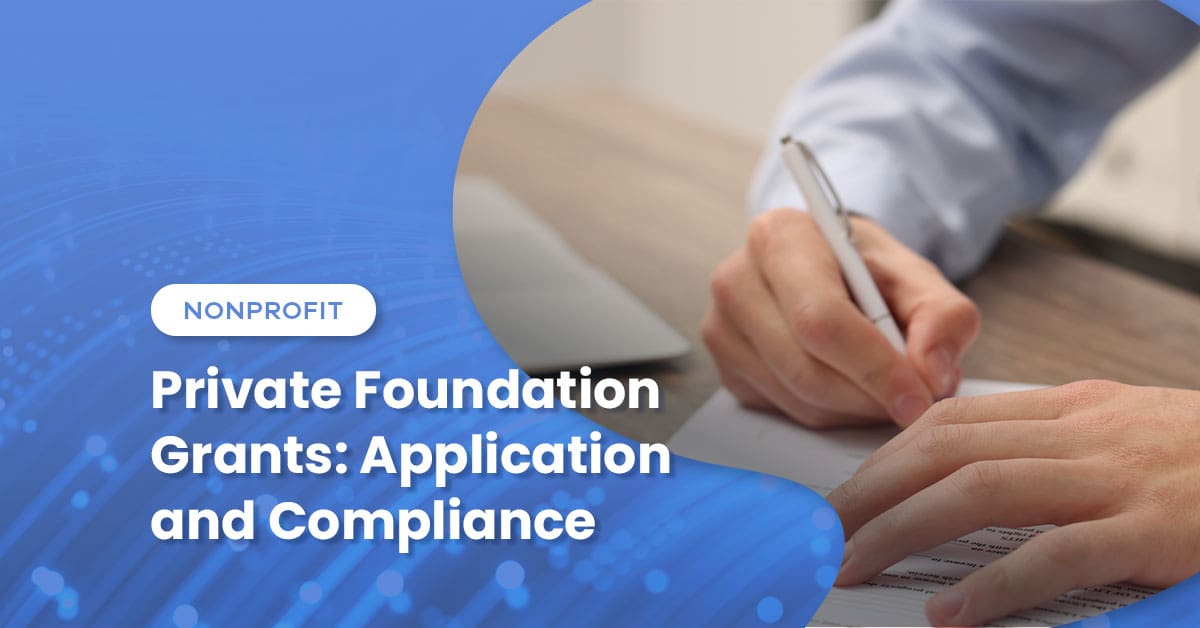
Private Foundation Grants: Application and Compliance
April 10, 2026



Key Takeaways
- Private foundations are subject to a distinct and demanding set of federal tax rules governing their grantmaking activities — rules that differ substantially from those applicable to public charities. Non-compliance can result in excise taxes imposed not only on the foundation but, in certain circumstances, on the foundation’s managers personally.
- The mandatory distribution requirement under IRC Section 4942 generally requires private foundations to distribute a minimum amount annually for charitable purposes — commonly referred to as the “5% payout requirement,” though the precise calculation involves a defined set of qualifying distributions and investment asset computations that are more nuanced than the shorthand suggests.
- Grants to organizations that are not public charities — including grants to foreign organizations, non-exempt organizations, and individuals — are subject to expenditure responsibility requirements under IRC Section 4945 that impose pre-grant due diligence, contractual, monitoring, and reporting obligations on the foundation.
- Bottom line: Private foundation grantmaking is not merely a philanthropic function. It is a tax compliance function, and the consequences of procedural failures — including excise taxes, correction requirements, and potential loss of tax-exempt status in egregious cases — are material enough to warrant rigorous internal controls and ongoing professional oversight.
Private foundations occupy a distinctive position in the federal tax framework. Unlike public charities, which receive broad public support and are subject to a lighter regulatory touch, private foundations — typically funded by a single donor, family, or corporation — are subject to a comprehensive set of restrictions and requirements under IRC Sections 4940 through 4945. These provisions govern not only how a foundation invests its assets and compensates its managers, but also how it makes grants, to whom it makes them, and under what conditions.
For foundation staff responsible for grantmaking operations, the compliance framework is not peripheral to the philanthropic mission. It is the operational container within which grantmaking occurs, and understanding its requirements precisely is essential to maintaining the foundation’s tax-exempt status and avoiding excise taxes that serve as the Code’s enforcement mechanism.
The Mandatory Distribution Requirement and Its Grantmaking Implications
IRC Section 4942 requires private foundations to distribute a minimum amount annually for charitable purposes — a threshold commonly referred to as the “5% payout requirement.” In substance, the requirement is that a private foundation must make qualifying distributions each year in an amount equal to or exceeding approximately 5% of the fair market value of its non-charitable-use assets, measured on average over the year.
The calculation of what constitutes a qualifying distribution involves some precision. Cash grants to public charities generally constitute qualifying distributions. Grants to organizations that are not public charities may also qualify, but only if the expenditure responsibility requirements discussed below are satisfied. Direct charitable activities conducted by the foundation itself may also qualify. Administrative expenses that are reasonable and necessary for conducting the foundation’s charitable activities also constitute qualifying distributions, though the allocability of certain administrative costs to qualifying distributions requires careful analysis.
A shortfall in qualifying distributions — termed “undistributed income” — is subject to an excise tax under IRC Section 4942. The amount subject to tax carries forward, and foundations that do not correct an underdistribution within the subsequent correction period face increasingly adverse tax consequences.
Qualifying Distributions and Their Documentation
The characterization of a payment as a qualifying distribution requires documentation adequate to demonstrate that the distribution served a charitable purpose. Grant agreements, pre-grant correspondence, program-related documentation, and evidence of the grantee’s tax-exempt status or equivalent charitable character are components of the evidentiary record that foundations maintain to support the qualification of their distributions.
Foundations making grants to organizations recognized under IRC Section 501(c)(3) and classified as public charities are generally in a more straightforward position with respect to qualifying distribution treatment. The more complex analysis arises in the contexts discussed below.
Grants to Public Charities: The Baseline Compliance Framework
Grants by a private foundation to organizations classified as public charities under IRC section 509(a) represent the most common and generally least procedurally demanding category of foundation grantmaking. In most cases, the foundation is not required to exercise expenditure responsibility over such grants, and the grant qualifies as a distribution for section 4942 purposes without additional conditions. However, this general rule does not apply in all cases: certain supporting organizations described in section 509(a)(3) may require additional analysis to determine whether expenditure responsibility applies and whether the grant qualifies as a distribution.
That said, basic due diligence practices apply regardless of grantee classification. Verification that the grantee organization retains its recognized exempt status and public charity classification — through IRS records and, in some cases, the foundation’s own review of the grantee’s Form 990 — is standard practice for foundations with established grant management systems. The Tax Cuts and Jobs Act of 2017 expanded the IRS Tax Exempt Organization Search database, and foundations now have ready access to publicly available information relevant to this determination.
Grant agreements are not legally required for grants to public charities in most circumstances, but they serve important functions: documenting the charitable purpose of the grant, establishing any conditions or reporting requirements the foundation has imposed, and creating a record that supports the foundation’s own compliance position with respect to Section 4942 and the self-dealing rules under Section 4941.
Expenditure Responsibility: The More Demanding Grantmaking Regime
Grants to organizations that are not public charities, such as foreign organizations or certain non-exempt organizations, may be subject to expenditure responsibility under IRC section 4945(h). Grants to individuals are not subject to expenditure responsibility, individual grants for travel, study, or similar purposes are generally taxable unless made under IRS-approved procedures in accordance with section 4945(g).
Expenditure responsibility is a multi-step compliance framework that imposes obligations at the pre-grant, grant agreement, monitoring, and reporting stages.
Pre-grant inquiry. Before making an expenditure responsibility grant, the foundation is required to conduct an inquiry reasonably calculated to give it assurance that the grant will be used for the intended exempt purposes. The depth of this inquiry is proportionate to the grant amount, the grantee’s organizational history, and other relevant factors. The inquiry must be documented.
Grant agreement requirements. Expenditure responsibility grants must be governed by a written grant agreement that includes, at minimum, a commitment from the grantee to use the funds solely for the purposes of the grant; a requirement that the grantee maintain the funds in a separate account; a prohibition on the use of funds for attempting to influence legislation, electoral campaigns, or voter registration drives (absent a specific legislative activity exception); a requirement for the grantee to submit reports to the foundation on the use of funds; and the grantee’s agreement to repay any funds not used for the stated charitable purpose.
Monitoring and reporting. The foundation must follow up on expenditure responsibility grants to ensure that the funds are being used as intended. The grantee is required to submit annual reports to the foundation on the use of funds, and the foundation is required to review those reports and take appropriate action if the reports indicate that funds are not being used as specified.
Form 990-PF reporting. The foundation is required to report all expenditure responsibility grants on its annual Form 990-PF, including the identity of each grantee, the amount granted, and a description of the grant’s purpose. The reporting requirement continues until the grant has been fully accounted for.
Grants to Individuals: Program-Related Restrictions and Procedural Requirements
Grants by private foundations to individuals for scholarships, fellowships, prizes, or similar purposes are subject to additional restrictions under IRC sections 4945(d)(3) and 4945(g).Individual grants are presumptively treated as taxable expenditures — a category that triggers excise taxes — unless the grants are made pursuant to a procedure approved in advance by the IRS.
The IRS advance approval process for individual grant programs requires the foundation to demonstrate, through an application to the IRS, that the grant program has a defined charitable purpose, uses objective and nondiscriminatory selection criteria, includes appropriate follow-up requirements, and is managed by procedures designed to ensure that the grants further charitable purposes. Approval, once obtained, covers future grants under the same program, provided the program continues to be administered as described in the approved procedures.
Foundations operating scholarship programs or other individual grant programs without prior IRS approval for those programs are in a potentially problematic compliance position. This is an area where foundations with existing programs benefit from periodic review by qualified counsel or tax advisors familiar with the Section 4945 framework.
Self-Dealing Considerations in the Grantmaking Context
While the self-dealing rules under IRC Section 4941 apply broadly to a private foundation’s transactions with its disqualified persons — a defined category that includes substantial contributors, foundation managers, and certain related parties — their relevance to grantmaking arises most directly when a grant is made to an organization in which a disqualified person has a significant interest.
A grant to an organization that is controlled by a disqualified person, or that provides a more-than-incidental benefit to a disqualified person, raises potential self-dealing concerns that require careful analysis. Similarly, the payment of compensation to a disqualified person in connection with grantmaking activities — including the role of a disqualified person as an intermediary, consultant, or grant advisor — warrants examination under the self-dealing framework.
Self-dealing excise taxes under IRC section 4941 are among the most serious compliance consequences in private foundation law, as they are imposed on the disqualified person involved in the transaction and on any foundation manager who knowingly participates in the self-dealing act. The foundation itself is not subject to the tax, although the associated correction requirements can be significant and burdensome.
Form 990-PF and the Public Disclosure of Grantmaking Activities
Private foundations file Form 990-PF as their annual information return. The form includes a complete listing of all grants and contributions paid during the year, and this information is publicly available. Grantee organizations, journalists, and the general public can access a private foundation’s grantmaking history through the IRS Tax-Exempt Organization Search database and third-party aggregation platforms.
The public availability of grantmaking data has practical implications for foundations. The description of charitable purposes assigned to each grant on Form 990-PF becomes part of the foundation’s public record. Inconsistencies between grant agreements, internal grant descriptions, and Form 990-PF reporting can attract scrutiny — both regulatory and reputational.
How Wiss Supports Private Foundation Compliance
Wiss’s nonprofit and tax advisory professionals work with private foundations on Form 990-PF preparation, expenditure responsibility program design and documentation, IRS advance approval applications for individual grant programs, and ongoing compliance review. Foundations with questions about applying the grantmaking rules to specific grant structures or programs are welcome to contact the Wiss nonprofit tax team.
 Previous


Share