
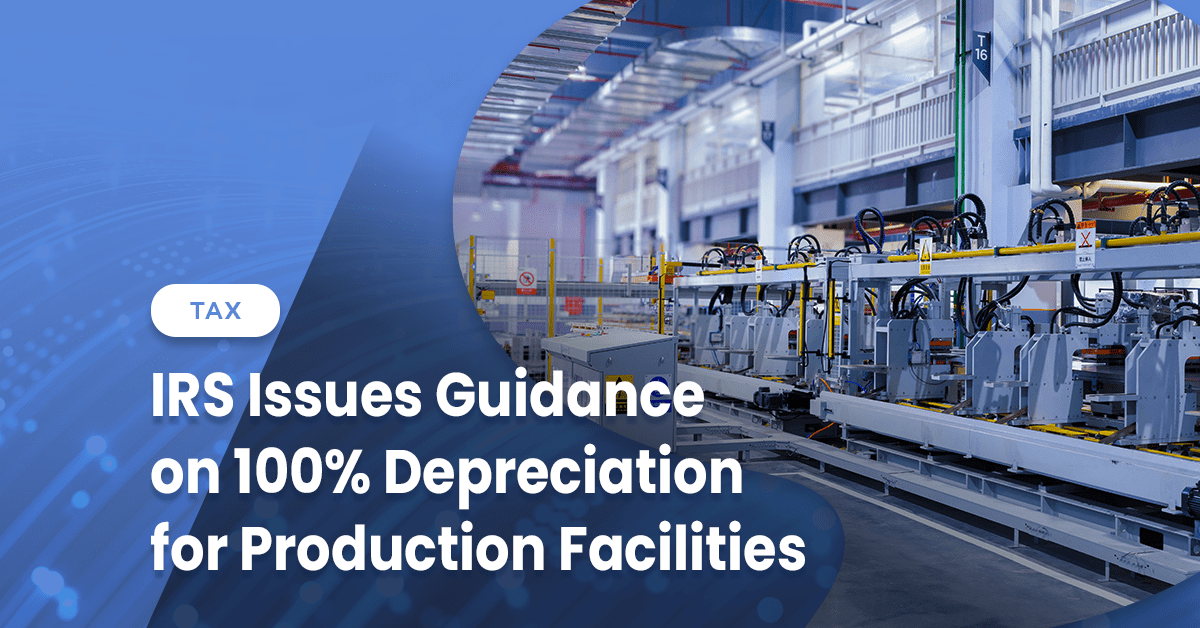
IRS Issues Guidance on 100% Depreciation for Production Facilities
March 30, 2026



Key Takeaways
- New deduction opportunity: Under Section 168(n) of the OBBBA, manufacturers and producers may elect to deduct up to 100% of the cost of qualified production property (QPP) in the year it is placed in service.
- Tight eligibility window: Construction must begin after January 19, 2025, and before January 1, 2029 — and the property must be placed in service after July 4, 2025, and before January 1, 2031.
- Interim guidance is in effect now: Taxpayers can rely on IRS Notice 2026-16 until proposed regulations are finalized.
- Recapture risk is real: If QPP ceases to be used in a qualified production activity within 10 years of being placed in service, Section 1245 depreciation recapture applies.
- Bottom Line: Manufacturers, chemical producers, refiners, and agricultural producers building or renovating U.S. facilities now have a significant tax incentive — but the rules are detailed, and the election is largely irrevocable, so careful planning before placing property in service is essential.
On February 20, 2026, the IRS and Treasury Department issued Notice 2026-16, providing interim guidance on a new depreciation provision under Section 168(n) of the Internal Revenue Code — one of the most significant manufacturing incentives included in the One Big Beautiful Bill Act (OBBBA). For companies in manufacturing, chemical production, agricultural production, or refining, this provision is worth understanding before breaking ground.
Here is what the guidance says, and what it means for your business.
What Is Section 168(n) and Who Does It Apply To?
Section 168(n) was added to the tax code by Section 70307 of the OBBBA, signed into law on July 4, 2025. It allows taxpayers to elect a special 100% depreciation allowance — taken in the year the property is placed in service — on the unadjusted depreciable basis of qualified production property (QPP).
QPP is, broadly speaking, nonresidential real property used as an integral part of a qualified production activity (QPA). A QPA is defined as the manufacturing, production, or refining of a “qualified product” that results in a substantial transformation of that product. Under the statute, “production” covers only agricultural production and chemical production.
A qualified product is any tangible personal property, with one notable exception: food or beverages prepared and sold in the same building as a retail establishment do not qualify.
What Qualifies as a Qualified Production Activity?
This is where the guidance gets precise. A QPA requires substantial transformation — meaning the taxpayer’s activity must turn constituent raw materials, inputs, or subcomponents into a final, complete, and distinct item of property that is fundamentally different from what went in.
The Notice provides helpful illustrations:
- Converting wood pulp to paper: substantial transformation.
- Steel rods to screws and bolts: substantial transformation.
- Freshly caught tuna fish to canned tuna: substantial transformation.
- Grouping and packaging finished goods into a gift basket or subscription box: not a substantial transformation.
The Notice also defines each activity type in detail:
Manufacturing means materially changing the form or function of tangible personal property to create a new item held for sale or lease. Packaging, repackaging, labeling, and minor assembly do not count.
Refining means purifying a substance into a higher-value product. The Notice lists specific examples, including petroleum processing, sugar refining, vegetable oil processing, wet corn milling, and recovery of nonferrous metals from scrap.
Chemical production encompasses processes in which a product is formulated from organic or inorganic raw materials — including pharmaceutical manufacturing, fertilizer production, adhesive manufacturing, and synthetic resin manufacturing.
Agricultural production includes cultivating the ground, planting seeds, raising and harvesting crops, and breeding or managing livestock for sale or lease. It does not include food marketing or activities that support agriculture but do not directly constitute production.
What Property Qualifies — and What Doesn’t?
To be QPP, nonresidential real property must meet all of the following:
- It is MACRS property.
- It is used by the taxpayer as an integral part of a QPA (or will be once placed in service).
- It is placed in service in the U.S. or a U.S. territory.
- Original use commences with the taxpayer (or the used property rules in section 4.06 of Notice 2026-16 are satisfied).
- Construction begins after January 19, 2025, and before January 1, 2029.
- The taxpayer designates the property as QPP in a timely election.
- The property is placed in service after July 4, 2025, and before January 1, 2031.
- The property is not subject to the alternative depreciation system (ADS).
Critically, property used for offices, administrative services, lodging, parking, sales activities, research activities, software development, or engineering activities is explicitly excluded. Storage of finished products is also excluded, though storage of raw materials and manufacturing inputs used in the QPA may qualify as an essential activity.
There is a de minimis rule: if 95% or more of the physical space of a property satisfies the integral part requirement, the taxpayer may elect to treat the entire property as qualifying.
How Is the Deduction Calculated?
The deduction equals 100% of the unadjusted depreciable basis of the property designated as QPP. Taxpayers do not have to designate their entire basis — they may designate a specific dollar amount up to the total eligible basis.
When the property contains a mix of eligible and ineligible space, the taxpayer must allocate basis using a reasonable method. The Notice specifically approves use of square footage, cost segregation data, architectural or engineering plans, process diagrams, and construction invoices. Employee headcount and employee time spent on QPA activities are explicitly not acceptable allocation methods.
How Is the Election Made?
The election must be made on the taxpayer’s original federal income tax return for the year the eligible property is placed in service, no later than the return’s due date, including extensions.
The election is made by attaching a statement — titled “STATEMENT PURSUANT TO SECTION 7 OF NOTICE 2026-16” — that identifies the property, provides its address and description, states the total unadjusted depreciable basis, identifies the portion allocable to eligible property, and states the dollar amount designated as QPP.
This election is largely irrevocable. Revocation requires filing a private letter ruling request and obtaining the IRS Secretary’s written consent, which is available only in “extraordinary circumstances.” Importantly, the IRS will not grant consent if the revocation request reflects hindsight.
What Happens If the Property Changes Use?
This is a critical planning consideration. If QPP ceases to be used as an integral part of a QPA and is used in another productive use at any point during the 10-year period beginning on the date the property is placed in service, Section 1245 depreciation recapture applies. The taxpayer is treated as having disposed of the property, and the excess of the recomputed basis over the adjusted basis is recognized as ordinary income.
There are a few nuances worth noting:
- Switching from one QPA to another does not trigger recapture.
- Temporarily idle property — taken out of service for a finite period with the expectation of resuming production — does not trigger recapture.
- If only a portion of QPP changes in use, recapture applies only to that portion.
- An automatic one-year extension of the placed-in-service deadline is available for property located in a federally declared disaster area during 2030.
Safe Harbor for Property Placed in Service in 2025
For property placed in service after July 4, 2025, and on or before December 31, 2025, the Notice provides a safe harbor. A taxpayer’s activity will be treated as a QPA if the principal business activity code on its most recently filed return corresponds to an applicable NAICS code under sectors 31, 32, or 33 (manufacturing) or subsectors 111 or 112 (crop and animal production), and the activity otherwise results in substantial transformation of a qualified product.
What Comes Next?
The IRS and Treasury have announced that forthcoming proposed regulations will follow the framework set out in Notice 2026-16. Taxpayers can rely on the interim guidance in its entirety until those regulations are finalized.
Comments on the interim guidance are due by April 20, 2026, and may be submitted electronically at regulations.gov (search IRS-2026-0016). The IRS has specifically invited input on allocation methods for mixed-use property, the scope of manufacturing and refining definitions, and additional examples of substantial transformation.
What This Means for Your Business
Section 168(n) represents a meaningful incentive for companies investing in U.S. production facilities. A 100% first-year deduction on the eligible basis of a new manufacturing plant or production facility — which may represent tens or hundreds of millions of dollars — can significantly accelerate the tax value of that investment.
That said, the rules are detailed: eligibility turns on specific construction start dates, placed-in-service windows, use requirements, and proper allocation of basis. The election is effectively permanent, and the 10-year recapture window is meaningful for businesses that might pivot operations. Planning ahead — before the property is placed in service — is essential.
If your company is in manufacturing, chemical production, refining, or agricultural production and has construction activity currently underway or planned, now is the time to evaluate whether Section 168(n) applies.
Have questions about how this guidance applies to your situation? Reach out to a Wiss advisor — we are closely tracking the OBBBA provisions and can help you determine whether your production facility qualifies and how to structure your election.
 Previous


Share


Related Posts

Production Cost Accounting Best Practices for Manufacturers
July 21, 2026
Essential Manufacturing KPIs for Financial Performance
July 21, 2026
Manufacturing Capacity Utilization: Where Profitability Actually Lives
June 15, 2026
Production Scheduling Optimization: The Financial Impact Most Manufacturers Miss
June 15, 2026