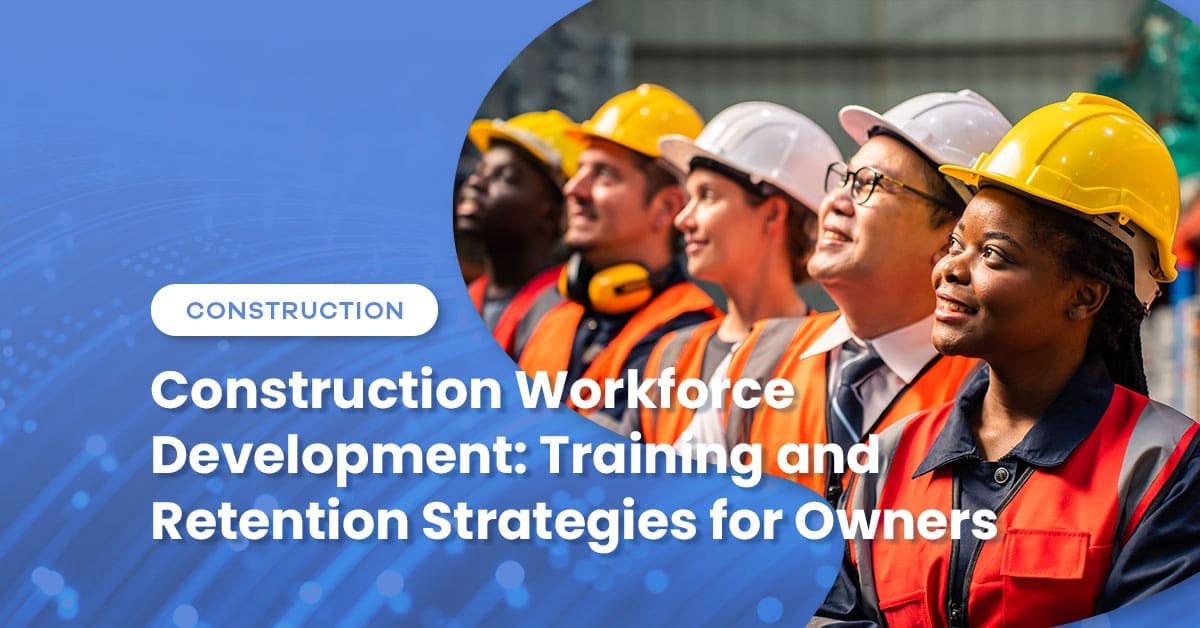
Construction Workforce Development: Training and Retention Strategies for Owners
March 12, 2026


Key Takeaways
- The labor shortage is structural, not cyclical: A 2017 study by the National Center for Construction Education & Research estimated that approximately 41% of the construction workforce would retire by 2031. That projection is now arriving on schedule, and the replacement pipeline remains undersized.
- Turnover carries a direct cost: Industry estimates place the cost of replacing a skilled trades employee at 50–200% of annual wages, accounting for recruiting, onboarding, lost productivity, and rework exposure on active projects.
- Compensation alone doesn’t solve retention: Wages matter, but data consistently shows that career path clarity, schedule predictability, and benefit quality — particularly retirement contributions and health coverage — drive long-term retention in construction trades.
- Workforce investment is a business valuation input: When a construction company’s operations are dependent on a thin, hard-to-replace labor base, that dependency registers as risk in any third-party valuation. Building a stable, trained workforce increases enterprise value.
- Bottom Line: Workforce development is not a cost center. It is a capital allocation decision — and owners who treat it that way build companies with a durable competitive advantage and measurably better project economics.
You can’t build anything without the people who build things. That sounds obvious until you’re staring down a backlog you can’t staff, watching a foreman walk out the door to a competitor who offered him $4 more an hour, or inheriting the rework costs of a crew that was never properly trained on your systems. At that point, it stops being obvious and starts being expensive.
Construction workforce development has been a persistent industry challenge for more than a decade. The retirement wave is real and ongoing. Vocational school enrollment declined steadily through the 2010s. The pandemic accelerated early retirements and disrupted apprenticeship programs at a moment when the industry needed to be building its future workforce, not hemorrhaging its current one.
The owners navigating this most successfully are not the ones waiting for the labor market to ease. They’re building deliberate, financially grounded workforce strategies — and treating retention and training as operational priorities on par with equipment maintenance and bonding capacity.
Understand What’s Driving Turnover Before You Try to Stop It
Reactive retention strategy — matching a counteroffer after someone hands in their notice — is both expensive and ineffective. By the time an employee is weighing a competing offer, the decision is usually already made. The competing offer is the permission slip, not the cause.
The actual causes of construction workforce turnover cluster around a few consistent themes: inconsistent work hours and scheduling instability, lack of visible career progression, inadequate benefits compared to what’s available elsewhere in the trades, and poor site culture — including safety practices, supervisory quality, and how subcontractors and crews are treated on the job.
If you don’t know your voluntary turnover rate by crew type and tenure band, you’re managing a problem you can’t see clearly. The starting point for any workforce development strategy is a factual labor assessment: current headcount by role, voluntary and involuntary separation rates over the prior 24 months, average tenure by classification, and a forward-looking projection against your backlog requirements. That assessment tells you whether you have a compensation problem, a culture problem, a career path problem, or all three. Each requires a different response.
Build Career Pathways That Are Specific and Credible
One of the most underutilized retention tools in construction is a clearly defined career pathway — not a vague promise of advancement, but a documented, role-by-role progression with specific competency requirements, time-in-grade expectations, and corresponding compensation milestones.
A laborer who understands exactly what it takes to become a journeyman, and then a foreman, and then a superintendent — with clearly articulated wage increases at each step — has a concrete reason to stay. The career ladder becomes a retention mechanism because leaving means starting the clock over somewhere else.
This structure also directly supports your training investment. When advancement requires demonstrated competency rather than just seniority, your training programs have a defined purpose. Workers know what they’re learning and why it matters to their earnings trajectory. That specificity drives engagement in a way that generic safety and orientation training simply doesn’t.
Apprenticeship programs — whether registered through the Department of Labor or structured informally with a defined curriculum — are among the highest-ROI workforce investments available to construction owners. They create a structured pipeline from entry-level to skilled trades worker, offset some of your recruiting costs by developing talent internally, and build loyalty because employees understand that the company invested specifically in them.
Compensation Strategy: Get the Structure Right, Not Just the Number
Wage competition in construction is real and immediate. If you’re paying below the prevailing market rate for your trade and geography, you will lose people, and you will struggle to hire. There’s no advisory strategy that substitutes for competitive base wages.
But the owners who are winning on retention have figured out that total compensation architecture matters as much as the base number. Specifically, three elements consistently differentiate high-retention construction employers from the rest.
Retirement plan design: A 401(k) with a meaningful employer match — structured to vest over two to three years — is both a retention tool and a deferred compensation cost that can be optimized for tax purposes. Owners who have not reviewed their plan design recently are likely leaving both employee loyalty and tax efficiency on the table. The SECURE 2.0 Act introduced several provisions relevant to small- and mid-sized employers, including enhanced startup credits and new automatic enrollment requirements that took effect in 2025. Understanding these provisions isn’t HR minutiae — it’s a decision to optimize compensation costs.
Health insurance quality: Trades workers and their families use health coverage. The quality of your plan — deductibles, networks, prescription coverage — is visible and evaluated. A lower-cost, worse plan is noticed, and it signals how the company values its workforce.
Profit-sharing and project bonuses: Tying a portion of compensation to project performance aligns worker incentives with company outcomes and creates a participation in success that hourly wages don’t replicate. The structure needs to be simple, transparent, and paid on a timeline that workers find credible — not an annual discretionary decision by ownership with no defined formula.
Training as a Risk Management Tool
Workforce training in construction is usually framed as a cost. It should be framed as a risk management expenditure — because the alternative is quantifiable.
Untrained workers generate higher incident rates, and OSHA recordable incidents have direct financial consequences: experience modification rate (EMR) increases that raise workers’ compensation premiums, potential disqualification from certain owner prequalification requirements, and surety relationship exposure if your safety record is questioned during bonding renewal. A 0.1 increase in EMR on a $20M annual workers’ compensation payroll is not a rounding error.
Inadequately trained crews also generate rework, and rework is one of the most reliable margin destroyers in commercial construction. The cost of fixing work that was done incorrectly is not always visible in your job cost accounting if you’re not tracking rework as a distinct cost category, but it accrues quietly and consistently.
Training investment — in safety, in technical skills, in equipment operation, in project management for your foremen and superintendents — is a direct input to project margin and a mitigation of insurance and surety cost risk. That framing belongs in the business case you make to yourself when you’re deciding what to fund.
The Advisory Lens: Where Workforce Strategy Meets Business Strategy
Workforce development decisions have tax, compensation structure, retirement plan, and entity-level implications that construction owners frequently navigate without coordinated advice. Your HR instincts might be exactly right, but if your compensation structure isn’t optimized for your entity type, or your profit-sharing plan isn’t designed to maximize the deduction, or your retirement plan hasn’t been reviewed since you set it up a decade ago, you’re paying more than you need to for the workforce outcomes you’re getting.
At Wiss, our advisory practice works with construction owners at exactly this intersection — where operational decisions and financial structures meet. We help owners evaluate compensation architecture, structure retirement and incentive plans, understand the tax implications of workforce investment, and build the kind of organizational stability that holds up under surety scrutiny and positions a business well for its eventual transition.
The companies that build great workforces don’t do it by accident. They do it because someone helped them think through the whole picture — not just the number on the offer letter.
Contact the Wiss Construction Practice Team to discuss how our advisory services can help you build and retain the workforce your business needs.
 Previous


Share


Related Posts
Residential Construction Accounting: What Separates Builders Who Grow from Those Who React
March 31, 2026
Construction Equipment Financing: Options and Tax Strategies
March 30, 2026

Cash Flow Management for Construction Contractors
March 24, 2026
Construction Workforce Development: Training and Retention Strategies for Owners
March 12, 2026